Thomas C. Chung: a departure from childhood innocence

Pau Waelder

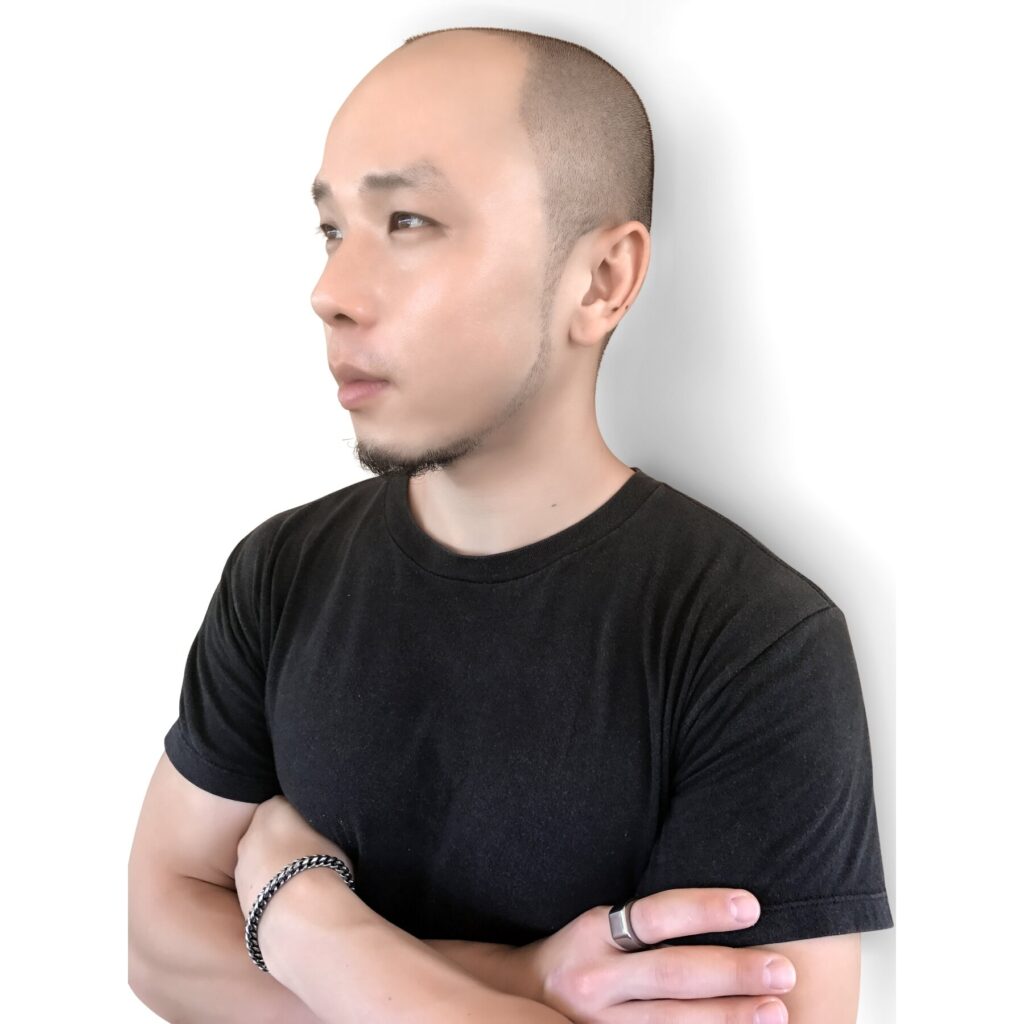
Chinese-Australian artist Thomas C. Chung has embarked on a lifelong artistic research that he is developing in well-structured phases, each one characterized by an exploration of different techniques and approaches to human experience. He earned his Bachelor of Fine Arts from the University of New South Wales’ College of Fine Arts in 2004 and has had a noteworthy international artistic presence in recent years. Chung has been a representative for Australia in several prominent international exhibitions, such as the 2nd Land Art Biennial in Mongolia, the 4th Ghetto Biennale in Haiti, and the 9th Shiryaevo Biennale in Russia. Currently, he is exploring the realms of psychotherapy as a means to deepen his artistic inquiry. 

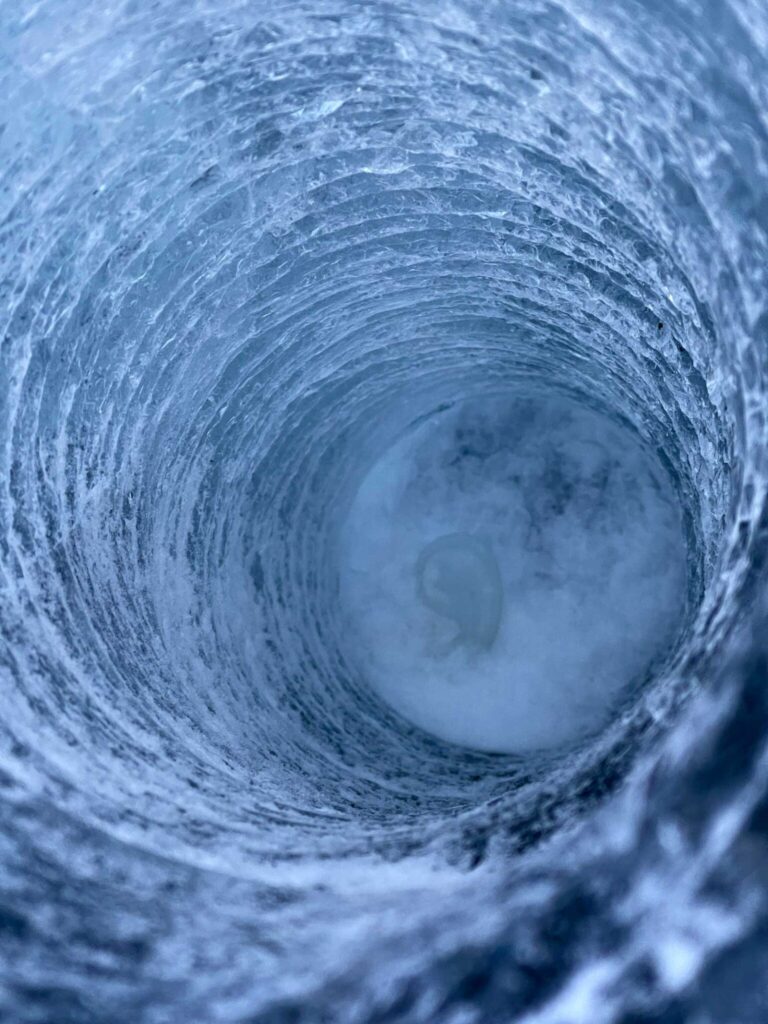
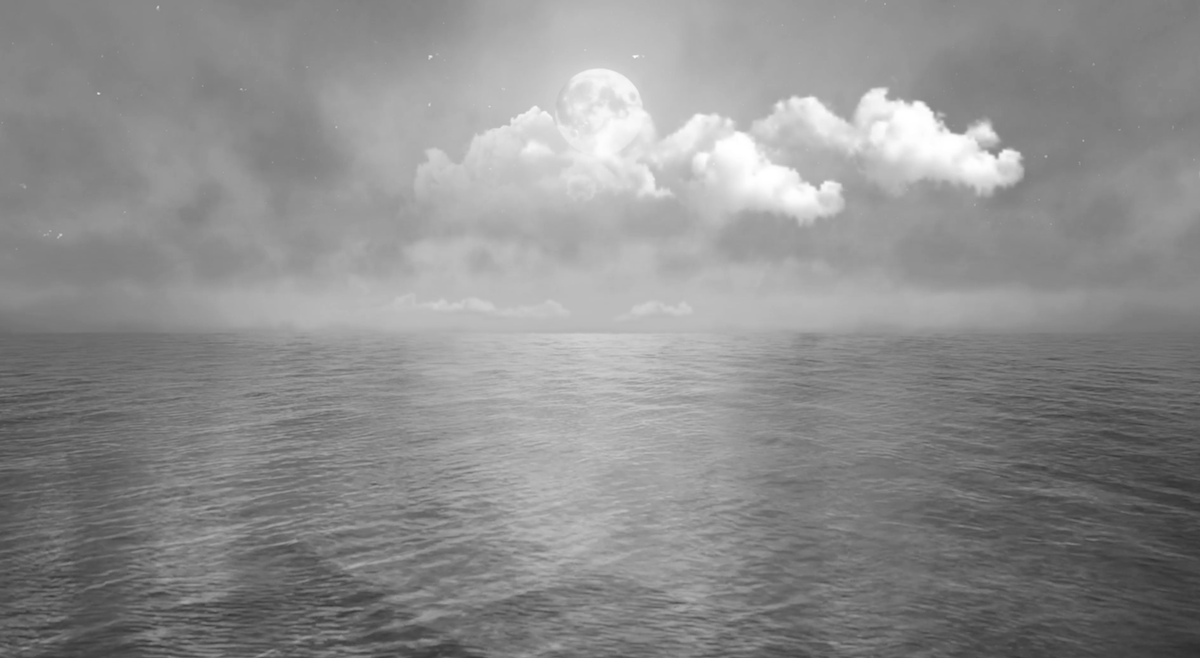
The artist presents on Niio three pivotal works from his ongoing second phase, in which he leaves behind a narrative focused on childhood innocence and enters the adult world with a series of more sober, meditative artworks. The landscapes that form the collection “As Far As I Could See…” introduce a deeper reflection on the human condition, not without a hint to the magic and surreal aspects of children’s imagination. 

Experience Thomas C. Chung’s dreamlike landscapes

Thomas C. Chung. “As Far As I Could See…” (I), 2023

In the following interview for Niio, Chung discusses the motivations behind his work and dives into his second-phase artworks, which have recently been exhibited at the Chinese European Art Center (Xiamen, China) in a solo show titled The Sea That Stands Before Me…

Your work has evolved over the last decades following a “lifelong narrative” determined by different phases. The first phase was characterized by crochet sculptures, installations, and an overall playful aesthetic, while the second-phase works present a very different approach. It may even be hard to recognize the work of the same artist in these two phases. How have you dealt with this transition, and what has been the response to it?

I’ll be the first to say I was nervous about the different phases I had conceived – I figured it might be too hard for others to accept, especially with the small but loyal following I had built. Over time, I understood that as long as the work was fascinating to myself & others, it didn’t matter what shape or form it took as long as the creativity was there. I clarified this by using new techniques each decade, approaching the chapters within my Art by splitting them into various methods that correlated with the story I wanted to tell. The 1st phase was all handmade, tactile, labor-intensive & filled with food motifs as avenues for expressing a child’s obsessions & dreams. This 2nd phase speaks of the departure from childhood & the realization that life has to progress beyond our comfort zones so that we can understand the totality of our world. 

I had a lot of interests as a child & wanted to grow up to be so many things, one of which was as a children’s illustrator & author. But Art chose me instead, so here I am, creating a different type of story, saving that option for later. 
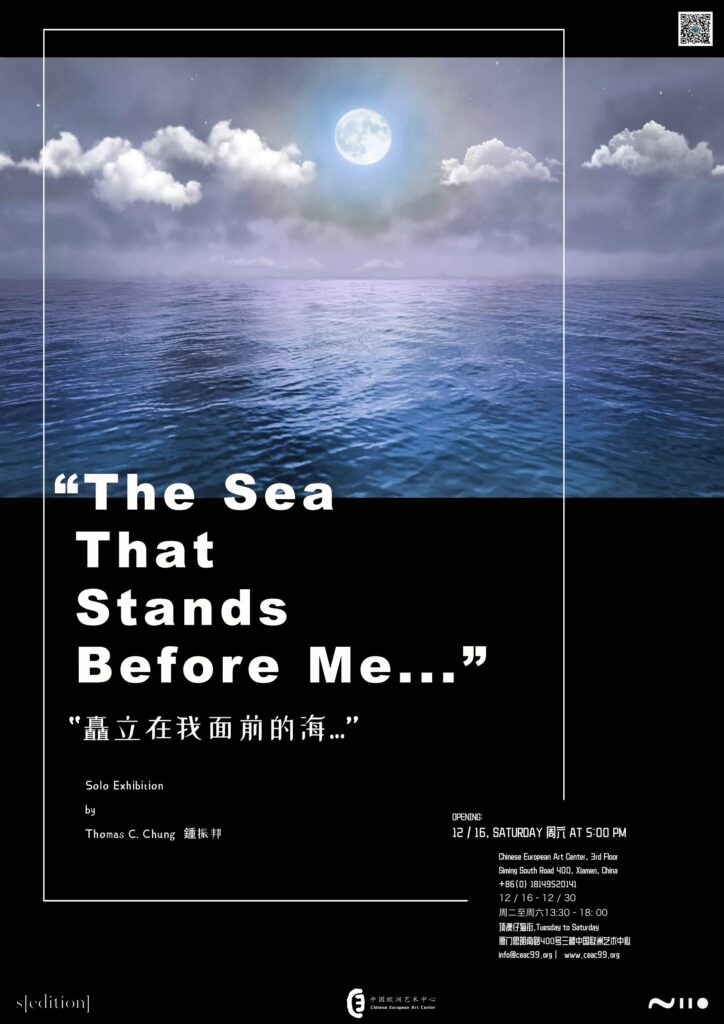
Thomas C. Chung’s solo exhibition at the Chinese European Art Center extends to Sedition and Niio with the presentation of a selection of artworks.

You have expressed that, in your work, you aim to see the world through the eyes of a child. How do you convey this idea without being perceived as childlike or superficial? Which is the underlying concept that grounds these artworks?

It aligns with how I interact with people these days in a direct yet open & gentle manner without overthinking the consequences. If others don’t appreciate it, I try not to let it matter. Everyone has their view or way of life. My artwork may have previously been seen as naive, which at times bothered me. I knew as a conceptual artist, my practice would be a lifetime’s work that would encompass the narratives of my inner child. The artwork titles are a hint to what it is they see & are presented to the audience as an observation of their journeys while exploring the world. To produce this lifelong story, it was always my vision to create a giant storybook-like body of work split into chapters, set within a contemporary art context, emphasizing the importance of patience, empathy & curiosity, where human beings have the ability to control what it is they feel or see.  
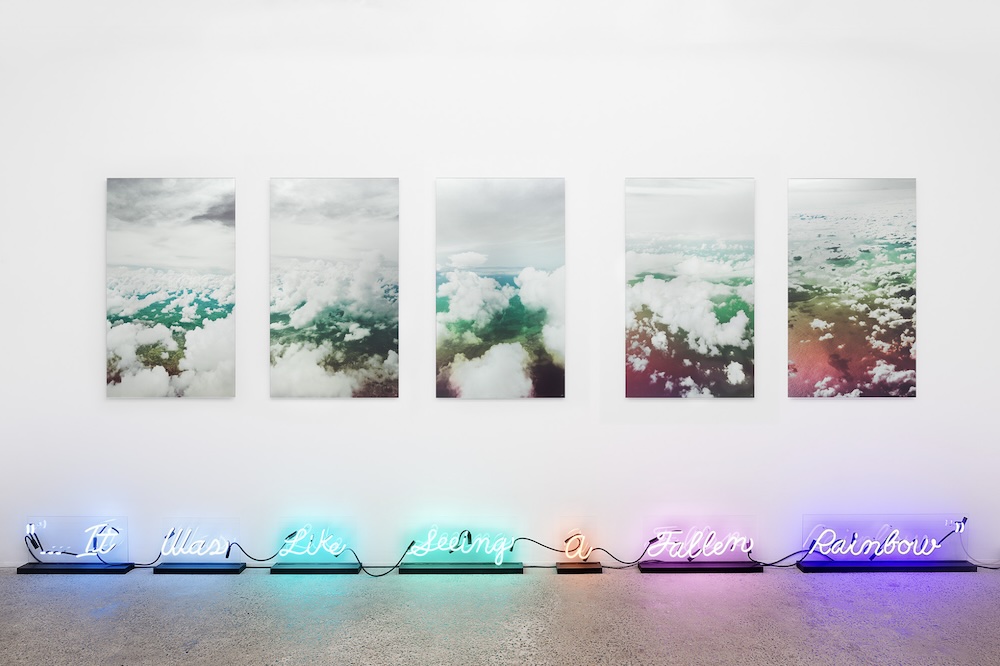
Thomas C. Chung. “It Was Like Seeing A Fallen Rainbow…” Exhibition view at Galerie pompom

Your video artworks are characterized by a slow tempo that suggests a relaxed observation. In our times of limited attention span and an overflow of media content, would you say that we need to take more time to observe our surroundings? In your opinion, does art create this space for observation or is it also caught in the spirit of fast-paced consumption?

That’s quite a complex one to answer. And that is a great question. I value the time I take to see the world unfiltered from electronic devices & media. Much of that is due to my not being attached to technology as early as others may have been. For example, the very first mobile phone I got was when I was 34 years old; I remember even thinking what a selfie of myself looks like. 

Until then, I spent a significant portion of my life turning up early to meet friends or acquaintances (if they were over an hour late, I would leave), keeping promises that I had kept & looking at the sky to tell the time. 

Art has always been a good reflection of our times, like a visual newspaper that begins & starts intriguing conversations before leaving it to others to visit, fulfill, react, or enjoy. The fast-paced consumption of our current world is an accurate indication of that, with the growth of digital art increasing among the masses.

Thomas C. Chung. “As Far As I Could See…” (II), 2023

You are studying to become a psychotherapist and draw inspiration from this knowledge to create your artworks. Do you intend your artworks to visualize or reflect upon states of mind, or do you wish them to become therapeutic objects, sparking certain emotions or thoughts that might have a healing quality?

This one made me think – thank you for that. My intention as an artist is to engage with everyone, but whether or not it connects with others is something I can’t control. Delving into the mental health field as a future psychotherapist, the purpose of whatever I create – however the audience receives it – there’s no right or wrong answer, just an open story. Food & landscapes have always intrigued me in this particular way. Some people love certain aspects or locations, while others dread it. Some people love a specific type of food but not others. No one person has the same reaction to different things & that’s what is so fascinating to me, to see life through the eyes of another human being.   

When I create, I have a particular concept & narrative for it, but ultimately, if the audience would like to enjoy it without any background or story, that is also up to them. Viewing Art, like watching any movie, reading a book, or tasting a special menu, is very subjective. 

“I’ve purposefully given artworks a title that invites an audience in…much like an open door to a gathering or party.”

You have mentioned your role as storyteller. How do you guide the narrative, from the title of the artwork to its description and the story that unfolds in it?

I’ve purposefully given artworks – particularly new bodies of work – a title that invites an audience in…much like an open door to a gathering or party. I grew up in an environment where Art was rarely seen as a necessity, so I knew the task for an artist was to be as engaging as possible – if not with their personality, then at the least with their artworks. Often, the title reveals a lot to the viewer & this should always be considered. 

Once the artwork has been created & the title carefully selected (I have a list of names for potential artworks), it unfolds as an individual experience. Once invited, I leave the guests to wander around to enjoy the ambiance of it. 

Thomas C. Chung. “As Far As I Could See…” (III), 2023

You are exploring “emotional landscapes.” Coincidentally, this is a term used by the singer Björk in her song Jóga, in which she refers to being puzzled by emotions and undergoing a healing process. Is this how you understand your exploration? Or is it more of a distanced observation? 

Oh – how wonderful. Thank you for this observation. I’ve been a big fan of Björk for many years, especially when I was younger…yet I never put the terms together like you did. I love this connection. I know the words ’emotional landscapes’ popped into my artistic practice at a time when I noticed how viewing one place or space brought out differing reactions & sensations in others. A lot of this stems from my studying in psychotherapy, where no one situation is identical, although similar when answered by participants or clients. For some, this exploration could be seen as somewhat distanced yet intimate. The space in front of us isn’t necessarily a gauge for how close one feels towards something. 

“These artworks point to a departure from childhood innocence, but also to longing for the past in a way that color cannot achieve.”

The series of artworks you present on Niio address the ability to find hope during times of hardship, which is something that everyone can relate to. The aesthetics and elements in them point to a more sombre, even melancholic atmosphere. Would you say that these artworks represent a coming of age, leaving aside the innocence of childhood and confronting the hard truths of adult life?

This series with Niio is particular in its aesthetics & I chose a black-and-white palette to illustrate this story. I’ve always found the limiting of colors to be very intriguing. I love to watch vintage movies because they have a very special quality. Sometimes, it can feel melancholic, while at other times, it can feel deeply romantic. These artworks pointed to a departure from childhood innocence, that’s for sure, but it also alludes to the longing for the past in a way that color cannot achieve. I wanted to insert an intangible without stating something obvious so people could have their journey & time to think for themselves.
Kian Khiaban: building a space of peace and clarity

Pau Waelder

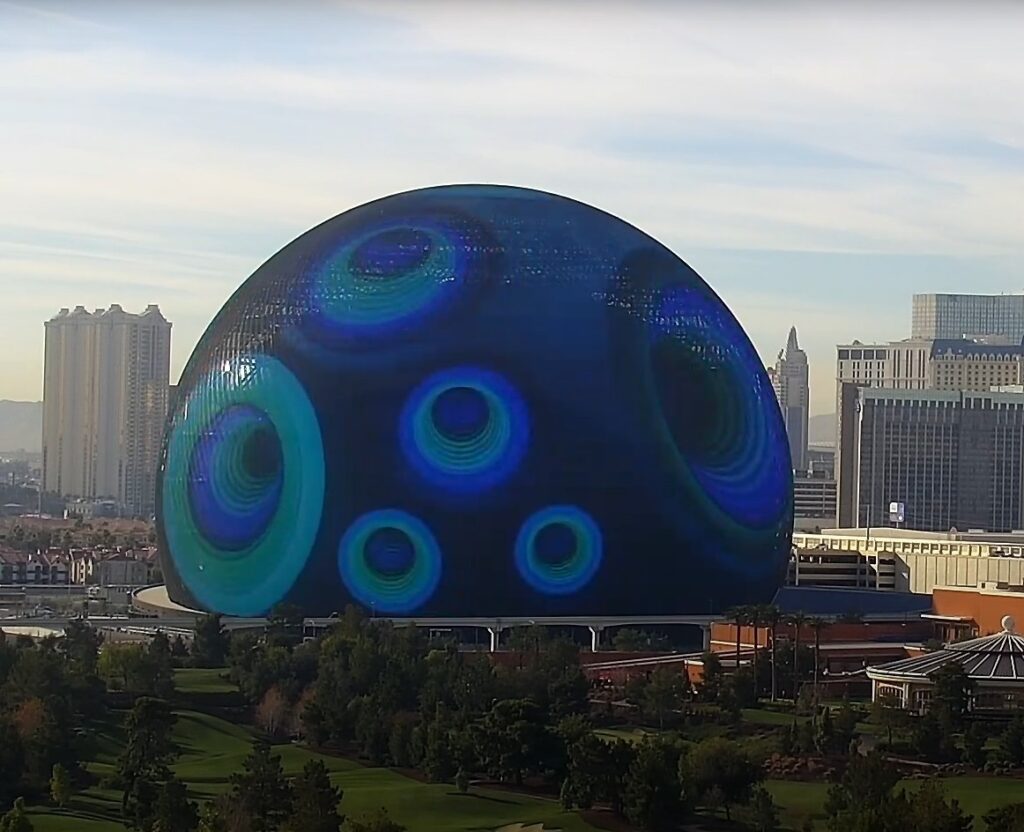
3D motion designer and visual artist Kian Khiaban has had an outstanding trajectory since he graduated from UCLA in 2015. Working early on with fellow artist Refik Anadol, he has closely collaborated with him in some of his studio’s most spectacular projects and is now part of the team at the world famous Sphere, a groundbreaking spherical screen with 580,000 sq feet of LEDs. Khiaban’s artistic work focuses on nature and abstraction, conceiving art as a way of addressing human emotions and engaging in healing processes.

The artist has recently presented a solo artcast featuring five artworks in which he creates fantastical landscapes that depict different emotions. In the following interview, he dives into what these imaginary spaces mean to him, as well as his creative process and his views on the current state of digital art. 

Dive into Kian Khiaban’s Emotional Landscapes

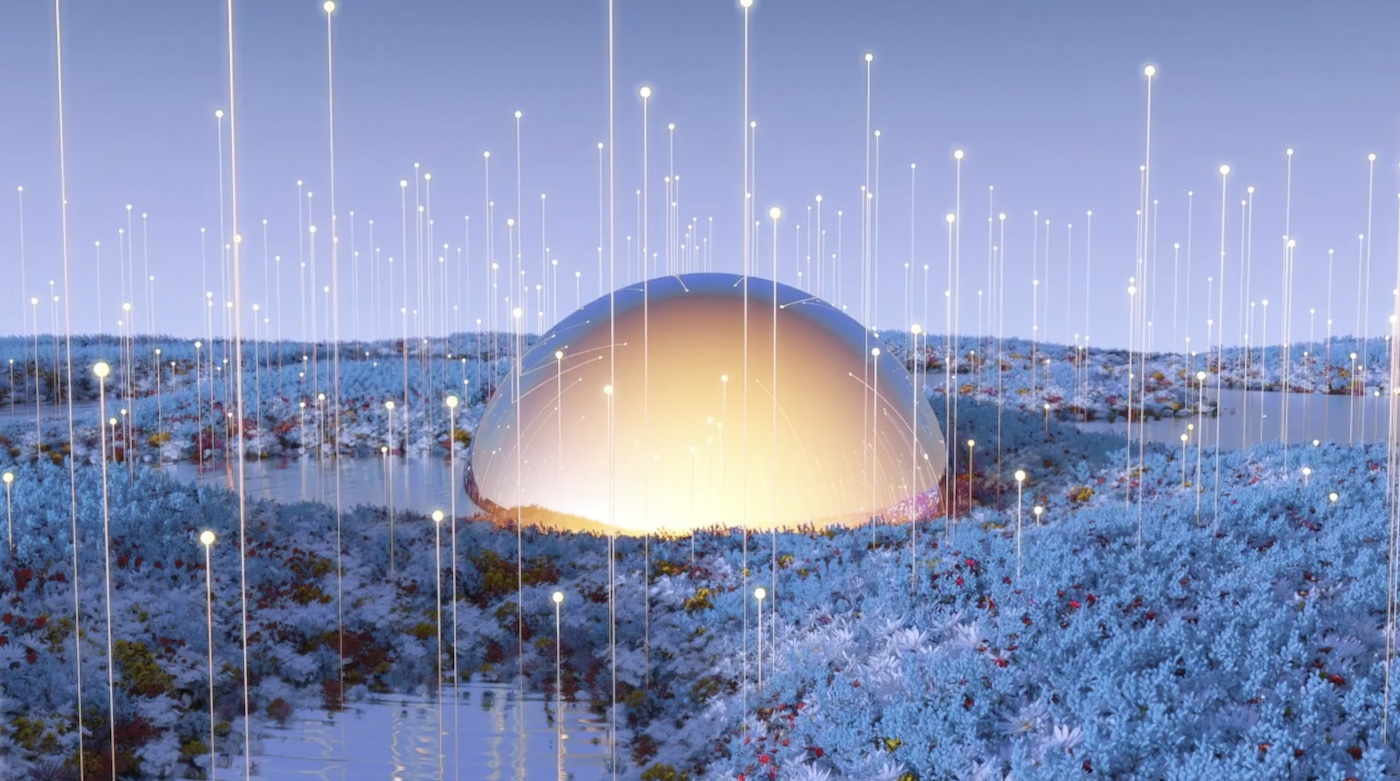
Kian Khiaban. Floater, 2021.

How did you get started in 3D animation? What interested you about this particular aspect of digital creativity?

I started doing 3D when I was thirteen. I got introduced to it through anime forums, actually. In the anime forums, every user would have their own design, which they called a signature, and they would teach people how to make their own signature. So through this I got introduced to Photoshop and 3D, and then when I went to university, I already had a whole portfolio of still images. They weren’t animations, they were just art. There I started to learn how to move the things that I had made. At UCLA I met Refik [Anadol], who was a grad student. He was using Cinema 4D, a professional 3D modeling, animation, simulation and rendering software. It was a good match between us, because we were both heavy C4D users, and then at some point Refik had an exhibition and I offered to help him, so we started collaborating and I worked my way up into his company and was part of its early establishment. This was around 2015, when I graduated.

“The way we worked [with Refik Anadol] is that he gave me a lot of freedom, maybe throwing an initial idea, and then I would go crazy with it.

You have created numerous animations for the studio of Refik Anadol. Can you tell us about your creative process within this context? What have you contributed and what have you learned from this collaborative practice?

Working with Refik mainly consists in that he would come to me with an idea, especially a visual idea and would say: “this would be really great if you can make something like this.” I was very good at iterating, so I considered myself, especially at that time, a remixer. I created a lot of the visuals of the projects we were doing at his studio. For instance, we had a project called Infinity Room. Refik said he had the idea of a room with mirrors on the top and bottom. So I experimented a lot, I did the sound design for it, made some animations, and gave it a particular character. Then Refik added some visuals onto it. In some projects he would take the lead, while in others I did for particular things. But the main characteristic of the way we worked is that he gave me a lot of freedom, maybe throwing an initial idea of what he was looking for, and then I would go crazy with it. Sometimes the project would develop in a totally different direction, but always with this ongoing conversation between us.

Kian Khiaban. An Open Heart, 2021.

On the other hand, I have also learned a lot from my commercial work, where I am given a style frame and I work on that, building an entire animation, and remixing it. I’ve gained a lot of technical knowledge and benefited from working with a team, which is something I love because it brings me multiple perspectives that widen mine. I would say that I’ve been lucky because in these jobs the clients have trusted me and given me a lot of freedom, and even allowed me to have some of my personal themes in my work. What I learn in my commercial work I later on apply it to my personal work. Working on one of these projects for eight hours every day, you get to experiment so much, and so I often develop things that seem perfect for one of my pieces, and then of course my personal work also inspires what I do for different clients.

“I love working with a team because it brings me multiple perspectives that widen mine.”

Currently I work at the Sphere in Las Vegas, in R&D and building the animations, and this is a very challenging type of shape because it is seamless. And you know, 3d animators don’t design in a seamless way. In addition, the form has to be a spherical camera, so there are a lot of little things you have to adjust for. But to be honest, I’m good at coming up with a lot of ideas, and then making things a bit prettier with each iteration. That’s what I do.

3D motion design by Kian Khiaban at the Sphere, Las Vegas, 2023.

The animations you have created have been displayed in very large installations and on the facades of famous buildings. How do you work on them when considering such a large scale, and an interaction with architecture?

The process starts by making a 3D model or a miniature of the building, because you need to be able to feel what you’re doing. If we don’t have the possibility of building a miniature version of what we’re doing, we do a VR version, building the space in 3D and then applying the projection. That gives you a starting place to experiment. But besides that I like to first consider where the building is located, in what city, what kind of environment is there around the building, what form does the building represent, and so forth. Then I try to build on top of that, but it depends on the project.

For instance, in WDCH Dreams, at the Walt Disney Concert Hall in LA, there was the almost impossible task of mapping the shapes of Frank Gehry’s building, for which they had had developers working for years. We used 42 large scale projectors that were able to display 50K resolution images. We used the entire facade as a screen, applying the visuals I created to a 3D model in order to adapt to the undulating shapes.

Kian Khiaban. Long Walk, 2023.

Your personal work is often characterized by an interest in nature (real or imagined) and mesmerizing visual effects in which light has a critical role. What attracted you to creating these fantastic worlds and the lively activity that takes place in them?

I’ve always liked hiking a lot. When I was a kid, there was this one place I went to that brought a lot of peace in my mind. When you go into a natural setting by yourself, it becomes a way of finding yourself because you’re getting this new clarity and simplification. You can actually hear your own thoughts, and to me that is very relaxing. So I like nature because it has that healing quality of bringing clarity, lowering the volume and allowing a space for reflection.

As for the dream-like quality of my work, I believe it is related to who I am. I was a big daydreamer as a kid. I would play out scenarios a lot in my head, and I also spent many hours, year after year, in front of the computer. Playing video games and searching the Internet took me to a distant place, away from daily reality, and I think what I do now is a more sophisticated version of that. I’m building this space for myself to bring me peace and clarity, the same way when there was chaos around me, I could go to a video game and be taken into that fictional world.

“I like nature because it has that healing quality of bringing clarity, lowering the volume and allowing a space for reflection.”

In the artworks we now present on Niio, a common denominator is the depiction of emotions through digital landscapes. What do you find interesting about representing emotions in this way?

Maybe I should talk about why I always have a light in the center of each artwork. I don’t want to impose my intentions on the viewer’s interpretation of the artwork, but I think it is worth explaining this. The light represents the hope of getting out of a hard situation, the objective you try to follow to achieve that, and that makes you very focused. I feel that what has helped me survive in my chaotic environment all these years is being really focused. The light obviously has other meanings, it can be the sun, that so many civilizations have praised as a God, or the light that people having near death experience say they have seen in a pleasant field, and that has brought them the most peaceful feeling they’ve ever felt in their life. So what I mean is that these artworks are for me a way to express something personal, even intimate, in a more abstract form. For instance, one of my latest pieces is called Adrift at Sea, and it refers to the feeling of having to choose among different values and not being sure what to pick, which made me feel a bit lost.

Kian Khiaban. Wisdom, 2020.

Despite this personal connection with a human experience, there is generally a lack of human figures in these landscapes, why is that?

I want it to feel lonely. It’s that feeling I get when I go into nature, there’s no one around me. But it is not about loneliness: I can think of having people there, but it would change the whole dynamic of the piece. It can become about them, and I am not interested in representing people in these landscapes, which would take you into figuring out what they are doing, but rather to express a feeling that you can only experience looking at this landscape where there is no one else but you.

“These artworks are for me a way to express something personal, even intimate, in a more abstract form.”

From your perspective as an artist involved in acclaimed large scale projects, what is your opinion about the current perception of digital art? Do you think it has finally become a widely accepted form of contemporary art?

Generally speaking, it is much more respected than before, partly because of the NFT boom. However, NFTs also brought negative associations, with purely financial speculation and lack of quality. On the other hand, 3D animation is now much more popular because it is widely used in advertising. Another thing I find that is more present in digital art is this blending of fine art and commercial creativity, which is pretty much connected to what Andy Warhol did, or now Takashi Murakami and Jeff Koons, for instance. For someone like me, who works with commercial projects as well as my own artistic practice, this is quite interesting, and to be invited to a fine art exhibition as a digital artist is something that the 13-year computer gamer in me finds really amazing. Digital art is definitely becoming art. It should have happened 20 years ago, but it’s okay.

“I think Niio is great. I feel that you have a deep appreciation and understanding of art.”

How do you see a platform like Niio contributing to this popularization of digital art?

I think Niio is great. I’d say that’s why we connected so well early on, because I felt like you had a deep appreciation and understanding of art. And if you’re guiding this platform, you’re gonna take it in the right direction. The way the artwork descriptions are written, the way everything is laid out, is the way a gallery would lay it out. I also value that the artist’s opinion, or vision is involved in the process. I’ve been approached by other platforms, but I didn’t say yes to a lot of things because I felt like they were mainly a business. Too much of a pure business approach to art. And I think that what you all are doing at Niio is really what the artists are trying to do.

Kian Khiaban. Lone Night, 2021.

Stan Adard: finding an inner anchor through digital art

NIIO Editorial

Stan Adard, a graduate in social psychology and an educator, has long recognized the significance of breath in stress reduction. This insight, combined with years of meditation experience, has been a guiding force in Adard’s career, spanning over three decades as the owner and CEO of various IT companies. Adard’s passion lies at the intersection of humanity and technology, a fascination tracing back to the early days of computer innovation. Committed to exploring the use of art as a mindfulness tool, Adard employs a unique 4-dimensional digital brush, where time represents the fourth dimension, infusing his pictures and experimental art films with a palpable sense of breath and flow.

Practice conscious breathing with Stan Adard’s Breathing Pictures.

Stan Adard. The Breathing Pictures: Sky Dance, 2017

As a professional of the software industry and social psychologist, what is your opinion on the way digital media influence our mental health?

To form an opinion, I need data and details. Digital media is an extremely broad term, and I don’t want to join those who mainly lament the dark side of new media. From the YouTube help videos created by hundreds of creators with loving intent to news and social media networks where digital content often creates a breathless atmosphere. In addition to these, just as examples of the many layers in the digital media landscape, there’s the entire digital advertising world that inundates us from practically every device. Or digital art, which can either unsettle, bore, or inspire us.

We experience daily the challenges of not simply being swept away by this flood of possibilities. Where do we direct our attention? It’s our decision which aspects of digital media empower us and which weaken us. This process of realization is not always easy, as we often don’t immediately sense whether something is beneficial or weakens us in the long run. The world is becoming more complex and is already overwhelming us in many aspects. That’s why it’s important to find an inner path, an inner anchor. Conscious breathing is a crucial key to this. And if I can do this in the form of digital breath images, it helps in using digital media productively.

“A single image cannot lead a viewer to Nirvana. But it reminds us that it’s time to consider what conscious breathing can achieve at its core.”

You have stated that fear and anxiety are often consciously used to manipulate people. Could your work be seen, thus, as being not only about mindfulness but also social change?

You’ve caught me there. I see how our world is trapped in a system based on fear. As a system architect for over three decades, I have an eye for systems. And the overall system that towers over the national and alliance subsystems of the entire world serves only one purpose: to channel the profits from this planet’s resources and the labor of every inhabitant upwards. Into the hands of a few. This happens with a ruthlessness that sends shivers down my spine. The hunger in the world, the senseless wars, the acts of terror in the name of some selfinvented, vengeful god. The fuel is fear. In my view, fear is the opposite of love. Hatred stems from fear. What I can do in my smallness against this machinery is to bring to light that conscious breathing helps us so that our thoughts, and therefore our fears, can no longer control us. It’s an illusion to think that we can control our thoughts. But we can learn not to be controlled by our thoughts anymore. The breathing images, in their simplicity, are a subversive and loving element against a system that needs to be fundamentally renewed. Of course, a single image cannot lead a viewer to Nirvana. But it daily reminds us that it’s time to consider what conscious breathing can achieve at its core.

Stan Adard. The Breathing Pictures: Breathing Luxury, 2017

Let’s talk about the artworks we are now showcasing on Niio. Can you elaborate on the differences between the breathing pictures and the flowing pictures?

Most of my breathing pictures come to life during a process where I create my next breathing film. My digital experimental films must flow and breathe. Sometimes, an endlessly flowing motion arises from the film’s context, into which I then, at times, insert a breathing structure or infuse the structure itself with a breathing motion. ‘Eternal Blue’ is such an example. The viewer needs to take a moment to tune into the image until they discover the breathing motion.

In terms of their appearance, these artworks are often characterized by the presence of shiny, reflective objects and neon colors. Is this a personal aesthetic decision or does it respond to meditation purposes?

The ‘neon colors’ are generated by a graphics card in my server. In 2019, I was invited to create a breathing picture for an eSports gaming event in Asia (over Niio). To visually capture the attention of the mostly young participants, I used colors they are well acquainted with from their gaming servers.

Using the same colors, I then created a small series of pictures. However, in general, I choose colors based on aesthetic aspects. Colors have to appeal to me so that I can spend a month working with them, which is the average time it takes to create a new image. As an educated social psychologist, I am well aware of colors and their perception, but I rely on my intuition and often chance to choose the colors.

“Each ‘breathing picture’ exists only once as an original, marked with the appropriate signature, and is registered in the blockchain as proof of existence.”

Your signature is present in the lower right corner of each artwork. Does this mean that you conceive them as a painting? Is it to reinforce their perception as a work of art?

Exactly! A decade ago, my goal was to bridge the gap between classical paintings and digital art. In this vision, digital works would reveal their true, breathing form only when the viewer stands calmly in front of the artwork, allowing them to perceive the subtle breathing movements.

Right from the beginning, the signature, along with the year and edition, was a crucial means in the digital realm of art to precisely locate a work. Each ‘breathing picture’ exists only once as an original, marked with the appropriate signature, and is registered in the blockchain as proof of existence. The same applies to unique NFTs. For streaming platforms, exhibitions, and fairs, I always use an Artist Copy to ensure the integrity of the original work.

Stan Adard. The Breathing Pictures: Clematis Torus, 2018

Usually, a sphere is the element that guides the meditation. Does it have a different purpose according to its movement in the composition? Would you say that certain movements are easier to carry out a guided breathing exercise?

A sphere is a perfect geometric form. Inhaling enlarges the sphere and makes it rise, just like our chest does. Exhaling lowers the focal object and makes it smaller again.

Over the years, I’ve realized that in public spaces, the breathing movement must be clearly visible. People are often in a rush, and if we want to motivate them for a single conscious breath, it needs to be evident that something is breathing. The representation of breath can take many forms, and for each image, I explore the possibilities for it to fulfill its purpose in either a calm setting (gallery, living space) or a more hectic place (art fairs, exhibitions, Times Square).

“People are often in a rush, and if we want to motivate them for a single conscious breath, it needs to be evident that something is breathing.”

Tell me about the use of the torus as a recurring shape in your compositions. What do you find most interesting and/or effective in terms of guiding the viewer’s attention in this shape?

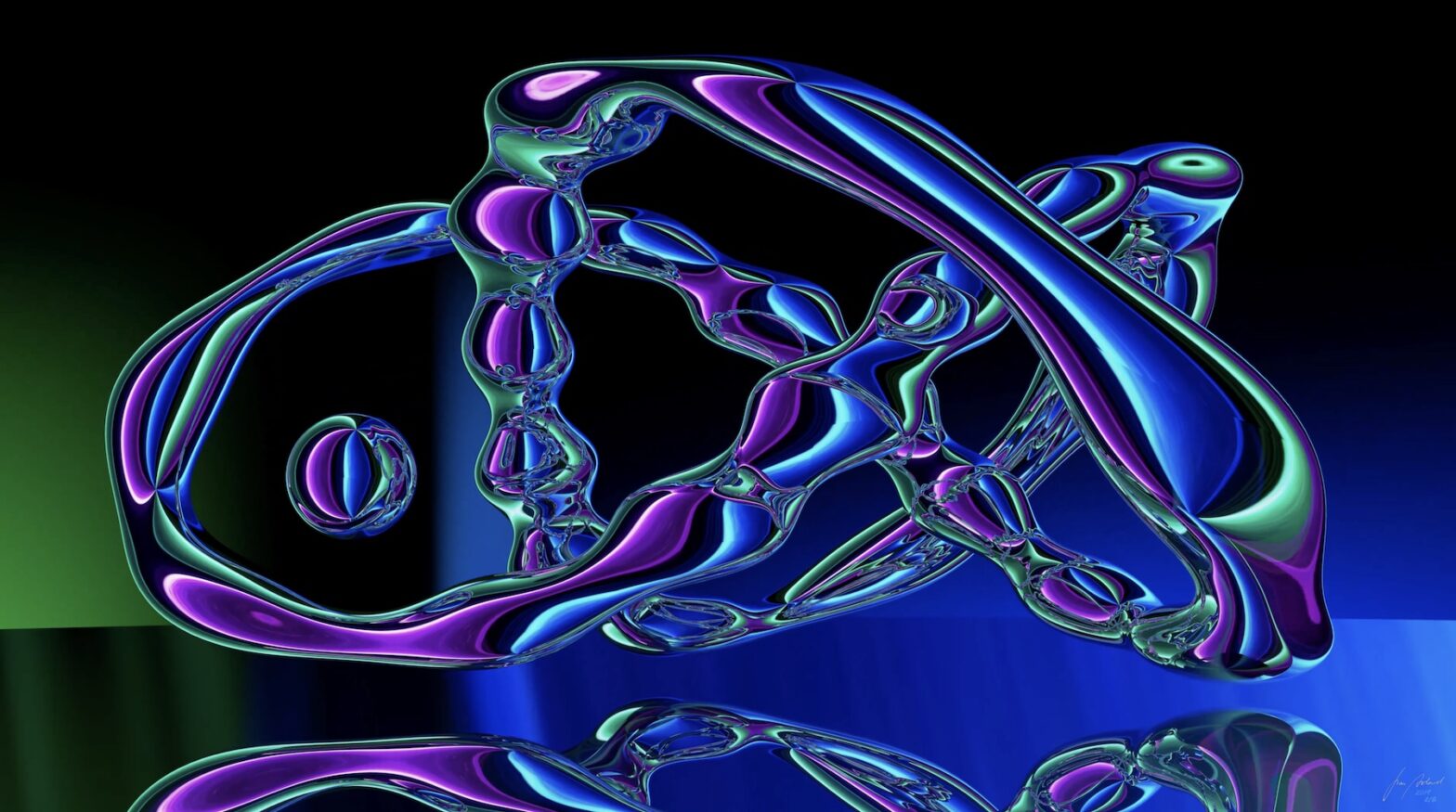
A torus symbolizes infinity for me. I also enjoy twisting a torus, forming a lemniscate, or adding gentle extensions to it. The eye can then glide along the structures of this ever-circular body, capturing the details. Ultimately, we reach a point where we perceive the structure as a whole and then also see that it breathes.

You have mentioned influences from Buddhist art and architecture such as the Wat Rong Seur Ten (blue temple) in Chiang Rai. Which other sites or works of art have inspired your work?

I’ve been practicing Buddhist meditation for decades, so visiting various temples on a tour through Thailand was a natural choice. A photo of the Blue Buddha, with blue being a color I often use in my works, stayed with me after my return to Europe. This inspiration led me to create three works in total: ‘Blue Buddha’ as a breathing image, ‘Blue Buddha Meditation’ with a soundscape by my longtime musician friend Mihaly Horvath, and a Virtual Reality version of ‘Blue Buddha Meditation.’

The breathing experimental short film ‘Time(s) to Breathe’ was inspired by Times Square in NYC, but these are exceptions. My primary source of inspiration is nature itself.

Stan Adard. The Breathing Pictures: Ethernal Blue, 2019

There are subtle references to nature in many of your artworks, can you tell us about this connection to the natural environment?

We discussed systems earlier. Nature, where humans are a part of, is the most complex and wonderful system we know. Its forms, colors, creativity, everchanging behavior, inter-connectivity, forces, and inner structures are all miracles rooted in the quantum fields that fill our universe. Sometimes, it leaves me breathless when I attempt to comprehend even a tiny fraction of it. At such moments, it’s time to create a new breathing picture, do some garden work, or to make concepts about the next experimental art film.

Some of your works display a mesmerizing, cyclical movement, while others reveal very subtle, almost imperceptible changes. How do you decide on the type of movement that each artwork will display?

Well, that depends on the environment in which I see the artwork being used. Initially, I primarily created breathing pictures with a slow and almost imperceptible breathing motion. The idea behind it was that only those who are calm would take the time to observe the image and perceive the breathing movement. These images only breathe 3-4 times per minute, while in everyday life, we may breathe 10-12 times per minute. The movement should not distract and should resemble a painting.

For art fairs, exhibitions, and ultimately the presence of the breathing pictures in very vibrant settings, I made the breathing movement more apparent. Spheres expanding and moving are easier and quicker to read. Moreover, based on many observations, I’ve found it more helpful to draw people’s attention to their breathing patterns when the initial breath rate is higher, perhaps around eight to ten breaths per minute, gradually slowing down over time. Such setups resemble therefore more to a meditative session.

“I’ve found it more helpful to draw people’s attention to their breathing patterns when the initial breath rate is higher, gradually slowing down over time.”

You were a musician at the progressive rock band Nautilus, yet music does not seem to play a central role in these artworks (although there is a sense of rhythm). Why is that?

Music still plays a significant role in my works, albeit not in The Breathing Pictures. Perhaps this perception arises from platforms like Niio, where I primarily showcase breathing pictures that are meant to fill the large black voids, often referred to as inactive screens, with art. However, I also create experimental breathing short films. ‘Time(s) to Breathe’ and the VR short film ‘Breathing Through’ feature carefully crafted soundscapes composed and realized by my musician friend, Mihaly Horvath.

Furthermore, we (astradream) collaborate in workshops and exhibitions with various sequences of The Breathing Pictures, accompanied by a carefully drafted soundscape, creating what we call a ‘Breathing Space.’

You have created a series of artworks in collaboration with several artists, such as Magno Laracuente, Zmakey, and Maura Patrizia Zoller. How have these collaborations developed? Which is your approach to incorporating their paintings into your digital animations?

I love working with people and in teams. All the artists I mentioned earlier, including the recent addition of Margarita Somnolet, have come into my life through art exhibitions. There must be something in the structure or movement of a painting that challenges me to find an additional layer that gives rise to a breathing motion. Sometimes, I carry a painting in a corner of my brain for a year, searching for the right approach that does justice to the image. My artist friends see it as an opportunity to expand their viewership.

For me, it’s the connection with various artists, their perspectives on the world, and the diverse life circumstances they come from that contribute to my creativity. These connections have also resulted in some wonderful friendships.

Stan Adard. The Breathing Pictures: Ethernal Blue, 2019

You have experimented with VR, how would you compare this immersive medium with your digital paintings in terms of the conception of the artwork and the viewer’s experience?

A classic painting is like a view from a window. Everything that doesn’t fit within the window frame is omitted and remains unseen. Creating a film or artwork in a virtual environment is the construction of an entire world. In this realm, you can’t hide a camera; what’s behind or beneath you is as significant as what’s in front of or above you. Crafting a virtual concept requires strategic thinking in concentric layers, perhaps similar to building an onion. A virtual space structurally resembles a sphere, which we perceive from the inside. This sphere must be developed in all directions.

We’ve also experimented with immersive audio, and the two VR works available today, ‘Breathing Through’ and ‘Blue Buddha Meditation VR,’ are quite impressive. I look forward to Niio delivering VR content to its subscribers in the future. In a virtual environment, the viewer can immerse themselves in the artwork; art can’t get much more comprehensive than that.

I think that I’m a fan of this art form?

“In the near future, we will certainly see more 16K (for both eyes), larger devices, more VR entertainment, and new ideas in the realm of digital art.”

You have had a long relationship with media during your life, from your first Super8 camera and a Hammond electronic organ to the current 3D animation and VR software. From that perspective, how do you expect digital media to evolve in the near future? Will it continue to bring constant, groundbreaking innovation, will it stagnate…?

Wow, that’s a vast field for predictions. The developments in the realm of artificial intelligence are currently pushing the boundaries of our comprehension. So, let’s focus on films and art for now. From my perspective, humans are inherently curious beings, and they age best when they remain open and curious. This nature won’t let humanity rest until it improves its film techniques, which naturally include the depiction of virtual realities, to the point where there are no discernible differences between the real world and the depicted world. Only when we can’t distinguish resolution, ambient sounds, music, and eventually even scent from reality while watching a movie or using our VR goggles, will this development, which has entered an exponential phase, come to a halt. So, it’s only when we can’t tell whether the actors in a film are real people or animated characters that the developers of these technologies can finally sit back. In the near future, we will certainly see more 16K (for both eyes), larger devices, more VR entertainment, and new ideas in the realm of digital art. The race for the world’s largest display recently gained momentum with the Sphere in Las Vegas.

As public advertising spaces are increasingly rejected by many communities, it will become more crucial to produce meaningful content for these spaces. I look forward to being a small part of shaping this landscape.

What is the role of art museums in the Anthropocene?

Pau Waelder with Karin Vicente and Diane Drubay

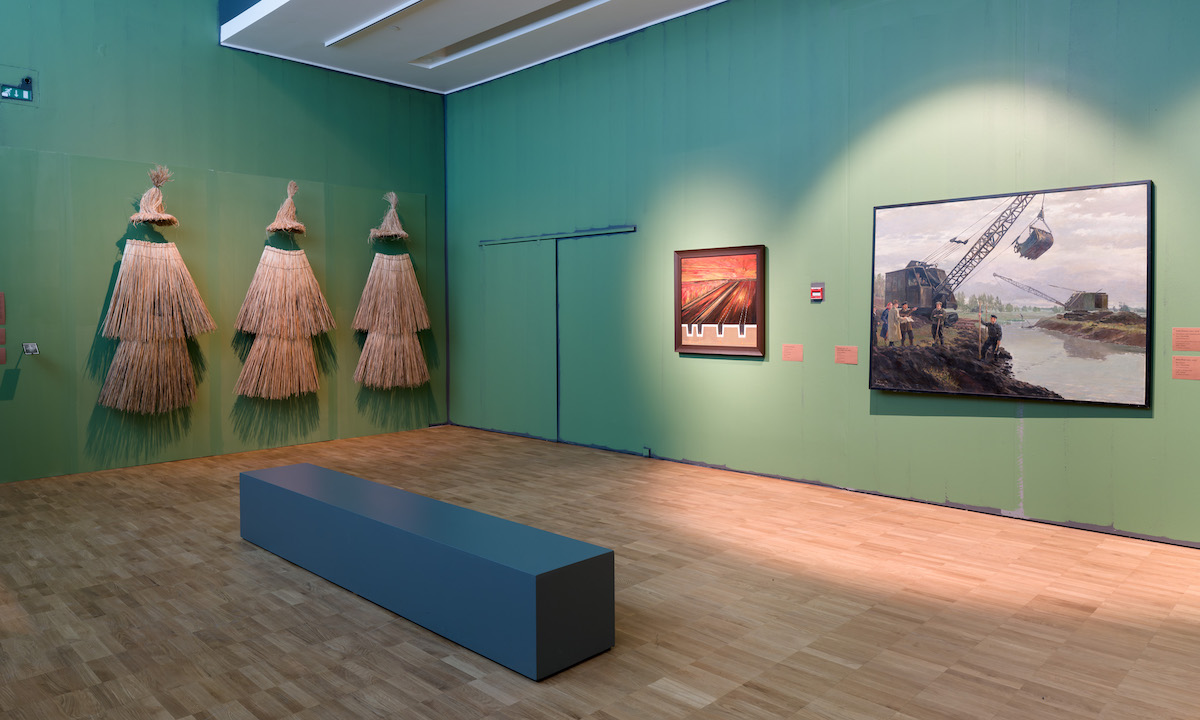
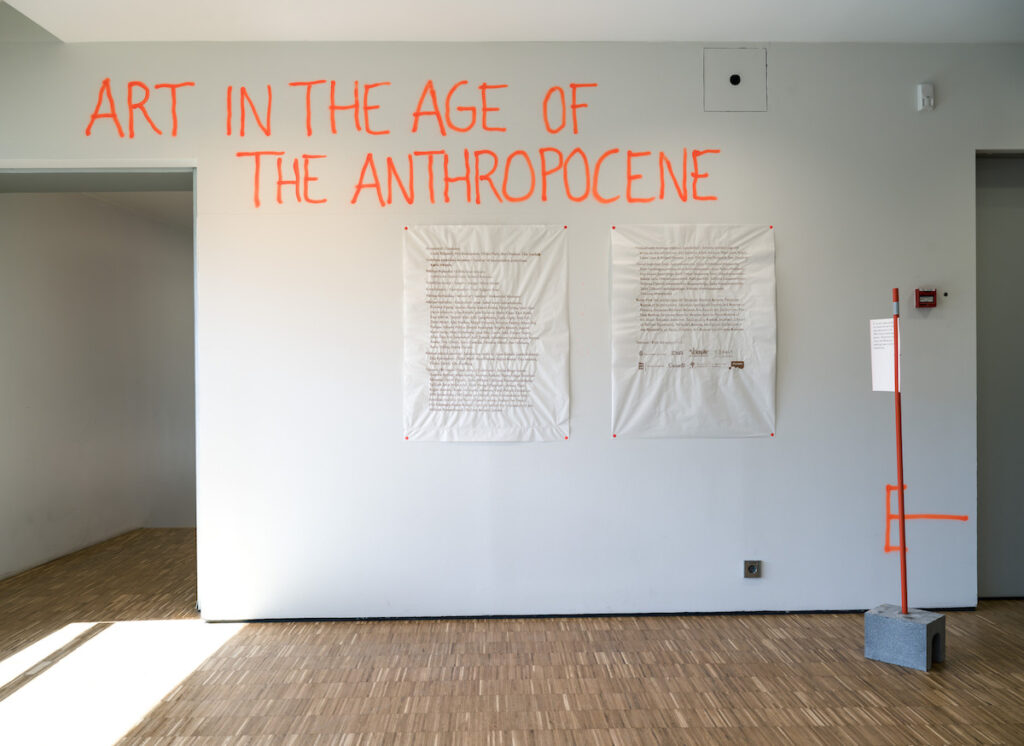
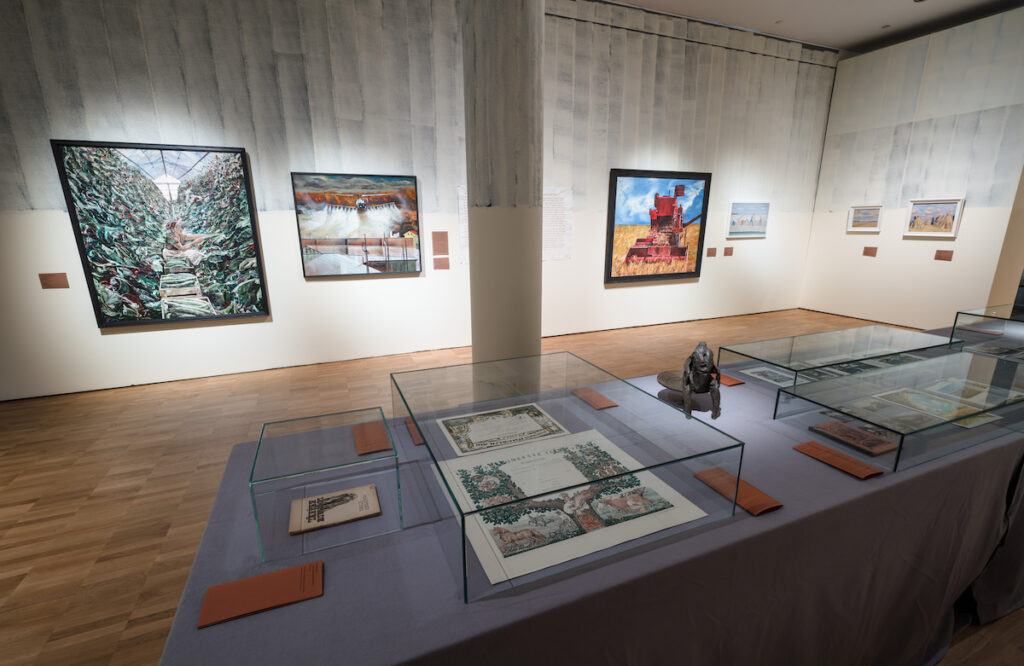
Art in the Age of the Anthropocene, Kumu Art Museum. Exhibition view. Photo by Stanislav Stepashko.

Is there a need for art during an ecological crisis? This provocative question is the starting point of the exhibition Art in the Age of the Anthropocene, currently on view at the Kumu Art Museum in Tallinn (Estonia). The exhibition explores Estonian art history from an ecocritical perspective, addressing how nature, but also the industry and the impact of human activity on the environment, have been depicted in painting, sculpture, photography, and other media, including video art and performance. Such an approach is particularly interesting in itself both for bringing new perspectives to Estonian art history, and for suggesting a reflection on our relationship with the environment from the vantage point of a selection of artworks spanning more than a century. However, what makes this exhibition even more relevant to our present time is that it is the outcome of a three-year-long project debating the role of the museum in the Anthropocene and particularly during a climate emergency. 

What should an art museum do at a time when sustainability is no longer a choice, but a need? What should be the institution’s role in raising awareness about the way human activity fuels the current climate crisis? How can art museums become hubs for reflection, and possibly action, to face a growing environmental disaster? These are hard questions to answer, and we cannot expect a single project or institution to be able to answer them. In fact, this has been an ongoing debate for many years among museums experts, in forums such as the Museums Facing Extinction programme carried out since 2019 by We Are Museums in collaboration with the EIT Climate-KIC agency. However, the exhibition at Kumu offers a good example of how sustainable exhibition principles can be put into practice, and furthermore communicated to the visitors.

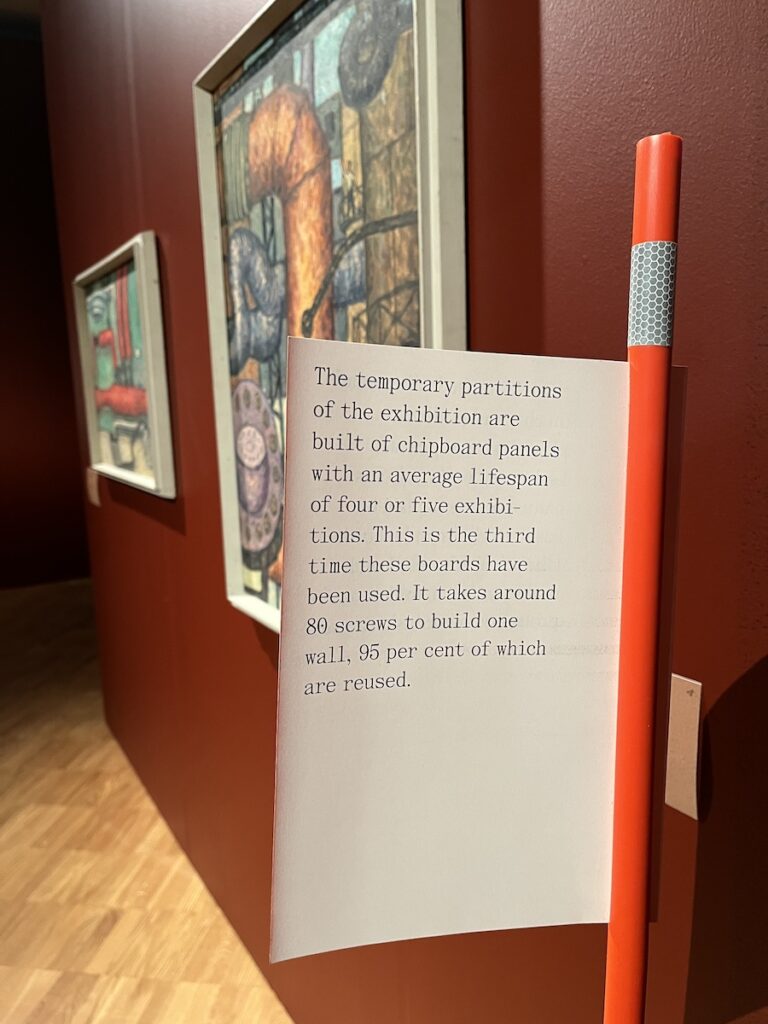
This is actually the aspect in which this exhibition stands out, questioning its own museography and drawing attention to experimental solutions for a more sustainable exhibition design with highly visible informative signs. Before entering the exhibition, visitors encounter an unusual sight: instead of using vinyl lettering, the exhibition title has been spray painted on the wall, while the curatorial text is displayed on two large sheets of paper. Next to them, a thin red pole stands on a concrete brick, holding a cardboard label with additional information. These freestanding labels are scattered across the rooms, providing an additional reading of the exhibition in terms of the sustainable practices applied to this particular curatorial and museological project. 

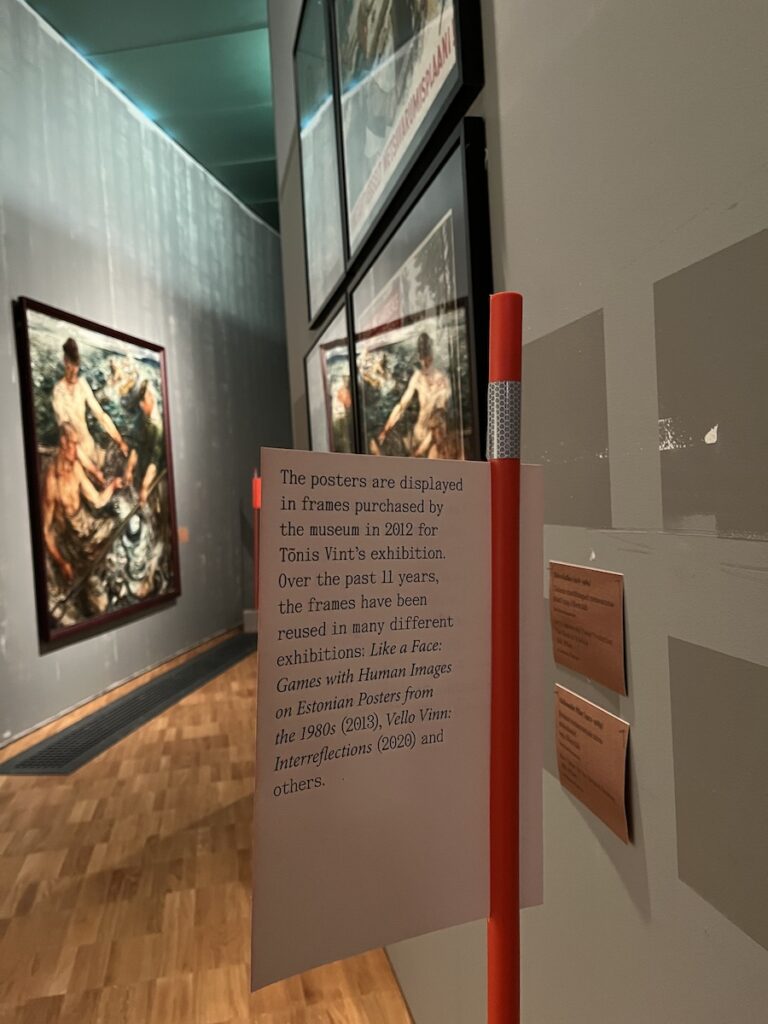
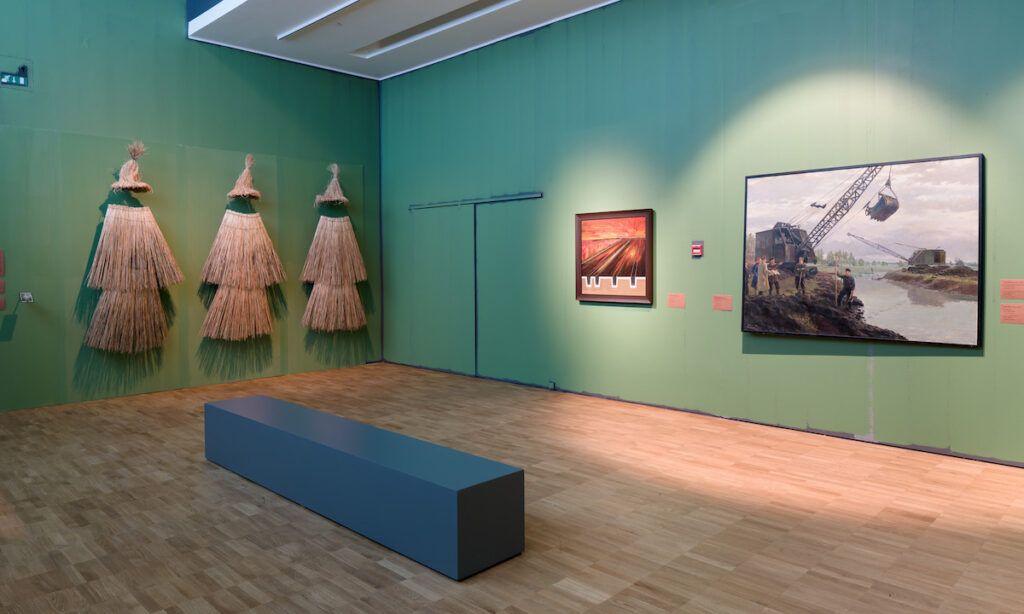
Art in the Age of the Anthropocene, Kumu Art Museum. Exhibition view. Photo by Pau Waelder.

Thanks to them, we learn for instance that clay paint has been used to create the wall texts and labels, and that the labels are UV-printed on leftover cardboard, thus avoiding the use of plastics. Different wall paint solutions have been tested, considering their ecological footprint, price, amount of work required, and efficacy. We also learn that the posters in the exhibition are displayed in frames that have been used multiple times during the last eleven years, or that a painting that has been in storage in the museum’s collection for 78 years is now on display for the first time. Sustainability therefore goes beyond the choice of materials used and involves larger decisions about the management of the museum’s collection or the carbon footprint of an exhibition that includes artworks brought from remote locations. Art in the Age of the Anthropocene does not pretend to solve all of these questions but rather to raise awareness about the challenges that museums face on their path to sustainability. The freestanding red poles and experimental solutions give the appearance of a construction site and seem to convey the idea that it is all in the works. This is actually an honest way to address the issue, and also to involve the visitor, who is encouraged to consider how to contribute to a sustainable museum experience.

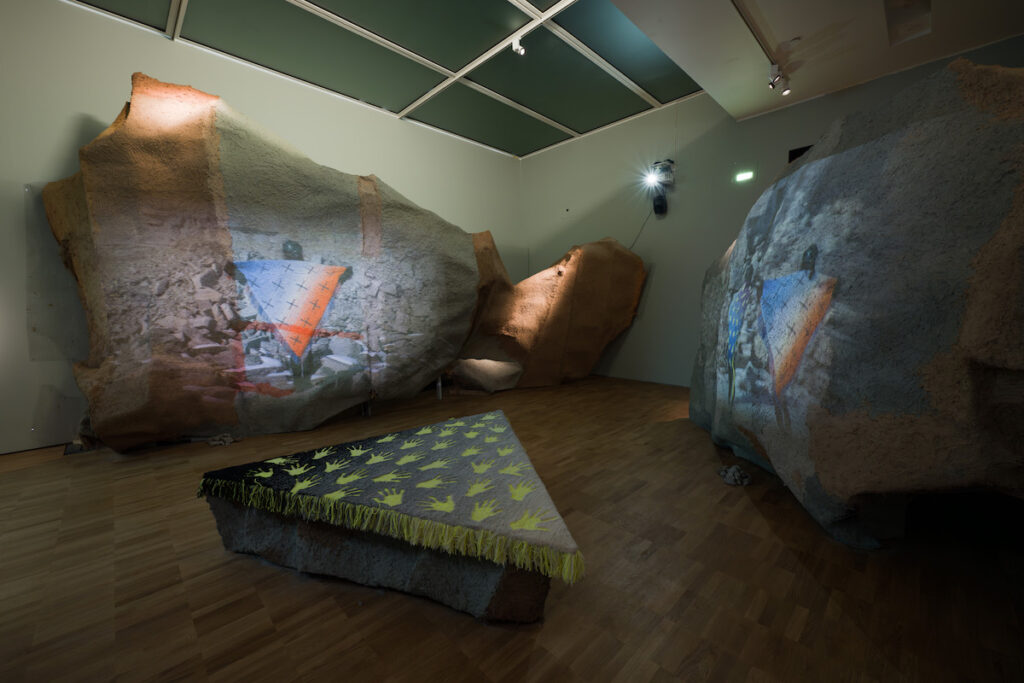
Art in the Age of the Anthropocene, Kumu Art Museum. Exhibition view. Photo by Stanislav Stepashko.

An expert’s view on sustainability in museums

To better understand the ideas and the work behind Art in the Age of the Anthropocene, I had a brief exchange with Karin Vicente, the head of the sustainable work group at the Art Museum of Estonia.

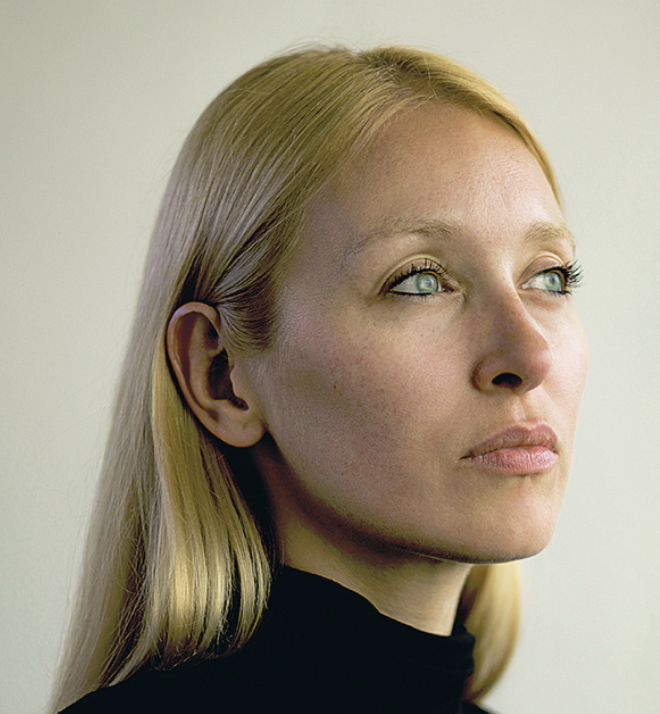
Photo by Terje Ugandi

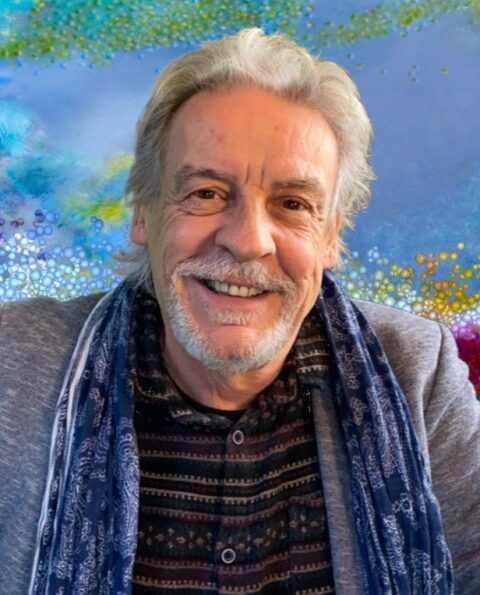
Karin Vicente is an art historian based in Tallinn, Estonia. She works as a programme manager and curator at the Adamson-Eric Museum. She is the head of the sustainable work group at the Art Museum of Estonia. Currently she is working on the project A Model for a Sustainable Exhibition.

The exhibition Art in the Age of the Anthropocene has had a long gestation period of over three years. Can you highlight the main tasks and processes that have taken place during this time? 

The preparation of the exhibition is a part of a research project. It helped us analyze our collections (as well as collections of other museums) from an ecocritical perspective. Beyond the content, the exhibition has also initiated discussions about the green transition in the museum. How can an art museum minimize its ecological footprint? We organized a few seminars and discussions in the museum, involving participating artists and designers.

“We wanted to raise questions among the audience, such as the price of being part of a global art network.”

The exhibition is characterized by a double educational approach, on the one hand selecting artworks that speak about the representation and appropriation of the environment in Estonia, and on the other hand pointing out the sustainable exhibition practices carried out in its mounting. How have you combined these approaches?

The “red flags” indeed reflect the issues we discussed with curators and the exhibition team during the process. However, the selection of artworks was made by curators, following the narrative of the exhibition. We didn’t plan to create a zero-waste exhibition. For example, we invited international artists to contribute to the exhibition and designed a special exhibition layout considering eco-design aspects. We wanted to raise questions among the audience, such as the price of being part of a global art network. The pollution generated by air travel casts a shadow over bringing international art to Tallinn, yet it makes more sense than visitors traveling to the country of origin of each piece to see it. We want to be part of a global arts network, but how do we balance the pros and cons?

The sustainable exhibition practices have involved collaborations with third parties, such as the Tallinn Book Printers, to obtain leftover material. Can this lead to continuous collaborations? Is it possible for a museum to fully transition into using donated materials for purposes such as wall labels or brochures?

We collaborate with many companies, and there is a growing demand and consciousness concerning “green solutions” in the field. In some cases, it might be reasonable to create an exhibition using only reused/recycled/donated materials, but we also need to consider other aspects, like the security and well-being (climate conditions) of our collections. Handmade silkscreen texts and labels on waste paper were playful experiments, but they demanded a lot of human resources. Therefore, I’m afraid we won’t be able to do it every time.

Art in the Age of the Anthropocene, Kumu Art Museum. Exhibition view. Photo by Stanislav Stepashko.

Reusing elements purchased by the museum from previous exhibitions is a good practice both environmentally and economically, and currently most museums have a certain amount of reusable stock. How can this practice be even more effective and sustainable, balancing the specific needs of artists and curators with those of the museum?

The only restriction to reusing more materials is the limited storage space we have. We have discussed with other museums and institutions the idea of a platform that would facilitate the exchange of different showcases and materials between different institutions, but it still needs to be developed.

Wall painting is a major element of exhibition design, as it conditions the visual perception of the artworks. How do you see the solutions you have tested in Art in the Age of the Anthropocene being applied to other exhibitions?

The experimental design decision our team made involved testing different wall paint solutions. We were looking for the most economical and sensible solution, so we have analyzed the properties of clay, casein, linseed oil emulsion, and acrylic paints: their ecological footprints, prices, covering capacities, drying times, scratch resistance and ease of removal, and the required amount of work. The result was visually effective as we also tested different painting styles (using less paint). I think it’s a matter of taste; different wall paint solutions can be used when exhibiting artworks from different periods. There are obviously other methods to use wall paint in a more sustainable way. I think the trick is to find a good balance between the desired outcome (how it looks) and how we achieve it.

“Handmade silkscreen texts and labels on waste paper were playful experiments, but they demanded a lot of human resources. Therefore, I’m afraid we won’t be able to do it every time.”

Video and digital art are increasingly present in contemporary art exhibitions, which demands that museums have screens, projectors, computers, and other equipment that is also commonly used in educational activities. How does incorporating digital art into the museum align with sustainability goals? How would you compare it with traditional formats (painting, sculpture) in terms of shipping, maintenance, and storage, and the need to participate in the global art scene?

Indeed, both digital and traditional art forms have their ecological footprints. Traditional artworks need to be kept in a controlled climate that consumes a lot of energy. Digital artworks require computers, etc., and they have a digital footprint. However, we need both, and I think it doesn’t make sense to compare them.

Climate control is necessary inside the museum, not only to make visitors comfortable, but also to preserve the artworks. How can it be made more sustainable? What are the challenges for a museum in Estonia, where the difference between summer and winter temperatures can be extremely high?

We are updating our HVAC systems at Kumu in 2023; this requires a significant investment. This year, we also initiated a discussion in the museum to form our opinion about the Bizot protocol and weakening the climate standards. These are not easy decisions to make, but we are working on them.

Art in the Age of the Anthropocene, Kumu Art Museum. Exhibition view. Photo by Stanislav Stepashko.

Is there a need for art during an ecological crisis?

Considering the issues raised by the Kumu exhibition in a wider scope, I asked Diane Drubay, artist and founder of We Are Museums, about her views on the sustainability of art museums and a possible answer to the role of art in our current climate emergency.

Diane Drubay is an artist whose work focuses on better futures and nature-awareness and a researcher working towards the transformation of museums and art through various communities, events and programs, internationally since 2007. Founder of We Are Museums and WAC-Lab. Member of Museums For Future.

What is your opinion about the interplay of artworks and information in Art in the Age of the Anthropocene

In my opinion, the greatest challenge to overcome when we want to adopt sustainable exhibition practices is taking the first step. There are endless lists of practical sustainable actions, but they are often repetitive and tailored to a global audience rather than a local or personal one. Over the years, I’ve learned that it’s by sharing our personal stories that our actions can resonate with others. So I don’t hesitate to talk about what I do or don’t do any more, and to explain how I do it and what impact it has on my daily life. 

In the “Art in the Age of the Anthropocene” exhibition, we find this very personal way of talking about what has been done and why, but also a very practical one. All the details provided give visitors the chance to draw inspiration from them and apply this mindset to their everyday lives, or even their professions. I would love to see all these practical insights shared online in a global “ressourcerie” for museums on their climate journey!

Also, while museums tend to have the reputation of being large, secretive or inaccessible institutions, showing such openness and sincerity highlights the human beings who work in this museum and who, like everyone else, have moments of questioning and try to do their best to reduce their carbon footprint. Such honest behavior addresses the human being before the visitor. Leaving questions open invites dialogue and shows great humility, while sharing insights can be inspiring.

Art in the Age of the Anthropocene, Kumu Art Museum. Exhibition view. Photo by Pau Waelder.

In a recent article on Art Review, Marv Recinto states that art exhibitions about ecology “often feel futile in the face of real environmental devastation” and calls for “a more concerted effort towards action.” As an artist addressing this subject, how would you respond to this? Is the effort carried out at KUMU a step in this direction?

As there are many different types of disaster, there are many different ways of approaching an environmental emergency. Some people need to feel emotionally involved in order to act, others need figures and scientific facts to speak to their rationality, and still others need to be on the ground, collaborating with others, and so on. What I see is that many artists have several points of action, and the creation of stories or emotions complements local community action or changes in behavior. If we want to make a lasting impact and see behavior change profoundly, the approach must be multiple and complementary. As in nature, it is the diversity of species that makes a land fertile.

“If we want to make a lasting impact and see behavior change profoundly, the approach must be multiple and complementary. As in nature, it is the diversity of species that makes a land fertile.”

Karin Vicente states that both traditional art formats (painting, sculpture) and digital art have their carbon footprint, and that we need both, so it makes no sense to compare them. What is your opinion about digital art and sustainability in museums?

Exhibiting digital art and, above all, preserving it are key priorities for museum professionals today. So now is the perfect time to experiment with sustainable practices in my opinion. Many museums and associations are already well advanced in their search for a sustainable digital strategy. 

Like KUMU did beautifully, low-tech cultural mediation within the museum is a very good way of offsetting the carbon footprint of hosting servers and other carbon costs. But museums can also seek to reduce their carbon footprint by implementing actions in favor of biodiversity, reducing their water consumption, maintaining or creating forested or natural areas around the museum, thinking in terms of slowing down, circularity and renunciation, or supporting the local before thinking global.

“A digital work of art can reach more people in a global and inclusive way.”

And I agree with Karin Vicente that comparing the different media and their carbon footprints makes no sense, because we would also have to add a measure of the impact in terms of raising awareness, encouraging people to act and changing behavior, but also in terms of the number of visitors reached. A digital work of art can reach more people in a global and inclusive way.

Disordinary Beauty, a work in progress (part 3)

Domenico Barra and Pau Waelder

DISØRDINARY BƏAUTY is an ongoing art project by Domenico Barra that explores ugliness through glitch art. The project has been developed as a series of NFTs, with a new phase taking place on Niio as a work in progress, in which the artist will periodically upload new artworks and accompanying documentation. Here in the Editorial section, we are publishing email exchanges bringing light into Domenico’s creative process and the ideas and influences behind this project.

Follow Domenico Barra’s work in progress on your screen in DISØRDINARY BƏAUTY: art canon

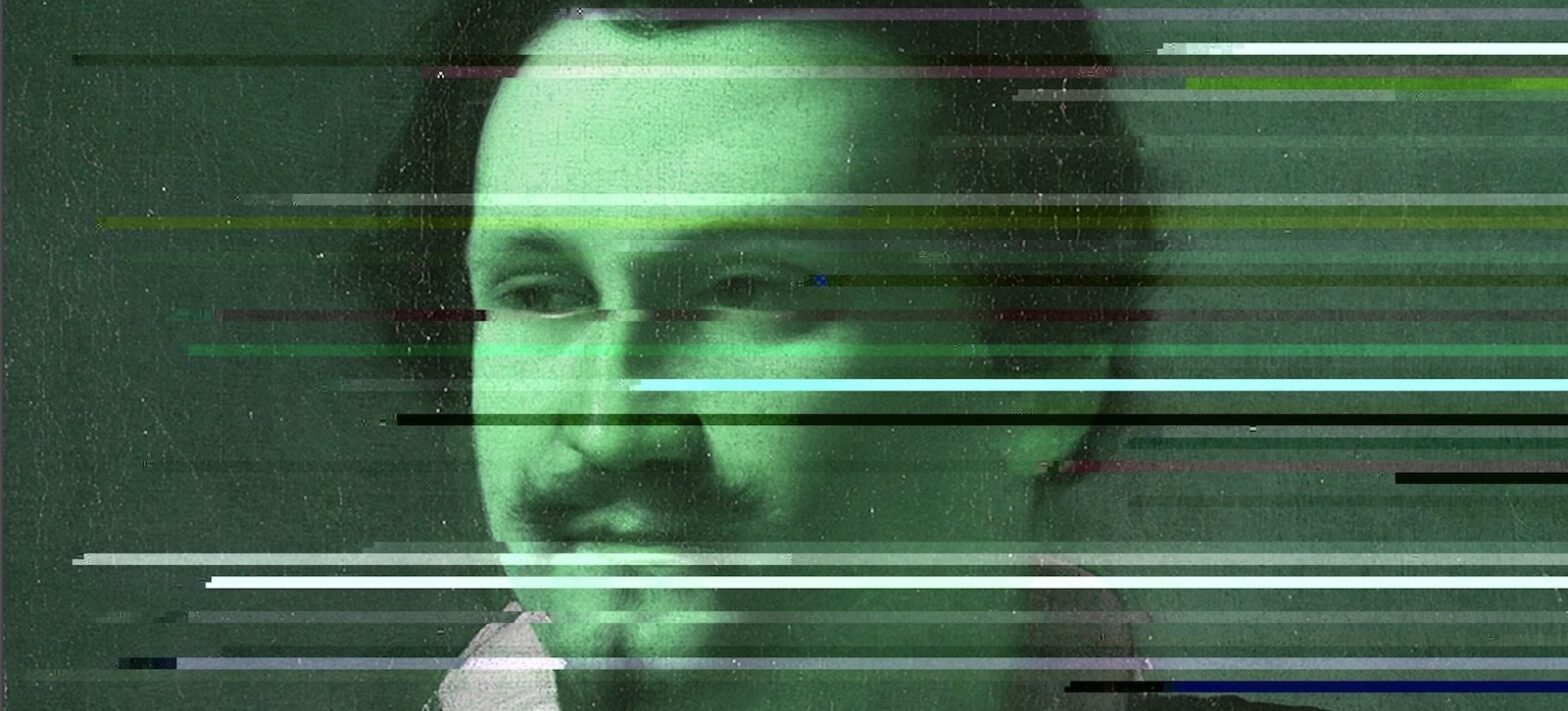
Domenico Barra, DB a̶r̶t̶ ̶c̶a̶n̶o̶n̶ | p̶o̶r̶t̶r̶a̶i̶t̶_̶g̶e̶n̶t̶l̶e̶m̶a̶n̶, 2023

Third ɛʍǟɨʟ exchange

from: Pau Waelder
to: Domenico Barra
date: Jul 26, 2023, 6:46 PM
subject: Re: Disordinary Beauty #03 on Niio

Hi, Domenico!

Again, work piles up and it is hard to keep up with everything!

I hope summer is going well despite the heatwaves, Barbenheimer and the overall craziness of the world (including the disorienting change of Twitter to X, is this the end of times?).

Ok, so I have a couple more questions (in attachment) that came to mind after watching your latest artwork, I hope you find them interesting.

Looking forward to your answers, take care and best wishes!

Pau


from: Domenico Barra 
to: Pau Waelder 
date: Jul 31, 2023, 4:43 PM
subject: Re: Disordinary Beauty #03 on Niio

Dear Pau,

We live in a society that demands us to be always busy even when we have nothing to do. We are online crafting content to SHARE we are not doing anything. We never take a break from doing, just for the sake of having always something to SHARE, it’s crazy. I think doing nothing is an act of rebellion. I am spending at least one hour per day on the reef by the sea only staring at the horizon.

I am glad you had the chance to have some quality free time, and I am happy it feels great. Creativity runs wild during those moments. Make sure you will have more of that, you won’t regret it.

Here below are my answers to your questions. I hope you will find interesting thoughts for your piece. 

I wish you well and I look forward to reading your next email.

Sincerely,

d0/\/\!

This time we have a portrait by Caravaggio, no less. Some would say that using the work of such a great master is disrespectful, or that you might be using his fame to draw attention to your work. This also brings to mind the availability of these artworks in the public domain, for everyone to use, which is also our right, and the artists’ right, to build on the legacy of the culture we have inherited. How would you respond to this?

In the realm of the public domain, a critical landscape emerges, particularly in the era of AI-generated images and the resurgence of artists reclaiming their copyrights against the proliferation of their styles through text-to-image AI systems. While the focus here does not revolve around a living artist, one cannot ignore that those who might perceive my reinterpretation of Caravaggio’s work as disrespectful could be driven by a similar sentiment. “Do not copy other artists, if you are a real artist you should create your style signature”.

Read about the Electronic Frontier Foundation‘s take on Copyright and AI art

Drawing from a background deeply rooted in remix culture, I wholeheartedly support the open access to cultural content, advocating for its use to create something innovative and as a means of paying tribute and preserving legacies. This commitment forms the basis of my series, exclusively created for Niio, where my aim is to shed light on lesser-known artists and their works, fostering art literacy and cultural appreciation. As I did in this video where I picked a not so famous work by the Italian Great Master. My art strives to serve a cultural purpose, akin to remix culture, by presenting novel perspectives and reimagining traditional artworks. I make it a point to provide additional files and content alongside my creations on Niio, enabling people to download, use, and remix them.

I make it a point to provide additional files and content alongside my creations on Niio, enabling people to download, use, and remix them.”

In this particular video featuring Caravaggio’s work “Portrait of a gentleman” (presumably Scipione Borghese), I intend to pay homage to the artist and his legendary narrative and legacy. My roots in Naples, Italy, and my current residence in Malta strengthen my connection to Caravaggio, whose presence has been an integral part of my cultural upbringing and daily life. The three masterpieces located in Napoli, namely “The Flagellation of Christ” at the Museo Nazionale di Capodimonte, “The Seven Works of Mercy” at Pio Monte della Misericordia, and “The Martyrdom of Saint Ursula” at Palazzo Piacentini, hold a special place of pride in my city’s history. These pieces have been an essential part of my childhood memories, instilling a sense of artistic bong and cultural appreciation. Upon moving to Malta, one of my first actions was to visit Caravaggio’s works, “The Beheading of St. John the Baptist” and “St. Jerome,” at the Oratory of the Co-Cathedral of St. John in Valletta. Their presence in my new home further deepened my connection to the artist.

In creating my art, I do not seek to copy Caravaggio’s style or exploit his fame and name. Rather, I endeavor to pay tribute not only to Caravaggio but also to other artists who have left a lasting impact on the art world. My series, titled DISØRDINARY BƏAUTY | a̶r̶t̶ ̶c̶a̶n̶o̶n̶s̶, showcases artworks that, in my opinion, stand out within their respective canons, either through their classical nature or innovative approach. Much like Caravaggio revolutionized art with his masterful use of Chiaroscuro, I aspire to bring fresh perspectives and novel experiences to the realm of art. I am humbled by the inspiration drawn from Caravaggio’s artistic persona, while fully acknowledging that I am not comparing myself to his immense talent.

By encouraging accessibility to artistic and cultural content, we contribute to the richness of our collective heritage and enable a broader audience to engage with and appreciate art in its various forms.

Embracing the principles of open access, be it Public Domain, Creative Commons, Copyleft, or copy-it-right, I firmly believe that such practices foster a healthier and more inclusive cultural environment. By encouraging accessibility to artistic and cultural content, we contribute to the richness of our collective heritage and enable a broader audience to engage with and appreciate art in its various forms.

Since a glitch is perceived as an error, some might understand glitch art as just randomly distorting the source material, without real agency in the outcome. But I see a methodical work and some aesthetic decisions. Can you take us through the process you have carried out to create this glitched portrait of Scipione Borghese?

The conventional perception of glitch = error has resulted in numerous misconceptions and misunderstandings of Glitch Art. However, this has also led to diverse artistic interpretations, hindering the establishment of a precise technical definition for Glitch Art, something I believe it kind of resulted into an opportunity for artists to explore different meanings and stories.

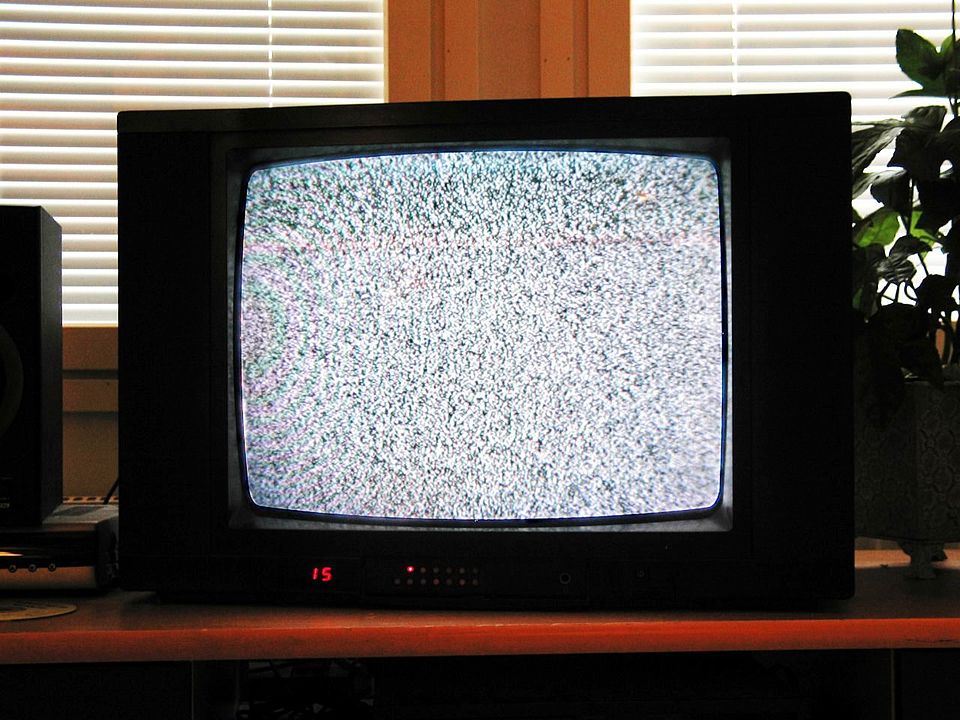
Notably, the lack of a direct translation for “glitch” in Italian and many other languages further adds complexity to its understanding. Instead, terms like “rumore” in Italian and “ruido” in Spanish were suggested, words mostly associated with sound, rather than visual anomalies. I still recall my grandmother calling me to check her TV because there was some rumore on the screen.

Rumore on a TV screen. Source: Wikipedia

To rectify these misconceptions and align those with my glitch art experience, I emphasize in my classes and art presentations that glitches are not errors as if they were errors, we would have nothing as the machine would stop working; glitches are unexpected events, anomalies arising from deviations in standard functions, and instances where machines misbehave. These glitches can even be deliberately induced forcing the machine into glitching defying expectations and programmed exhibiting a level of controllability, while others emerge organically in the wild digital landscape. In post-production, we have the freedom to craft and edit our glitches as desired, opting for “natural glitches” or controlled variants, depending on their role within the semiotics of the artwork.

“We have the freedom to craft and edit our glitches as desired, opting for “natural glitches” or controlled variants, depending on their role within the semiotics of the artwork.”

In my current series for Niio, I adopt a dual approach, incorporating both databending and generative glitches. In the case of databending, I allow the glitches to unfold spontaneously, experimenting with various formats and video codecs, curating the most potent ones for later use in post-production. While I maintain some degree of control over these glitches, their behavior often surprises me, as different codecs interact distinctively due to variations in data arrangement standards. Conversely, generative glitches grant me more control; I can determine their appearance, speed, and intensity by modifying the script’s values.

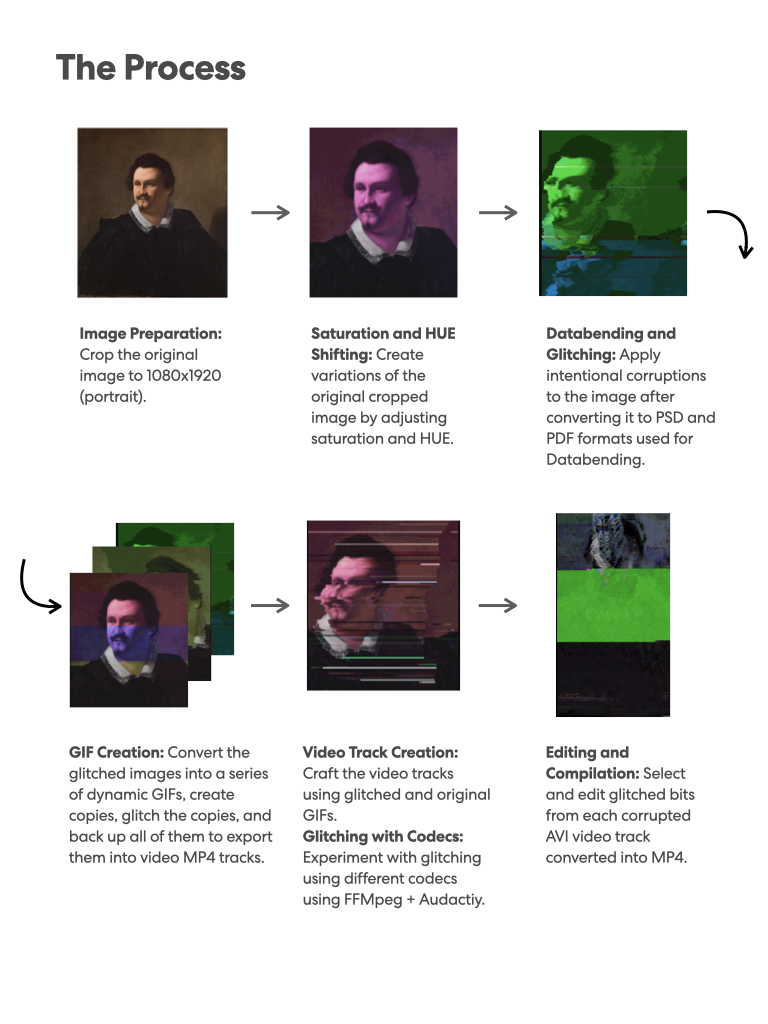
Creating each video segment exclusive to Niio in this series is a labor-intensive process, involving a dizzying cycle of coding and decoding, transitioning from one format to another, combining databending and generative glitching, rendering, and finally editing. For “DB a̶r̶t̶ ̶c̶a̶n̶o̶n̶ | p̶o̶r̶t̶r̶a̶i̶t̶_̶g̶e̶n̶t̶l̶e̶m̶a̶n̶” after Caravaggio, I opted for an even more challenging path. Initially, I rendered the original image in diverse hues and saturations, saving each frame for use in a gif. Subsequently, I glitched this gif using a hexadecimal software named Notepad ++. Both the unaltered and glitched gifs were then imported into a couple of generative glitch apps running in Processing and JAVA, where I live recorded some of the generative processes and effects, later glitching a few outcomes using Notepad ++.

“Creating each video segment is a labor-intensive process, involving a dizzying cycle of coding and decoding, transitioning from one format to another, combining databending and generative glitching, rendering, and finally editing.”

The video editing process for this artwork involved integrating approximately seven to eight gifs at this first stage of editing. One of this GIFs features an upward-breaking effect, the one you suggested is reminiscent of Francis Bacon’s style, achieved through generative means. To add further complexity, I introduced another glitch cycle by combining the original image and its various HUE versions in a PDF file with JPG encoding, subsequently glitching the PDF files using Databending in Notepad ++. Through this intricate process, I generated around 90 images, each then rendered into more gifs for additional Databending and generative glitching in Processing, yielding a considerable array of gifs for the final video editing.

Some of these files are available for download on Niio, and I have utilized them on social media to showcase the work in progress and announce the video’s release. The complexity of this process is a testament to the dedication and creativity poured into my glitch art, striving to challenge conventions and push artistic boundaries within the contemporary context.

A package of 14 files from the editing process is freely available to download from the artwork’s page on Niio. 

Borghese was a famous collector, and supporter of Caravaggio and many other artists, who helped introduce the Baroque style in Italy. Was his role as an influential individual in the arts what led you to choose this portrait? It certainly does not depict a classical form of beauty, as the previous artworks in this series, but rather an image of power. How would you contextualize this work in your research on the canon of beauty?

In our society, few things are as captivating as the allure of power. The pursuit of a public and esteemed image of power becomes an undeniable canon to conform to, one that can elevate our perceived beauty in the eyes of the world. My decision to delve into this subject was motivated by various factors. Traditionally, portraits have centered around classic subjects such as muses (as seen in DB a̶r̶t̶ ̶c̶a̶n̶o̶n̶ | a̶ ̶b̶e̶a̶u̶t̶y̶ ̶i̶n̶ ̶v̶i̶o̶l̶e̶t̶ after Paul Quinsac) and self-portraits (explored in DB a̶r̶t̶ ̶c̶a̶n̶o̶n̶ | s̶e̶l̶f̶-̶p̶o̶r̶t̶r̶a̶i̶t̶  after Carl Joseph Begas). However, with this third artwork, I aim to shift the focus towards collectors.

Collectors, though often playing a quieter role in the art world show, have now risen to prominence, especially since the mainstream emergence of NFTs. In the digital art renaissance, they have become the true stars, the esteemed patrons fueling this transformative movement. Everyone, including myself with a diverse collection of digital art on blockchain platforms like Tezos, Near, and Ethereum, has embraced the role of a collector.

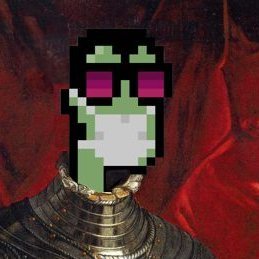
Cozomo de’ Medici’s profile pic

NFTs have transformed the digital art domain into an intricate role-playing game, where anonymity through nicknames adds an element of playfulness. We witness figures like Cozomo de Medici and the entire Medici dynasty virtually ruling the Web3 digital art arena. Here, the term “ruling” is not used lightly, as money, and by extension, wealth and influence which embody power, find particular significance within this game.

“In the digital art renaissance, collectors have become the true stars, the esteemed patrons fueling this transformative movement.”

Collectors have become the darlings of admiration, and collecting itself has evolved into a means of garnering adoration and building influential networks and status within the digital art scene Web3 industry, social media circles and various communities. It is an avenue to monetize one’s social and digital art capital. This work, DB a̶r̶t̶ ̶c̶a̶n̶o̶n̶ | p̶o̶r̶t̶r̶a̶i̶t̶_̶g̶e̶n̶t̶l̶e̶m̶a̶n̶ after Caravaggio, delves into the realm of art portraiture as a potent symbol of power, it delves into the captivating allure of power collectors have and the fascination it holds for us, reflecting the beauty and allure we attribute to those in positions of authority. 

Drawing upon my experiences in Napoli, where several years ago I encountered two captivating exhibitions at the Museo di Capodimonte, the very same museum housing a Caravaggio masterpiece, I found myself immersed in the world of portraiture. The exhibitions titled Tiziano e il ritratto di corte da Raffaello ai Carracci featuring portraiture works by Tiziano and V.I.P. – Very Important Portraits featuring works by David LaChapelle provided a thought-provoking discourse on power, fame, and wealth, illustrating how these themes were portrayed through contemporary artistic aesthetics and the canons of their respective eras. These exhibitions deeply influenced my decision to explore the realm of portraits in several of my projects and collections.

“This work shines as a tribute to art collecting, a praise to visionary collectors, and also a mockery of power and portrait as a temple of power, let’s say.”

The selection of this specific work by Caravaggio was intentional, as it stands as a less popular piece by the Italian master. In this painting, Caravaggio exhibits a more conservative approach, juxtaposed with the often rebellious nature he is famous for, especially when it came to choosing the models for his painting scenes where he often preferred to pick common people from the streets. Here he conceded to some compromise and adhered to a more traditional style, and the subject of his portrait is nonetheless his patron, depicted in all of his authority and prestige. In my work I also disrupt that image, pushing its features to the extreme.

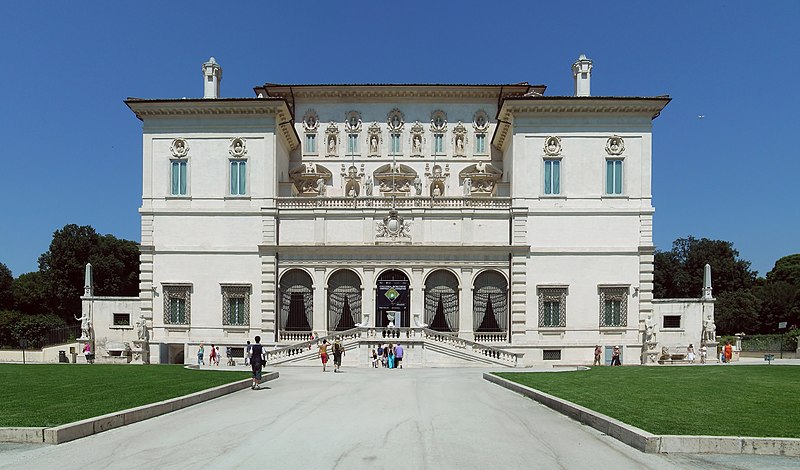
Facade of the museum Galleria Borghese in Rome, Italy. Source: Wikipedia

Lastly, I have cherished the captivating moments spent in Villa Borghese during my time in Rome, indulging in the tranquility of warm summer nights and immersing myself in the Borghese’s park, Collection and Museum. These places have had a profound impact on me as an art lover. Villa Borghese’s ambience exudes the essence of art’s beauty and power like few other places, leaving an indelible mark on my artistic journey.

This work shines as a tribute to art collecting, a praise to visionary collectors, and also a mockery of power and portrait as a temple of power, let’s say.

Solimán López: becoming a Terran artist

Pau Waelder

Spanish new media conceptual artist and researcher Solimán López has developed over the course of a decade and a half a body of work that connects contemporary art with scientific research, 3D imaging, geolocation, biotechnology, and lately blockchain and web3.0. An indefatigable experimenter, he has explored numerous technologies to create his artistic projects and always kept a connection with traditional techniques such as painting and sculpture, although reconfigured through digital imaging and computer-aided manufacturing. 

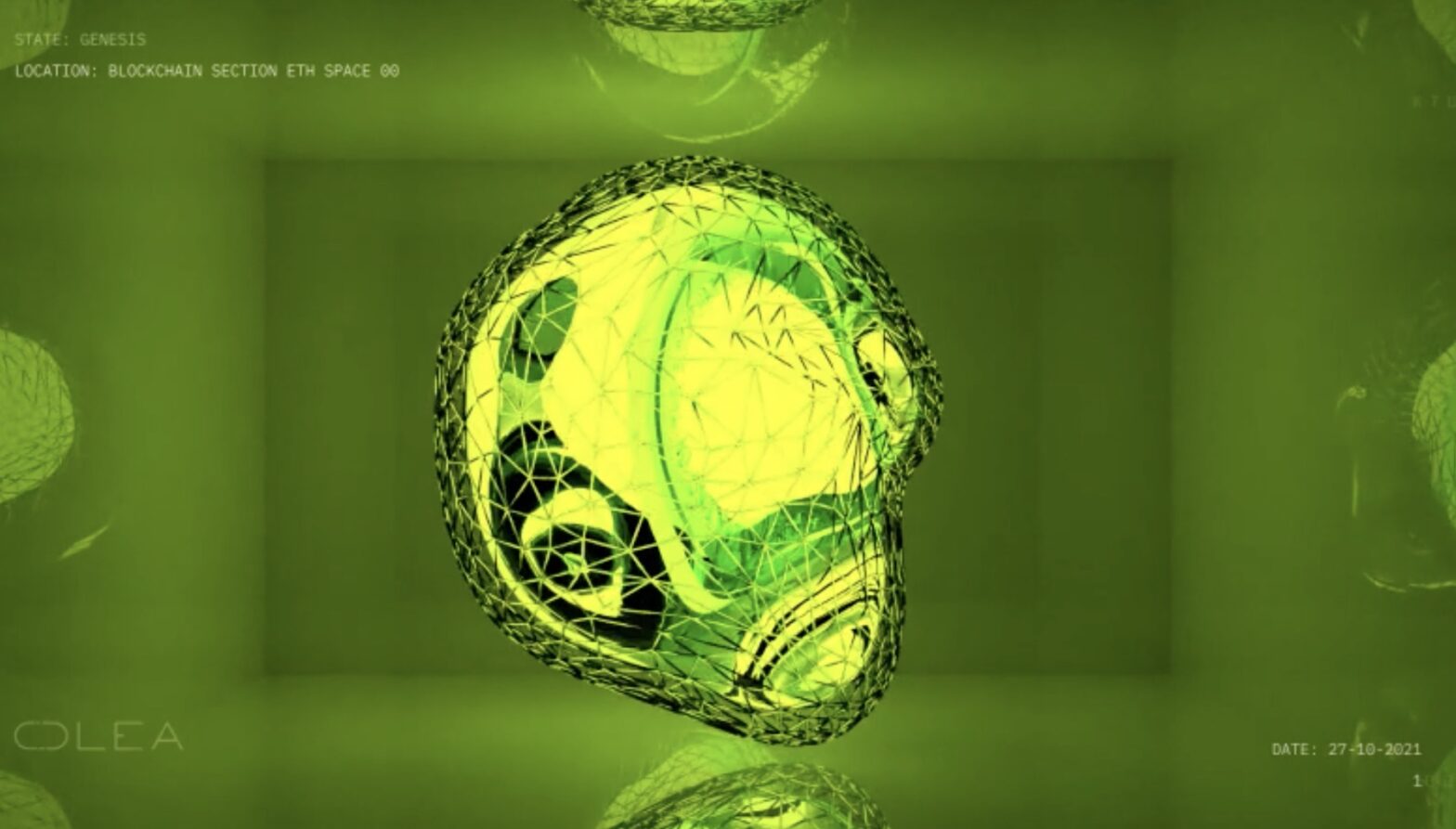
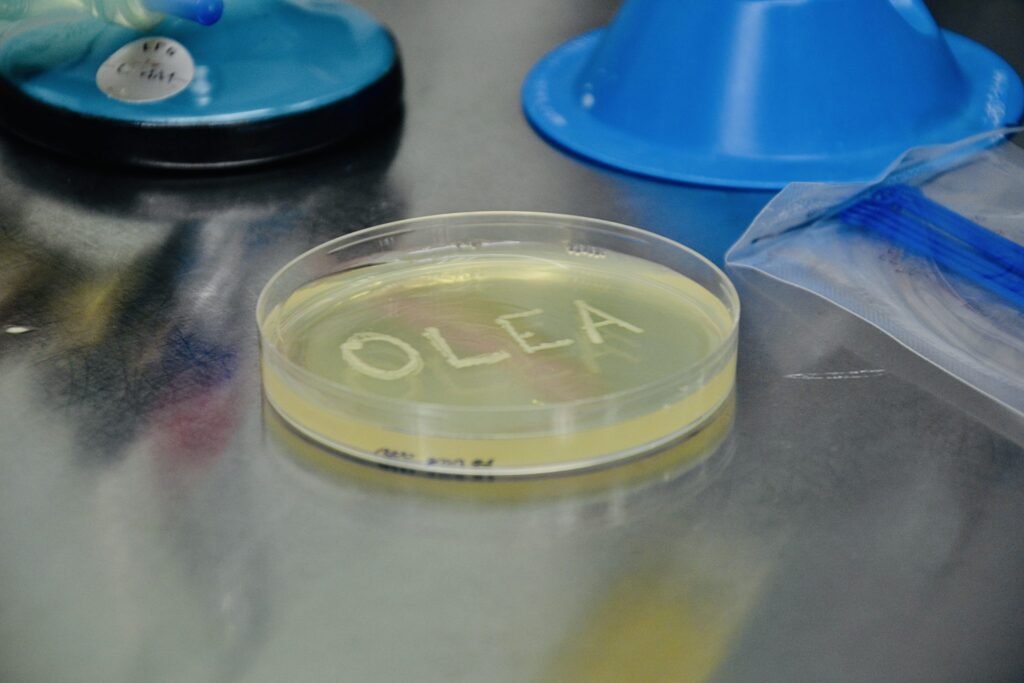
The artist recently presented on Niio several artworks related to OLEA, an ongoing project that consists of the production of a substance composed of olive oil that contains the code of a smart contract, synthesized in DNA. Solimán has created a number of NFTs and installations around the concept of OLEA. In the following interview, he elaborates on the making of this project and the main themes he addresses in his work.

Explore the visualizations of OLEA on Niio

Solimán López, OLEA Genesis Space, 2023

Throughout your career you have used a wide variety of technological resources. How have they influenced the development of your work? Has it been technology that has inspired the creation of a work, or have you sought the necessary resources to carry out an idea you had developed? Or has it been both?

My background is in art history. That is why I have finally become what we could call a “new media conceptual artist”. This means that I consider my work to be essentially conceptual. During my training I quickly understood that much of the relevance in today’s artistic discourses can be found in uses of technology because of its social, ethical, moral and sensory impact. In order to talk about the changes derived from this revolution, I also understood that it was necessary to know very well its origins, motivations and functioning logic, and that is why I started doing research on different new technologies, thinking that their understanding would allow me to make poetry, as the poet does with words.

“What is clear to me is that a good concept ages better than any technique.”

For this reason, my use of technology is always subordinated to a particular idea that I understand is expressed in a successful way with those means. But at the same time, there is a sort of parallel learning about the message and techniques. Nowadays it is difficult to choose the technique with which something makes sense, since there are a great number of formats that are beginning to be accepted. What is clear to me is that a good concept ages better than any technique and that, together with other professionals in the sector, I think that in new media art, the artworks are generated every time they are exhibited, since technically they are running on software and hardware.

It is perhaps for this reason that some obsessions I have with the materiality of the digital arise, issues that we see very evidently in projects such as the Harddiskmuseum or OLEA.

Solimán López, OLEA Space 01, 2023

Your previous work has focused on data collection, geolocation and data storage in relation to the concept of memory. How does OLEA relate to these concepts?

OLEA is becoming a whole universe in itself! It has opened up a Pandora’s box of conceptual possibilities. With the passing of time, I myself have been surprised by the way in which my works fit together in a discourse that makes a lot of sense to me. The obligation to have a “style”, which worried me when I was younger, has simply become a set of features and themes that naturally emerge in my projects. 

OLEA relates to the storage of data as it is actually code stored in DNA and then preserved in olive oil. It is also a time capsule, in this case related to the evolution of the concept of value in the history of mankind and the understanding of data, which now encompasses genomics. Human beings have left traces throughout their evolution, and let’s not forget that technology is the true economy. That is why OLEA appeals to the collective memory in the history of mankind, where as early as 15 BC we have traces of genetic alterations in cereals, which led to the birth of added value in the exploitation of the land and gave rise to the concept of agriculture, a sort of value-added structure to a fractal production ecosystem. It is, in a synthetic way, the same thing that happens with the blockchain, a territory that is endowed with value through the creation of tokens. All these ingredients led to the production of this project.

It is true that I left behind more individual concepts related to personal data to appeal to something less individualistic. In recent interviews I keep repeating a phrase that perhaps explains this leap in my career: “In the era of fakes and empowered artificial intelligence, any personal story is possible. The challenge is to create collective stories that change us and influence us all. My work doesn’t talk about me in the first person, but about us.”

“In the era of fakes and empowered artificial intelligence, any personal story is possible. The challenge is to create collective stories that change us and influence us all.”

OLEA involves two very different technologies such as blockchain and genetic engineering, which however are both linked to the concept of registration and storage. What do these technologies bring to your work and how are they essential to the concept of this project?

Indeed, OLEA is a work that belongs to two intertwined worlds and that is what I intend to show when I exhibit it. Working with genetic code, which is still in a very primitive phase, requires a very interesting process of information synthesis, just as it happened back when we stored information on floppy discs.

This is also the case with the information stored “on-chain” in the blockchain, which also has its storage limitations, which is another interesting and common feature in the current state of these two technologies. Both are special to me for the way in which they leave their mark in their different materialities, as well as for their invitation to have faith in the technology or the value they bring to the ecosystem to which they belong.

Blockchain is basically based on a chain of blocks that stores metadata that actually have little meaning if they are decontextualized. Moreover, when we look at those blocks all we see is the hash in the log and the wallets involved in that transaction. It is something visible but that actually gives us very little information. It is we the users who assign it a value and presume it is a valid asset that refers to an artistic work or token.

We must have the same faith when we see a material containing DNA with the same information that resides on the blockchain. Now, we see the material it refers to but we do not see the code (we could see the DNA at a microscopic level). This game of consciousness, respect and trust in relation to the artistic object seems conceptually very interesting to me. It is also similar to the playfulness we find in great works of art that have questioned our beliefs and allowed us to overcome established assumptions as to what a work of art is. I believe that, as a contemporary artist, I should bring what I can to this constant reframing of our expectations towards art and that is why all these notions come together in OLEA.

Solimán López, Celeste, 2022

What do you make of the irruption of the NFT market, its boom and bust? What has it meant for you in your work as an artist? What is your perception of NFTs and what future evolution do you see in them?

I see NFTs as something that was bound to come sooner or later. I imagined them when I founded the Harddiskmuseum in 2013 as a museum that houses unique files or in the File Genesis exhibition (2017) where unique files are generated in real time that are stored in marble stones equipped with a USB stick, or the CELESTE project from 2016, in which we generated tokens from the digital images obtained from different colors of different skies distributed around the world. 

With this experience, I was ready to take on NFTs in a very natural way, including their market decline. A decline that, in fact, corresponds with all the hypes in the history of technology, sports and other disciplines.

In my work, NFTs are a practicality and a conceptual field of work. Accepting the blockchain as a fractal environment easily connectable with nature is a great evolution in technology, and to me it is a great milestone to have incorporated it into my work.

Let’s also remember that I was the first artist to sell an NFT at a contemporary art fair in Europe and possibly worldwide, since ARCO was the first post-pandemic fair to come to light. This sale renewed my confidence in a format that I still think is here to stay and that is becoming normalized and naturalized in its use, as it is a fair and necessary format for digital art.

I see the future of NFTs as being even more integrated with real objects (I myself am still working on this and in the process of patenting what I call biotokens) and above all we will stop talking about NFTs merely linked to art. This technology will be in our daily lives as soon as the capitalist and mass control systems loosen their grip and allow WEB3.0 to develop freely, including those belonging to the art world.

Solimán López, OLEA Space 03, 2023

NFTs have brought renewed attention to the use of blockchain in art projects, which already had a first boom in 2018. Regardless of its use for the registration of non-fungible tokens, what possibilities do you see in blockchain in the creation and commercialization of digital art?

Art has a history of occupation of spaces. This is made clear after modernity. Let’s remember the occupation of the streets by urban art, or of the internet by net artists or social media artists. Now the same is happening with blockchain, where we are witnessing an occupation of this technological medium as well. The possibilities are many, but let’s not forget that without a solid concept, in the era of the mechanization of tasks, robotics and artificial intelligence, the word Art with a capital “A” is easily refuted.

That is why I believe that we must continue to resignify this space of creation and provide it with powerful conceptual contents that generate thought and offer value. The possibilities of creation that I see with blockchain go through its own evolution as a medium and its insertion and conjugation with other technologies, including biotechnology, a place where I am currently very comfortable conceptually.

“Art is going through a very convulsive moment, trying to resist the cannons of a sustainable, dematerialized and conceptually advanced future.”

On the other hand, the possibilities of WEB3.0 and blockchain in the construction of spaces of thought and communities, has no historical comparison. This notion is very interesting and opens the door to a new concept of the artwork as a social ecosystem mediated by itself and not by museums or other cultural structures, including the self-management of sales and dissemination of the artworks, which is opening the door to other agents with its consequent mutations.

Undoubtedly, art is going through a very convulsive moment in its own foundations, finding great threats in the already traditional contemporaneity, which continues to defend its castle of post-industrial tangibility, trying to resist the cannons of a sustainable, dematerialized and conceptually advanced future.

OLEA in the lab. Photo by Solimán López.

Your work is closely linked to scientific research. How do you collaborate with teams of researchers and how do you conceive the role of art in relation to scientific dissemination?

I feel that real art has always been linked to science and its connections with scientific research and its other main actors. Let’s not forget examples such as the influence of the work of microbiologists James Watson and Francis Crick in the paintings of Salvador Dalí: Dalí was captivated by the discoveries published by the two scientists and did everything he could to get in touch with them. His interest in the findings about DNA led to the appearance in many of the artist’s paintings of the famous representation of the double helix (incidentally thanks to the photographs of the scientist Rosalind Franklin).

I believe that the role of art is established when the work is scientifically solid and the resignification of both researches is achieved for the benefit of a common one. It is at that moment where the culmination comes and a great excitement in which you feel that the pieces are conceptually fitting together. I also believe that art is a fundamental tool for the changes of our time and in this field we cannot leave behind the scientific discoveries that are conditioning our future.

“I feel that scientists are also artists in their own way and with their own intentions, so the relationship is always very fluid and of mutual learning.” 

In 100% of the cases, I have had excellent responses and collaborations. I feel that scientists are also artists in their own way and with their own intentions, so the relationship is always very fluid and of mutual learning. Undoubtedly an extremely rich and mandatory field to continue making contemporary art.

Normally I start with a crazy idea by linking some strands that a priori were disconnected. At that moment my scientific research begins and I start looking for papers, publications and records of what interests me and alludes technically to the work that is already in process. This is where I start to identify some key players, both companies and individuals, and I start to communicate with them, explaining my objectives and joint opportunities. At this point, a very rich production process is born, in which conversation is fundamental and sharing is evolving.

Image from Manifesto Terricola by Solimán López, 2023.

Your most recent project, Manifesto Terricola, combines the theme of memory with biotechnology and climate change, in what can be interpreted as an increasingly clear transition from the individual to natural systems and ultimately the relationship between humanity and the planet. What new aspects does this project bring to your work and what thematic avenues do you plan to develop in the future?

Manifesto Terricola is perhaps the most social project I have ever developed. Along with the Harddiskmuseum, it is a kind of project that you know will accompany you for a long time and that will be revised and even evolved or reinterpreted in the future (if we have any left). It brings me perhaps the possibility to engage with a more global community and not just the art niche, and of course it offers a pragmatic solution to the storage of our digital legacy through DNA and glaciers.

When you travel to a place like the Arctic you ask yourself questions that are already implicit in the manifesto, such as the habitability of the Earth for humans in the near future and the drift of the human species because of this issue and because of technology itself. In this sense, there is a mental doppler effect that forces you to want to go further and further with your work.

That is why the limits of my work are now also focused on space missions for example and to continue exploring those conceptual missives that the natural and the digital can send each other through the action of art and biotechnology until they live in harmony.

This line of work will continue to be very present, because as I mentioned before, these are places where I feel very comfortable since I believe that biotechnology will change the way in which human beings will relate to an unstable environment in changing conditions. Art can only survive from this position and from the understanding that we are Terran artists.