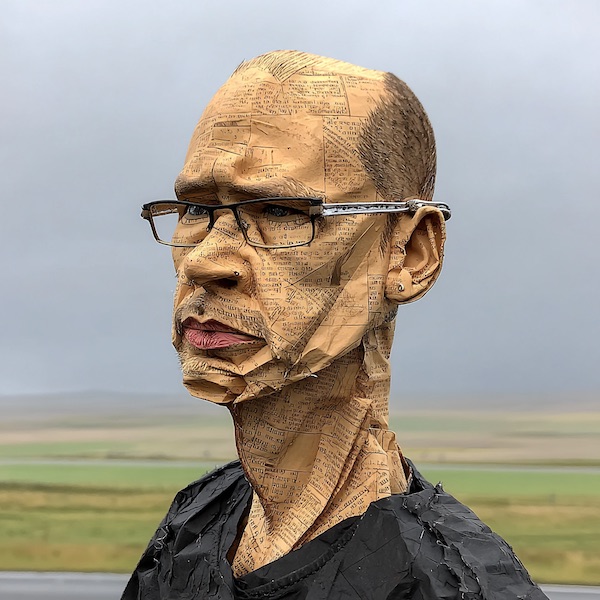
Addy Feuerstein: “Live Your Own Time, Child”

Pau Waelder  

Addy Feuerstein is a tech entrepreneur, designer, and AI artist. On the occasion of the launch of the “Artificial Nostalgia” artcast on Niio, we talked about his retro-futuristic universe, where he utilizes generative AI tools like Midjourney to recreate the elegant, optimistic machine aesthetics of the 1950s and 60s as a way to explore how the past envisioned our present. Throughout the conversation, Feuerstein reflects on his collaborative relationship with Midjourney in the creation of this series and addresses the contemporary skepticism surrounding AI art, sharing his insights on how modern artists must become multi-faceted curators of their own distribution channels while embracing the cultural shifts of our digital era.

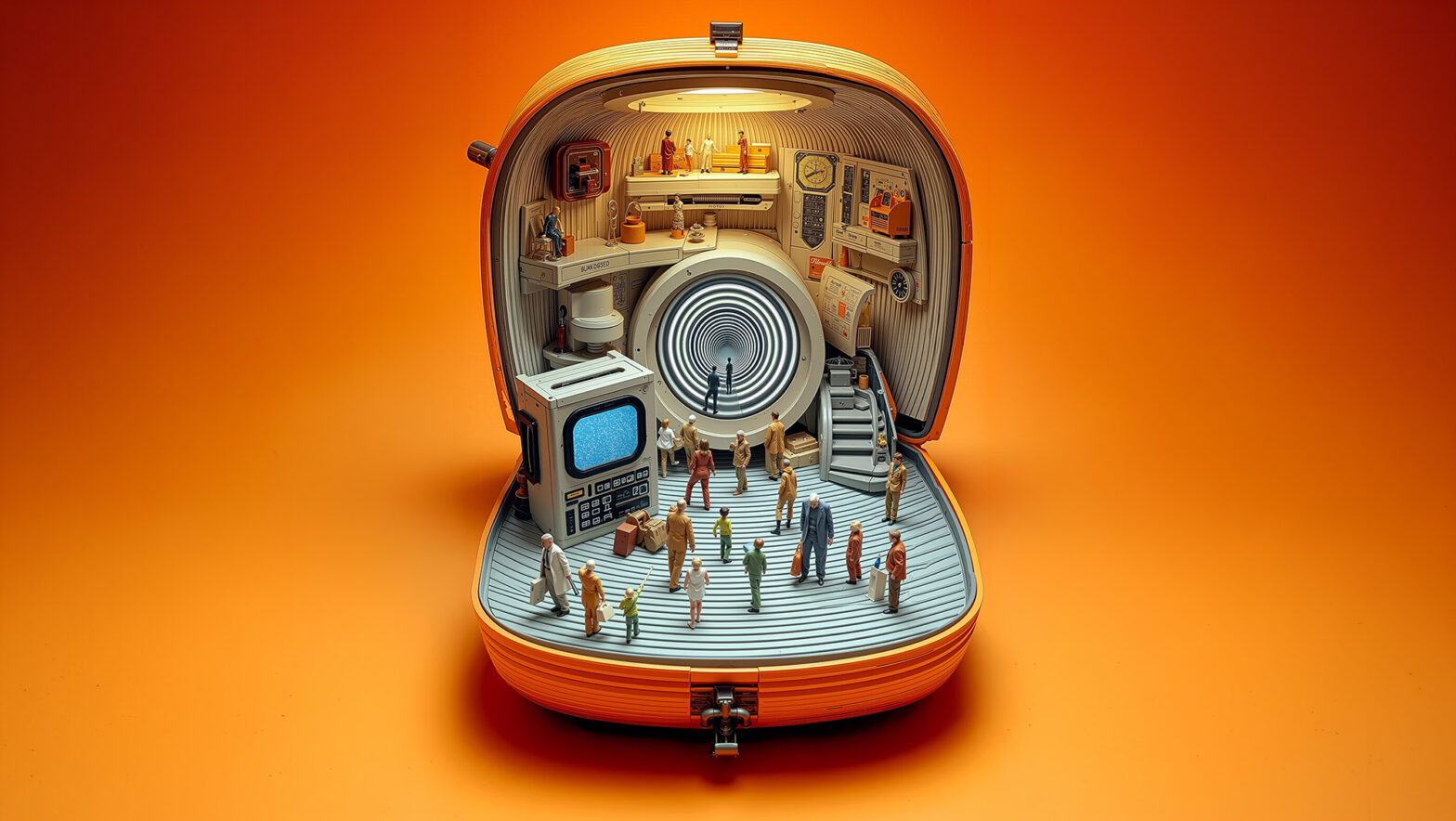
Addy Feuerstein. Artificial Nostalgia – Triptych #1, 2026

As a tech entrepreneur and designer, you have extensive experience in the tech and design industries. What drove you to develop an artistic persona, and how do you navigate the art world compared to the tech and design communities?

I never experienced these worlds as separate. I studied art and design, and although after school I was immediately drawn to tech, it was always there in the background, so in a way I feel like I’m coming full circle now.

The same topics that I explore in my art, such as time, the relationship between people and technology, and the sense of an individual within a crowd, were always present in my entrepreneurial career, mainly in my first startup, AllofMe, which explored personal memory through digital timeline representations. For example, you could explore your life in parallel with a historical technology timeline and examine how you were affected by it.

The interesting aspect here is that AI artists are very much tech entrepreneurs themselves. The development of the tools is happening so fast that you must be very tech-oriented to keep up. So, it actually feels very familiar to tech.

For me personally, generative AI is particularly rewarding. I was always a very visually oriented person. My dream was to become an architect, but unfortunately, I can’t draw very well. AI allows me to “paint with my mind” and create visuals that were not possible for me before, so it feels like I was suddenly awarded a new limb. It’s like a dream come true, and in a way, I feel like I have been waiting for it my whole life.

“AI artists are tech entrepreneurs themselves. AI is evolving so fast that you must be very tech-oriented to keep up.”

Artists often describe their relationship with AI tools as a “collaboration,” in which the AI system has a certain agency that can shape the outcome beyond the artist’s imagination. In this sense, how is your relationship with the tools that you use? How do you balance the willingness to control the outcome and the openness to be surprised by it?

Oh, it’s definitely a collaboration, and possibly even more. When I first exhibited the Artificial Nostalgia series at Reichman University, I gave the AI full credit. The sign next to the work read: “By Addy Feuerstein and Midjourney”.

When I work with AI, I sometimes intentionally try to confuse it using contradictory prompts mixed with poetic phrases, just to see where it takes me. Those are often the moments when I get the most surprising results. Then I take the variations that resonate with me and regenerate them again and again, gradually narrowing toward a direction that feels right.

In a way, I feel like my process mirrors the AI’s ‘diffusion’ process itself: the AI extracts an image out of noise, and I extract meaning and direction out of the AI’s noise. We are both reducing randomness, just at different levels. A single image can sometimes go through more than 100 variations before I feel like we finally “got it right”.

Addy Feuerstein. Artificial Nostalgia – The Mix, 2026

The artist Gregory Chatonsky has coined the term “Artificial Imagination (AIm)” to describe the idea that in the context of AI, an image is not a trace of reality but one in many possibilities within a latent space, and therefore it is a type of imagination not grounded in real experience but in mathematical probability. What is your take on this concept, and how would you relate it to your work?

I didn’t know that term. This is a very interesting claim.

I think that AI is basically a gigantic vocabulary of everything that has happened so far. Generative AI is, in a way, a visual index of human history that was fed into it. So one could argue, however, that it is in fact based on “grounded real-life experiences,” which also raises another question: isn’t our own human imagination itself based on a kind of mathematical probability?

“A single image can sometimes go through more than 100 variations before I feel like we finally «got it right».”

For example, when we watch a really good movie that moves us emotionally, we often develop a sense of “false nostalgia” for the time and place it represents. Are those feelings based on “grounded real-life experiences,” or on the fictional movie we just saw? And what about books, paintings, or photography?

This is exactly the “big question” I was trying to explore in Artificial Nostalgia, and I don’t have the answer. Instead, I now have even more questions. But I might have some observations: I can say that AI does an amazing job of rendering false memories that emotionally move me, perhaps more than any other medium I know.

Addy Feuerstein. Artificial Nostalgia – Triptych #2, 2026

You have expressed your preference for Midjourney. Can you elaborate on it and on how the choice of tools can determine the path of an artistic project?

It’s true. While generative AI models have developed at an amazingly rapid pace, Midjourney still stands out as a tool that enables extremely strong visual interpretations. This is not an accident. It works differently from many of the other tools. It relies on large-scale human crowd rating of “what is beautiful,” and therefore it has a massive aesthetic bias. It is heavily optimized to prioritize lighting, composition, atmosphere, and artistic flair, and most of all, it enables users to build their own personal “style” and teach the model what they themselves find beautiful.

When I work with it, it feels like we’re collaborating. I suggest directions, and Midjourney reacts with dozens of variations. I choose what I like, and it takes it from there and creates additional variations. It often surprises me with visual ideas I hadn’t thought about myself. I love this process. It feels like a ping-pong game.

The bottom line is that before Midjourney, I wasn’t creating the kind of work that I do today, and I probably could not have done it with any other tool. It allows me to create images I could previously only imagine.

“When I work with Midjourney, it feels like we’re collaborating. It often surprises me with visual ideas I hadn’t thought about myself. I love this process. It feels like a ping-pong game.”

Artificial Nostalgia uses AI to imagine a retrofuturistic world. What fascinates you about the technology and aesthetics of the 1950s and early 1960s? Is it the perception of technology as something bright and full of promise, in contrast to the more somber and dystopian views that have dominated since the 1970s?

I never really lived through the 1950s, and I was an infant in the 1960s, so obviously this is, in itself, a kind of “artificial nostalgia.”

It seems to me, however, that after World War II, which was probably the great shaping and provoking event of modern history, the world entered an unbelievably creative and, more importantly, liberating period. You can see it in art, in industrial design, in cinema, and in the music of that era. People in that period imagined the future as elegant, domestic, and almost theatrical. Technology appeared to be something understandable and aspirational rather than invisible and overwhelming.

From a design perspective, it was the era of machinery that was clear and visible. Form followed function. Bauhaus, the International Style, and even Streamline Moderne. This aesthetic simply moves me.

Today, in a way, technology itself has become hidden. Hardware has become software, as much of the technology we use now is concealed inside computers and networks, so the design often becomes just an empty UX shell. A simulacrum. I wanted to explore that emotional contradiction in Artificial Nostalgia.

By recreating imagined past futures with contemporary AI tools, the project creates a layered time loop: people from the present generating images of how people in the past imagined our present.

Addy Feuerstein. Artificial Nostalgia – The Film Drive, 2026

This series features both still images and short animations. How would you compare them, in terms of their production, the narrative, and the viewer’s experience?

The original installation of Artificial Nostalgia is exhibited as a three-screen triptych that randomly cycles through over 360 images and runs endlessly. Currently, about 70 of them include motion.

I wanted to find a way to surprise the viewer with a very subtle, almost unnoticeable difference between the still images and the videos. When you look at the installation, sometimes you’re not sure whether the image you just saw had actually moved or not.

I use a “time remapping” effect to start the motion very slowly, accelerate it momentarily, and then gradually freeze the frame again. This effect is very engaging because viewers stand in front of the piece and try to “catch” the motion.

The funny thing is that since some of the visuals are presented both as still images and as videos, I myself sometimes don’t know whether a piece is going to move or not, and occasionally I’m not even sure whether it actually did.

“Artificial Nostalgia creates a layered time loop: people from the present generating images of how people in the past imagined our present.”

You have participated in Peter Gabriel’s 50:50, a project inviting creators to imagine music videos for his songs. How was your experience participating in this project? Besides this particular project, you frequently create music videos with your studio UrbanOrigami.art. Is AI creation, with its unlimited possibilities of image creation, its tendency to surrealism, and its ability to create seamless flows between images, particularly apt for music videos? How do you integrate each song’s lyrics and music into your creations?

I think that music is probably one of the genres in which the sense of false “Artificial Nostalgia” feels especially strong. I see my children listening today to The Beatles, Pink Floyd, and Neil Young. What does this mean? It seems to me that this world is full of nostalgia by definition, and that we are all constantly trying to reimagine the past.

Participating in Peter Gabriel’s 50:50 project was, first of all, a great honor, as he is one of my all-time favorite artists. It was particularly exciting because it enabled me to interpret his beautiful 1977 song ‘Here Comes the Flood’ from today’s perspective. If you read the lyrics and Gabriel’s own expansion of them, you could see that he almost predicted today’s internet flood of information, and in a way even the AI revolution, back in the 1970s. I find that amazing.

“I love creating music videos because they leave vast room for imagination and storytelling, which is perfect for generative AI.”

I love creating music videos because they are usually open to interpretation, so they leave vast room for imagination and storytelling, which is perfect for generative AI. Besides, I guess I envy musicians. I wish I could write music. It’s a very liberating art form with an immediate emotional reward. So, I guess this is the closest I can get to it.

Addy Feuerstein. Artificial Nostalgia – Triptych #3, 2026

You have exhibited your work in art galleries, museums, festivals, online marketplaces, streaming platforms such as Niio, and have even created merchandise. What can you tell us about the possibilities and challenges that artists face when distributing their work through these different spaces and channels?

Well, I think the main challenge for AI artists is overcoming people’s fear, or even hatred, toward generative AI. It has a very bad reputation, and I can understand why. Much of the AI imagery currently being created does not feel very original. Frankly, it is a world that is full of crap, especially given the huge amount of fake and cringe imagery out there. Because of this, many people automatically reject anything that carries an “AI” label. I see that often on my Instagram.

At the same time, there is a growing movement of artists who are seriously trying to understand this new medium, explore what it means, and discover what can be done with it artistically. I think we are still in the very early stages of that process.

“Artists are no longer just creating art. We are also constantly curating ourselves, promoting ourselves, building audiences, and adapting work to very different environments.”

Additionally, one of the most interesting shifts happening today is that distribution itself has become part of artistic practice. Artists are no longer just creating art. We are also constantly curating ourselves, promoting ourselves, building audiences, and adapting work to very different environments such as galleries, streaming platforms, social media, merchandise, and digital installations.

You mentioned festivals. In a way, I think FilmFreeway has done to the film festival industry something a little similar to what Airbnb did to the hosting industry. It lowered the barrier to entry so much that suddenly there are far more festivals than before. So it became very difficult to understand which ones are actually worth your time and money.

Each space changes the way the work is experienced. A gallery invites contemplation, while Instagram encourages speed and endless scrolling. A museum creates context, while merchandise turns an artwork into an object people can physically live with. Navigating between all these worlds has become part of the creative process itself, and it is very much a full-time job.

Addy Feuerstein. Artificial Nostalgia – The Jellyfish Triptych, 2026

Nowadays even the Pope warns us about the dangers of AI. Do you think that artistic creation with AI tools can provide a more positive perception of artificial intelligence or help us understand it better, both with its bright and dark sides?

When I first wrote about Artificial Nostalgia, my first question was: “If you had a time machine, would you travel to the past or to the future?” I got surprisingly mixed answers, but for me, I’m pretty sure I would choose the future. I never feared technology, and I have always embraced it with excitement and curiosity.

So, to answer the question, I never fully understood the fear surrounding AI. I think that part of the artist’s “job” is to try to understand and express the world they are living in, and we are currently living in an AI world.

One of my favorite movies is Todd Haynes’s ‘I’m Not There’, the fictionalized Bob Dylan biography. I always remembered one quote from it, when the kid who plays the supposedly young Dylan, while performing old country music, is told by an elderly woman: “Live your own time, child.” I love that quote, and I try to live by it. The Times They Are A-Changin’, and we are all living in an AI world now. So, live your own time, child.

“The artist’s «job» is to try to understand and express the world they are living in, and we are currently living in an AI world.”
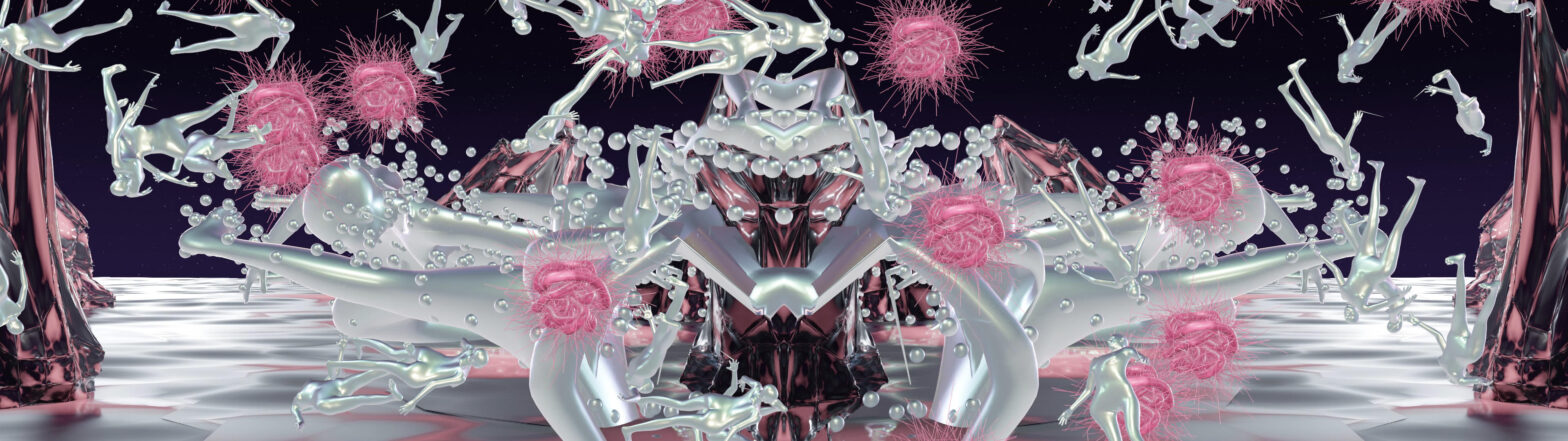
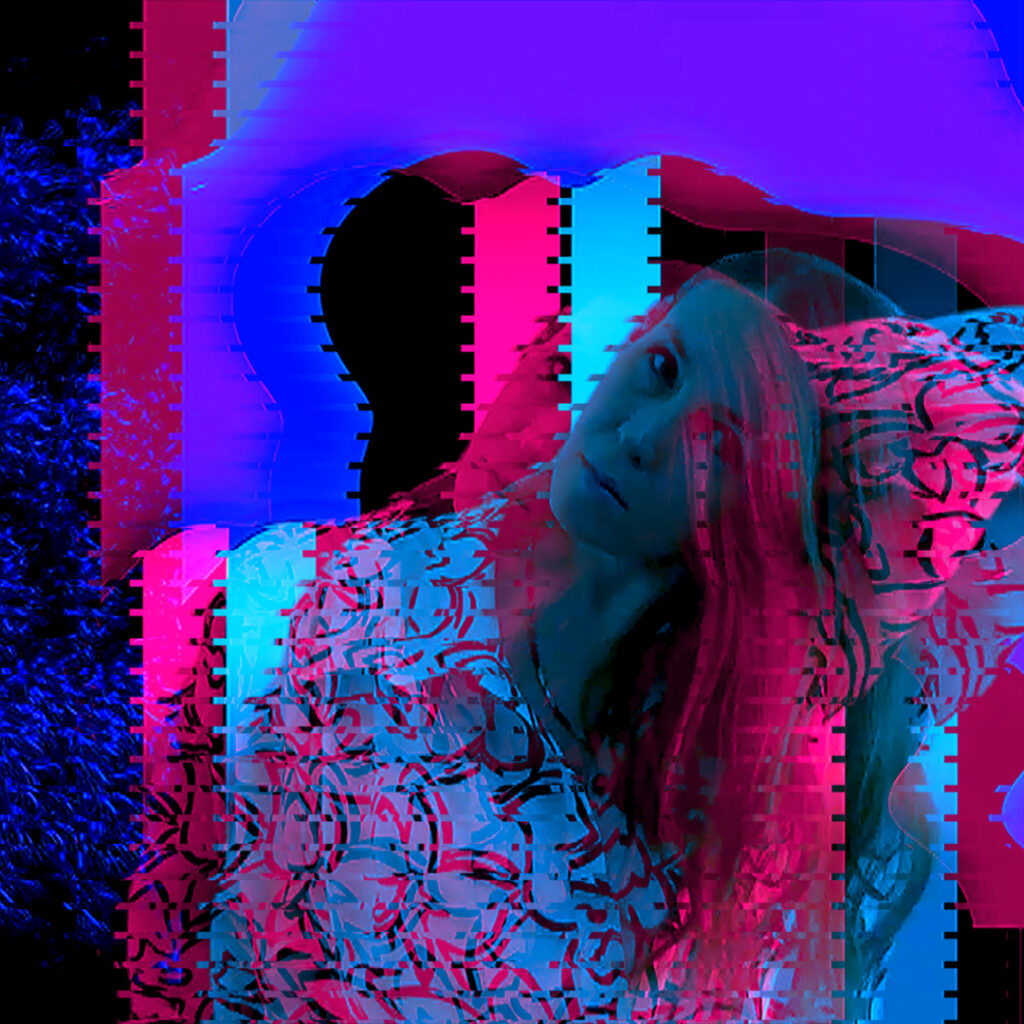
Dagmar Schürrer: spaces of augmented consciousness

By Roxanne Vardi

Dagmar Schürrer is a digital artist who lives and works in Berlin. Schürrer works with the moving image assembling found footage, digitally generated animations and objects, sound, text and drawing to create video works and AR works that explore human consciousness and perception, late capitalist paranoia, projected utopian futures, and our relationship with technological developments in the digital space.

In the following interview Dagmar Schürrer provides us an intricate account and look into her goals as an artist working with advanced technological tools to question technological progress and to understand its effects. This interview is published in conjunction with the curated artcast Dagmar Schürrer: Parallel Realities.

Many of your artworks deal with human consciousness and the complex processes of the human brain. When did you start to become interested in this subject, and what is it about the digital medium that helps in the exploration of this subject matter?

I have always been interested in the natural sciences, in particular physics and biology, the latter I even studied for a few years before my Fine Art degree. To understand how natural interrelations in our complex ecosystem work, you learn to search for recurring patterns and similarities that connect all organisms including humans and other natural phenomena. The importance of even the smallest part for the overall system functioning is basic knowledge in this field. During my Fine Art degree at Central Saint Martin ́s College of Art and Design in London, I was focusing very quickly on working with time-based media, in particular interweaving found footage with abstract moving images and soon also theoretical text fragments. In removing figurative imagery from its specific context, I was aiming to extract general patterns and through juxtaposing the imagery with abstract content, an associative space opened, where unexpected similarities were established. The addition of text fragments set a theoretical framework, in which the viewer is guided through her/his interpretations. In fact, an examination and reflection of a theoretical essay and its expression in poetic language is still the starting point of my works today.

In the following years my moving images became less film-like but more and more digital and three-dimensional. My focus shifted from the experimental filmic image and its narrativity to digital tools, new technologies and spatial installations. The impact of digitalization and new technologies on both society and the individual are at the center of my artistic practice, always through the lens of the emotional and reflective individual.

My approach is to create meditative, almost personal spaces of contemplation. The aim is to allow the viewer to ponder the manifold challenges of a digitalized society on a theoretical, visual, and emotional level. I combine theory in a poetic guise – often as voice overs – with a painterly digital composition that merges figurative imagery with abstract patterns. I constantly alter and modify these forms along the border of abstract and figurative, organic and synthetic, and emotional and material, which hopefully leads to an ambiguous tension in the digital works, suggesting the presence of multiple dimensions beyond physically experienceable and comprehensible objectivity.

“My approach is to creative meditative, almost personal spaces of contemplation. The aim is to allow the view to ponder the manifold challenges of a digitalized society on a theoretical, visual, and emotional level.”

Dagmar Schürrer, We are already history, and we don’t know it, 2021.

Digitalization and new technologies are created by and are of course closely entangled with humans. I am fascinated by the change of human self-perception parallel to the increase of knowledge, scientific progress, and the advancement of new technologies. These developments seep into society and directly influence our interpretation of what it means to be human and how we live in this world, and at the same time feed back into technological, scientific, and artistic research. For me this is directly connected to human consciousness and the functioning of the brain. The brain has often been described by technological metaphors. In the past the brain was seen as a centralized machine that works from the top to down and controls all movement and behavior. In the digital age it resembles a computer running its programs. And with the rise of artificial intelligence, we will get another step closer to a better understanding of how the human brain functions and new metaphors will emerge. These metaphors also have a great impact on how we see the human in relation to society, the environment and even concepts like time and space.

While researching into the interrelation of consciousness and technological developments, I was studying the work of French philosopher Catherine Malabou, in particular her essay “What should we do with our brain?”. In it she discloses how contemporary metaphors used to describe the brain in neuroscience closely mirror the language used for technology, and as it is even the political and societal structures of a neo-liberal capitalist world: decentralization, networks, flexibility, fluidity, simulation, etc. She argues in favor of using the term “plasticity” – the lifelong ability of the brain to develop, to influence the environment around it and to be formed by constant inputs – which allows for active involvement and exchange. The brain became the central subject of my media installation We are already history, and we don’t know it. Within three animations and an augmented reality (AR) application a voice over contemplates the analogies between the organ and contemporary technologies, juxtaposed with computer generated imagery reminiscent of cell structures, neuronal tissue, or electric wiring. The virtual additions of the AR app connect the animations and invite the user for a spatial exploration of the installation.

In Dreaming is the mind left to itself I deal with similarities between different states of consciousness – the waking reality, the digital realm, the dream world, drug induced conditions, spiritual meditations – and our feeling of individual presence in them. Each of them having their purpose and allowing humans to access different constructions of reality. In particular the role of dreaming has fascinated artists and researchers for a long time. The neuroscientific theory “The Overfitted Brain Hypothesis” (OBH) compares dreaming to a certain aspect of Artificial Intelligence (AI). For AI to deliver meaningful results it needs to be fed with a sufficiently variable dataset. To increase variations, it can be interspersed with noise and glitches. OBH draws parallels to the purpose of dreaming and argues that it works as a similar noise injection, so our brain can cope with the many self-repeating patterns during waking world. The AR video installation “Dreaming is the mind left to itself” leads the visitor through abstract dreamscapes and digital environments, focused through a vignette reminiscent of Virtual Reality glasses. The imagery becomes more and more enmeshed, suggesting the dissolution of the parallel realities.

Dagmar Schürrer, Dreaming is the mind left to itself, 2022.

“I am fascinated by the change of human self-perception parallel to the increase of knowledge, scientific progress, and the advancement of new technologies.”

Can you dive a bit deeper into your interest in Augmented Reality as a critical tool to question the future, specifically in terms of technological advancements?

Augmented Reality (AR) is the first visual tool, with which you can truly merge the digital and analogue space and blur their borders. I am excited about the possibility that my computer-generated environments can literally leave the screen and mingle in our daily environment – the analogue realm. AR allows new forms of presentation of art outside the white cube. It is easy to access AR works at places like home or in public space, as many people have a compatible smartphone or tablet. Quite a lot of the pioneering AR works were created in an activist spirit – logo hacking or museum hijacking – as you can communicate on an invisible meta layer, which you need to know how to activate. In the future AR-glasses will gain importance, at the moment they are still very expensive and also slightly restrictive in their visual quality. The glasses will increase the immersive experience and digital content could seamlessly blend into every day’s life. The more the technology advances the more it will be integrated in our routines and have an impact on many aspects of society. Therefore it is important that artists explore new technologies, and don’t just leave them to commercial corporations and big tech. We can learn about the impact of these tools when we create with them, use them, and reflect about them without commercial objectives. This allows both creators and viewers to train their media competence and technologic languages to develop the skills to critically question technological progress and understand the effects. In an ideal world an aware society could implement ethical and responsible use of these technologies.

In some sense, do you fear that technology will outsmart the human brain? That the post-digital age is not only a mirror of society but a warning sign to what is to come?

Maybe I can’t think that far ahead, but I am not really concerned that technology will outsmart us. What is more worrying is the distribution of power and access among humans. Who can use technology for what, and how can we regulate that without cutting individual and creative freedom. The programming of technology is done by humans, including both positive and negative perceptions. Of course, technological tools are somewhat addictive, and it is easy to get lost with and in them, which obfuscates their far-reaching effects on many meta levels. Media education is really important to be able to navigate through this complex and subtle process of development.

Pierre Levy, author of Becoming Virtual, Reality in the Digital Age, argues that the Virtual is not the destruction of the personal but in fact a transformation, thus it will not replace the Real, the Possible, and the Actual. Do you agree with Levy’s proposition? How do you see the Virtual differentiating from the Possible in line with Pierre Levy’s belief?

The ideas elaborated in “Becoming Virtual, Reality in the Digital Age” were the starting point for my AR Video installation “Virtualized”. Levy proposes that one should not think about the Virtual as the supplement or even the opposite of the Analogue, but rather its continuation, and proposes to overcome a dualistic way of perception. He circumvents this problem by introducing four modes-of-being: Reality, Possibility, Actuality, and Virtuality, as well as the various transformations between them. This allows us to see the Virtual not as imaginary or illusory, but as a full-fledged state of existence beyond the immediate physical presence. One could say that the Real and Potential contain manifest things, while the Virtual and Actual can be rather seen as dynamic events, or “a continuously reviewed problem rather than a stable solution”. Reality implies a material embodiment, a tangible presence. The Possible is the same as Reality, only missing physical existence. The Virtual on the other hand is detached from the here and now, cannot be precisely located, is nomadic and dispersed and has no stable point of reference. As Levy puts it, “virtualization comes as a shock to traditional narrative”.

“Becoming Virtual, Reality in the Digital Age” was written already in 1998, so I think it is quite visionary to label the different digitized states-of-being as separate entities with their own parameters and characteristics. In my work Virtualized I was trying to translate these rather complex theories into an audiovisual manifestation. The two thoughts I was mainly focusing on were on the one hand dispersion and fragmentation, fitting well with my method of establishing patterns and similarities by creating an associative narrative and visual space, and on the other hand the question of physical materiality. Only one of the four modes-of-being is manifested in the physical, what does that mean for the importance of physical presence and, what is non-physical materiality? How can materiality and the idea of haptics be communicated in the digital?

Your work, GALAXY, presents to its viewers a story about an encounter of love and disappointment told and generated by an algorithm. Could you elaborate on the creative process here and what rules are given to the software to generate this narrative?

GALAXY is in a way quite different to my other works of the last few years, as the text is not written solely by me and the analysis of narrativity takes a central role again. It is a nice bridge to my earlier works in experimental film. The story is created with a fairly straightforward text writing algorithm. You feed the generator the essential parameters: some key words you want to include, what kind of genre you aim for, the overall mood of the story, if it should have a bad or happy ending, etc. The result is a simple and not very sophisticated short story. The exciting thing was, that it was quite a “bad” generator, the algorithm was not very successful in simulating a meaningful structure of sentences. It showed weird deviations in the language and the narrative logic, and it fabricated great obscure sentences like: “They looked at each other with quiet feelings, like two shy snakes stroking at a very gentle stream, which had electro music playing in the background and two noble uncles swiping to the beat.” For me the glitches and imperfect simulation were certainly the strength of the generator. As soon as the illusion is perfect, it becomes pretty boring.

Quantum Memories, the spectacular power of AI art

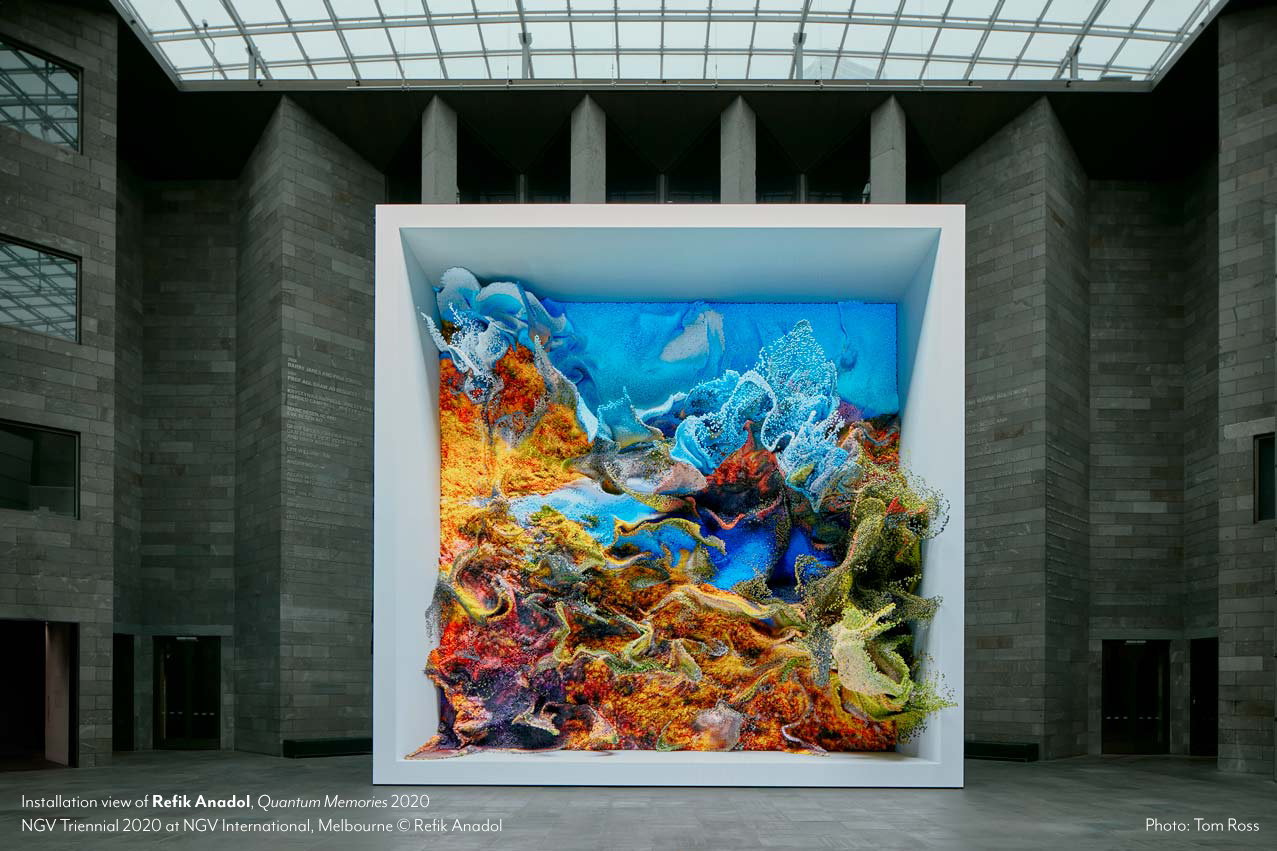
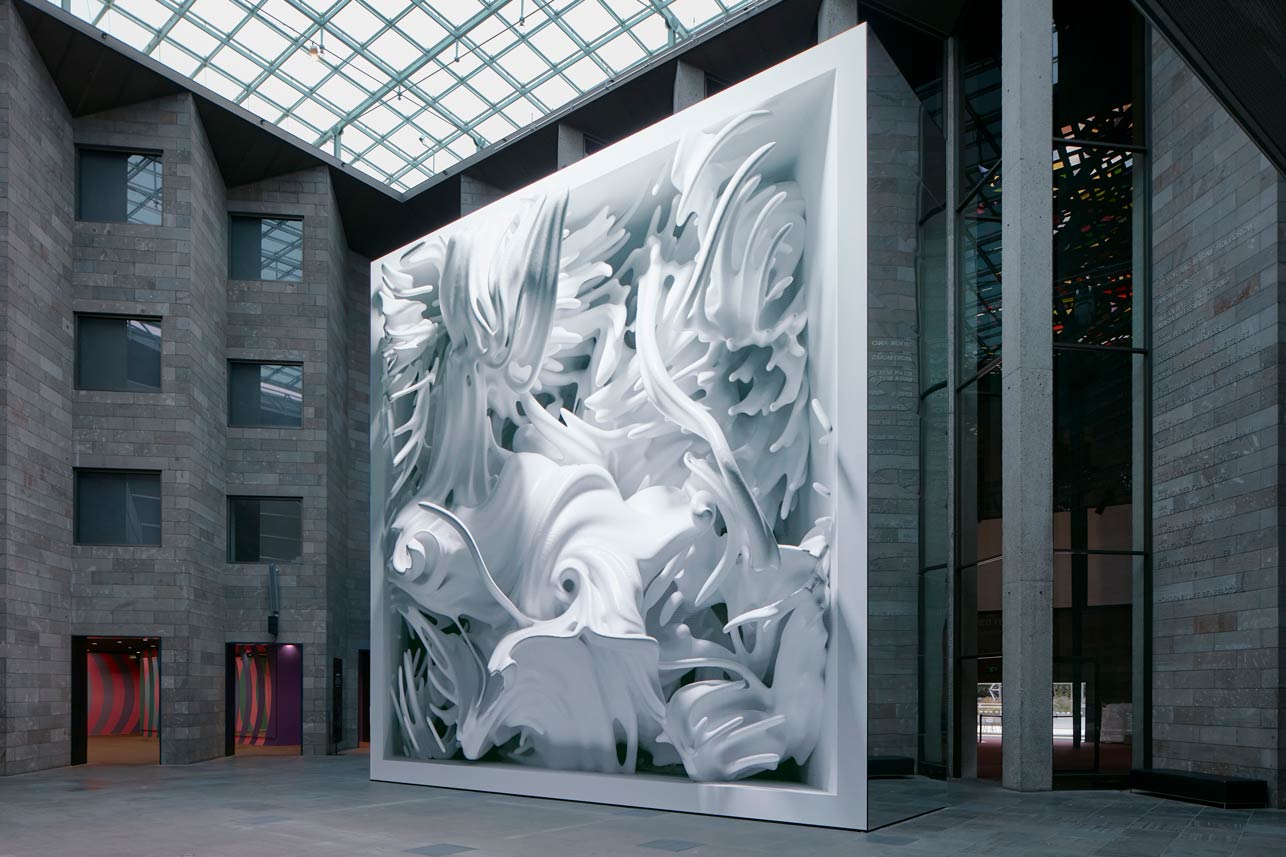
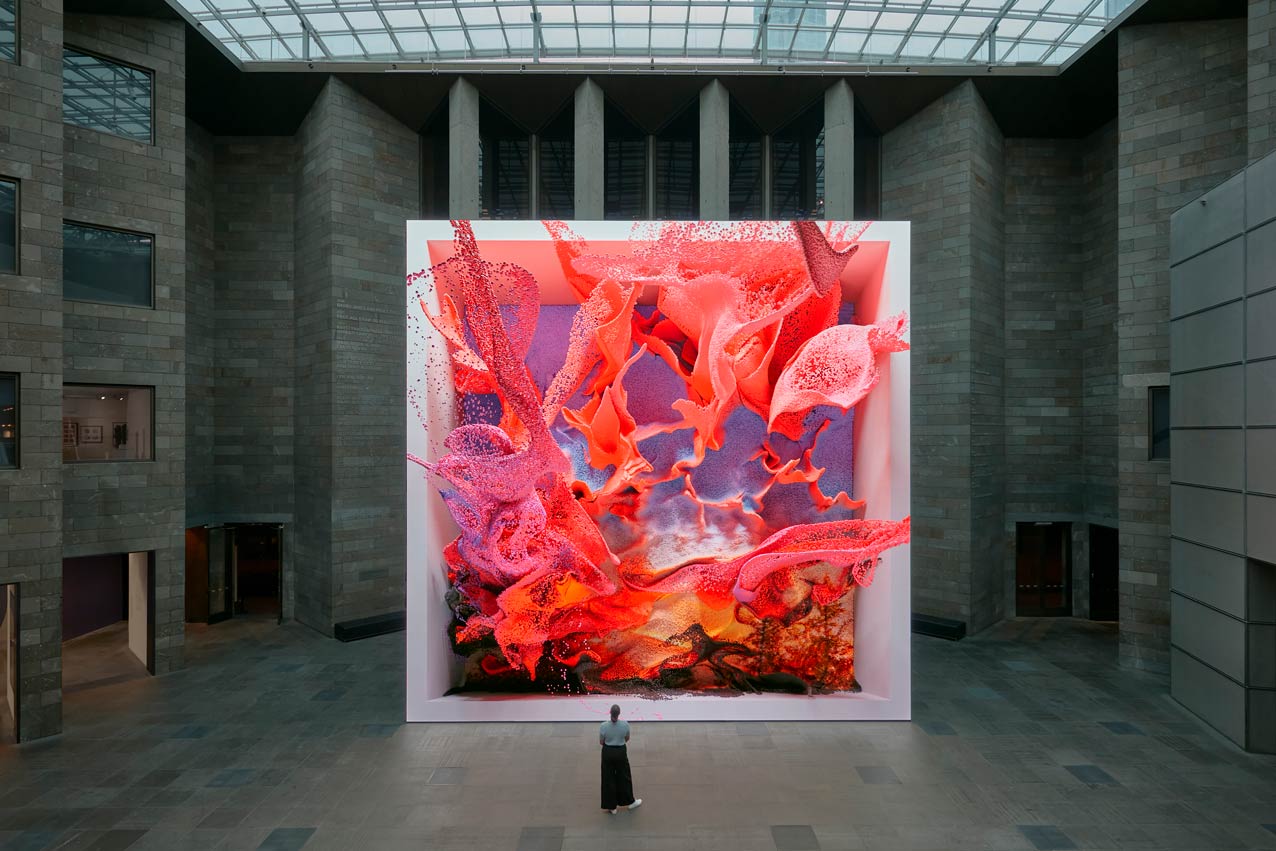
Quantum Memories is Refik Anadol’s most technically and conceptually ambitious work to date. Commissioned by the National Gallery of Victoria, the work explores the opportunities presented by artificial intelligence, machine learning and quantum computing to visualise an everchanging large-scale immersive multimedia artwork.

Installation view of Refik Anadol Quantum Memories 
On display in NGV Triennial 2020 from 19 December 2020–18 April 2021 
At NGV International, Melbourne
© Refik Anadol Photo: Tom Ross

New media artist Refik Anadol has created a body of work that locates creativity at the intersection of humans and machines. His site-specific parametric data sculptures, live audio/visual performances and immersive installations take many forms, while encouraging us to rethink our engagement with the physical world, its temporal and spatial dimensions, and the creative potential of the machine.


In Quantum Memories 2020 Anadol is harnessing a dataset drawn from over two hundred million images linked to nature from publicly available internet resources and processed using quantum computing with machine learning algorithms. Anadol’s work uses the data to speculate an alternate dimension of the natural world as a complex cultural entity with memory.

Installation view of Refik Anadol Quantum Memories 
On display in NGV Triennial 2020 from 19 December 2020–18 April 2021 
At NGV International, Melbourne
© Refik Anadol Photo: Tom Ross

The first true quantum artwork created, Anadol’s arresting visuals and accompanying audio are composed in collaboration with a generative algorithm enabled by AI. In taking the data that flows around us as his primary material and the neural network of a quantum mind as his collaborator, Anadol paints with a thinking brush offering us radical visualisations of our digitised memories of the natural realm.
By representing the complexity of our collective memory in the largest digital artwork staged by the NGV, the artist encourages us to imagine the beginning of a quantum computerised mind and its immense potential for the future of art and design.

Refik Anadol Quantum Memories on display in NGV Triennial 2020 from 19 December 2020 – 18 April 2021 at NGV International, Melbourne.