Matteo Zamagni: interrelations: nature/technology

Roxanne Vardi

Matteo Zamagni is a multi-disciplinary artist who works across the visual arts, electronic music, multimedia installations, and film production. Using analytical geoscientific tools, VR/AR/MR, real-time generative imaging, photogrammetry, and CGI techniques Zamagni explores the complexities of the different crises that define our contemporary age and society. Zamagni’s artistic production is characterized by the exposure of the interrelations between nature and technology through machine-driven visual artworks.

Matteo Zamagni is represented by Gazelli Art House, and has exhibited works at international exhibitions and festivals such as the Barbican Centre, V&A Digital Futures, and Torino Film Festival. In conjunction with the release of Matteo Zamagni’s artcast on Niio titled Experiences of Synchrony we spoke with him about his artistic practice, and his work on the project titled “Unison” for Paraadiso, the new audiovisual collaborative project from producer TSVI, and visual artist and producer Seven Orbits. The audio-visual artworks included in this artcast induce altered states by presenting works which are played out as hypnotic journeys of sound and visuals.

Many of your video works include a sound element as a fundamental focal point. Could you please elaborate on your ongoing exploration of combining the visual and the auditory?

Music has always been a driving force for my works since a very early stage; over the years I have been working with many musicians and producers collaborating on music videos, short films, live visuals and installations, and more recently after delving into music production myself I began exploring real-time audio-visual experiences through the following projects ‘seven orbits’ and ‘Paraadiso’ which were released on Shanghai-based record label SVBKVLT. Through these projects I wanted to develop a tool that seamlessly connected Film, CGI and Audio into a real-time, audio-reactive and interactive environment, where logic systems connect and bridge communication between multiple softwares, informing one another. The project Paraadiso, created in collaboration with TSVI marks the first goal towards the realization of such a tool. This system is autonomous yet can function alongside user input, in this sense, it combines light and sound together using an ecosystem of softwares that enables seamless communication and interaction between the 3D/2D environment and the soundscapes. This approach opens up a sea of possibilities in the creation of real-time video and 3D-based content fully synchronized and triggered via sound, resulting in highly dynamic, ever-changing works. Moreover I can see a lot of potential in creating highly stimulating works which could lead the viewer into deeper states of consciousness.

In the near future, I’m hoping to expand this body of work into a 1-hour long CGI film combining my music production as seven orbits together with CGI shots created inside a game engine.

Matteo Zamagni, Unison – 02, 2022.

As the title suggests, your audiovisual collaborative project Unison, aims to create a communal energy as a collective physical experience. What is it that you would like your viewers to gain from this experience?

While we were making the album we were fascinated by how the combination of light and sound in a space would influence the people inside of it; heightening the senses and sometimes, given the right circumstances, conveying a sense of relatedness and care for one another. Human interaction is profoundly social, our everyday life does not take place in isolation but constantly requires our engagement with other people. This feeling of relatedness, reciprocal care and collectivity, is rare and not normally experienced on a day-to day basis especially among strangers and in big cities; The Project Unison references sacred functions and rituals by indigenous populations globally. In ceremonies, it is common to find elements of sound, light, dance and singing which would sometimes throw people into a heightened state of consciousness, sometimes even transcendental. There’s also a strong sense of community and interrelatedness felt within those groups, not only between humans but across the living kingdom, including other animals, plants, biomes and the cosmos.

Many of your artworks are created through a combination of different imaging tools and techniques such as AR, generative imaging, CGI techniques, analytical geoscientific tools and many more? Could you walk us through this complex working process of bringing these elements together into one final piece?

Since I have been quite fluid from an early age I naturally developed a diverse toolset which I reflected in my approach to navigating my diverse interests. Working with technology has deepened my knowledge and skillset by granting me access to accessible tools and resources that could be applied to a wide range of outputs spanning across augmented, virtual and mixed reality to projection mapping, live visuals, virtual production, Interactive Installations, and traditional screen-based work. The creation of a work in my case, is usually aided, informed and mediated by technology; As initial ideas start to materialize they morph and shift based on the environment they’re being developed in.

Matteo Zamagni, Unison – 06, 2022.

You have stated that you would like your works to contribute meaningfully to the broader field of environmental activism. In your opinion, what is it about the use of digital tools that can assist us in critically exploring complex planetary issues?

I am incredibly fascinated by the crossover of tools from computer graphics with forensic investigation or geoscientific surveys. Nowadays thanks to the accessibility of software for physics simulations of fluids, sounds, rigid bodies coupled with photogrammetry 3D reconstructions, and publicly available databases online the tools that are commonly used in a VFX pipeline can be ported into a forensic investigative studio. To critically and methodically reconstruct events of various types: from climate-related disasters to cases of social injustice. Inversely you could use geoscientific tools normally used in scientific surveys as a base to develop creative ideas.

Further along this line lies the combination of the ever-increasing power of GPUs (hardware initially designed for CGI) coupled with AI and machine learning, bringing unimaginable leaps forwards in virtually every existing industry but especially crucial in tackling the ecological crisis. What  used to take years to simulate now takes minutes.

Matteo Zamagni, Unison – 01, 2022.

Many of the sound elements in your works resemble alterations of microscopic sounds which would be heard out in nature such as a caterpillar cracking out of its cocoon. How are these sounds accumulated?

It’s funny that you mention this, it probably came out completely unconsciously. This reminds me of foley recording, a technique used in cinema to recreate the sound of things as well as SFX by recording the sounds of seemingly unrelated objects which allude to the original sound. I can see some similarities between foley and the creation of sounds in our album; Even though we mostly created the sounds digitally rather than physically. Our sample library consists of various techniques spanning digital synthesizers, granular synthesis, and distorted samples.
Andreas Nicolas Fischer’s Ambient Art

Roxanne Vardi

Andreas Nicolas Fischer is a multidisciplinary artist from Berlin. Fischer started his artistic career as a traditional artist working mainly with painting and drawing, but became interested in generative art upon his visit to artist Casey ReasProcess/Drawing exhibition in 2005 at DAM Gallery in Berlin. 

At the time he discovered Reas’ work, Fischer was interning at ART+COM, founded by Joachim Sauter, who also later became a professor at the Berlin University of the Arts. Fischer learnt Processing from the very first people who worked on the creative coding environment conceived and developed by Casey Reas and Ben Fry in 2001. While he did not have a background in computing, Fischer was motivated to teach himself code and started creating animations with Processing. He also worked briefly with fabrication and sculpture to adapt to the demands of the market at a time when the interest in digital art was not yet mainstream. However, he considers himself a purist and likes to create systems that operate autonomously, something that he can achieve by working with generative algorithms. 

In the following interview, that took place on the occasion of the artist’s solo artcast The Art of Hypnosis on Niio, Andreas Nicolas Fischer unfolds the motivations and techniques behind his work.

How would you describe your art practice today?

My practice is mostly generative pure abstraction. I do some narrative 3D animation philosophizing about the end of the world, but my main focus is generative systems and aesthetics and abstractions; developing these systems over time and translating them into different means. My personal preference is to create art that is self-contained, and doesn’t take data from the outside. I used to work as an art director to make a living, making 3D animation as this was a bigger market, but I didn’t want to be part of that career where artists need to receive grants. I always wanted to have a hard skill, with a foot in the industry, but I like my work to be more dynamic where I learn something and then apply it. This is what I did for ten years, but then I started to receive commissions, until at some point my art practice and commercial practice merged. Today I don’t work for agencies and I don’t work as a freelance artist. I do my own work. My main focus is generative systems and aesthetics and abstractions, developing these systems over time and translating them into different means.

My main focus is generative systems and aesthetics and abstractions, developing these systems over time and translating them into different means

Andreas Nicolas Fischer, Nethervoid 07 L 2180, 2022

You have described some of your latest works as ‘Ambient Art’. Could you please elaborate on this concept?

I have been doing more real-time work in the past few years, I like to call it ambient art, it’s not narrative and it’s not super intrusive. You don’t need to pay attention to the work all day, but it’s a small intricate development with its own pace. I really like when you get drawn into the work. In this way I like to see my work as hypnosis, I hypnotize people through the work in a sense. I do this for myself, because I like the process of viewing my own work, but I have also observed that in my audience, some people tell me that they get lost in the work. And that’s what I like, changing people’s state, changing their psychological state. We all have a perceptual system, but you can influence that. I like changing someone’s state of mind with my art overtime. It’s an introspective process, there are no demands, it’s more subtle. In a sense I am not saying anything. I make my work for myself but also for other people.

Many of your latest series such as Nethervoid and Infinite Void also contain a sound element that feels crucial to the works. Is this another way for you to influence your audience’s perceptual system?

There are sound frequencies that you can use to influence one’s perceptual state, which I started looking into. I create some of the sounds with other artists, while others I find and modify myself using generative code. Composers hear so much more than we do, that’s the beauty, to be able to collaborate with sound designers because it enriches the artwork and we learn from each other.

On one of my works, I worked with a friend of mine, David Kamp, a composer and sound designer. I had sent him a rough cut for this work and I literally almost cried when I got it back from him. There are not many things that move me, but when I got that [sound design] back it was very powerful, it was so subtle. It was like listening to 70’s progressive rock on a good sound system, there is just so much there. 

Andreas Nicolas Fischer, Feeder-01-2160p, 2022

I like changing someone’s state of mind with my art overtime. It’s an introspective process, there are no demands, it’s more subtle.

Can you tell us more about your involvement with creating video sound installations which make the work immersive and create a dialogue with an environment such as The Origin of Quantum Dot, established in collaboration with Samsung?

That was a unique and special project. I co art directed it and created the content for those screens, but the sculpture was made by Christopher M. Bauder and Schnelle Bunte Bilder, a studio of visual art in Berlin. But this is not something that you can do every day.

In 2021 we were commissioned to create an installation in Washington DC.  It was such a powerful experience as the end result resembled an animated James Turrell, playing with light, where the sensation of the room completely changed according to the light.

What is it that draws you into creating digital art or software-born art created with code?

What I like a lot about the process is creating something from nothing, just from text and code. Of course the whole programming environment and the libraries were created by someone so it’s not nothing-nothing, but what I like is that you have something that is a pure instruction and you can create something new from it that has so much depth and richness . This  is so powerful. I love 3D animation and coloring and shading, but 3D animation is an insane amount of work. What I like about software is the leverage that you have, making systems autonomously while you are running the code, it’s also a flexible medium. With AI and generative systems you have a lot of leverage and you can control these machines to do something, I appreciate that on a conceptual level.

You start with pure instruction and you can create something new from it that has so much depth and richness. This is so powerful!

When you use found data in your generative artworks, how important is it for you that people know the origin of the source material? 

It depends, in the past I would use found images to create some of my works, but now I generate my own procedural compositions. I like both but I am not interested in where it came from, and visually it’s far enough removed from the original image that I don’t feel guilty about it. The machines give you power to create some things that you cannot create by hand.

Andreas Nicolas Fischer, Infinite Void 13A L 2098, 2022

You have also experimented with AI. What is your take on working with generative adversarial networks?

I had a brief and romantic relationship with AI. People talk about the end times of machines and the domination of AI. There are reasons to be concerned about that. I received a few DALL·E invites which I intentionally gave out to people who are not versed visually, but what I found is that if you don’t have good taste or that trained eye, what you produce with the AI is not going to be that interesting. This is what I concluded from my sample experiment. These tools on the one hand are very helpful for certain things, but also very biased because as soon as you get specific about things, what it hasn’t seen, then it gets harder. In the beginning when I got it I was completely sucked in, I sat there for a couple of days and hit the ‘dopamine button’. 

As an artist everything you do is a dopamine loop, that warm fuzzy feeling is something I am trying to reproduce. But the thing is once you have an image prompting machine to create things that are visually pleasing, things one can do without a huge effort, your receptors shut down, and the satisfaction is that you don’t feel good or accomplished with yourself. It’s like TikTok, after half an hour of scrolling if I would ask you what you remember about it, it wouldn’t be very much. I see AI going where you can turn yourself and other people into dopamine junkies, it’s visual stimulation on steroids. The thing with all of technology is that it’s only going to get stronger, sowe need to find a way to deal with it.’. Today I mostly use AI tools to up-res all of my older videos by adding more detail to them. To me, this is the beauty about it, to increase the fidelity of the content.

I see AI going where you can turn yourself and other people into dopamine junkies, it’s visual stimulation on steroids.

Can you dive deeper into your use of the term ‘void’ in describing or naming your works?

Using the term void is intentional, coming back to wanting to hypnotize or affect people’s mental state through the works. The void is more of a meditative void, a mental void. Of course it’s visually very full, but for me meditation is hard, I don’t have a solid practice but sometimes my work can help me with it by producing that mental void.

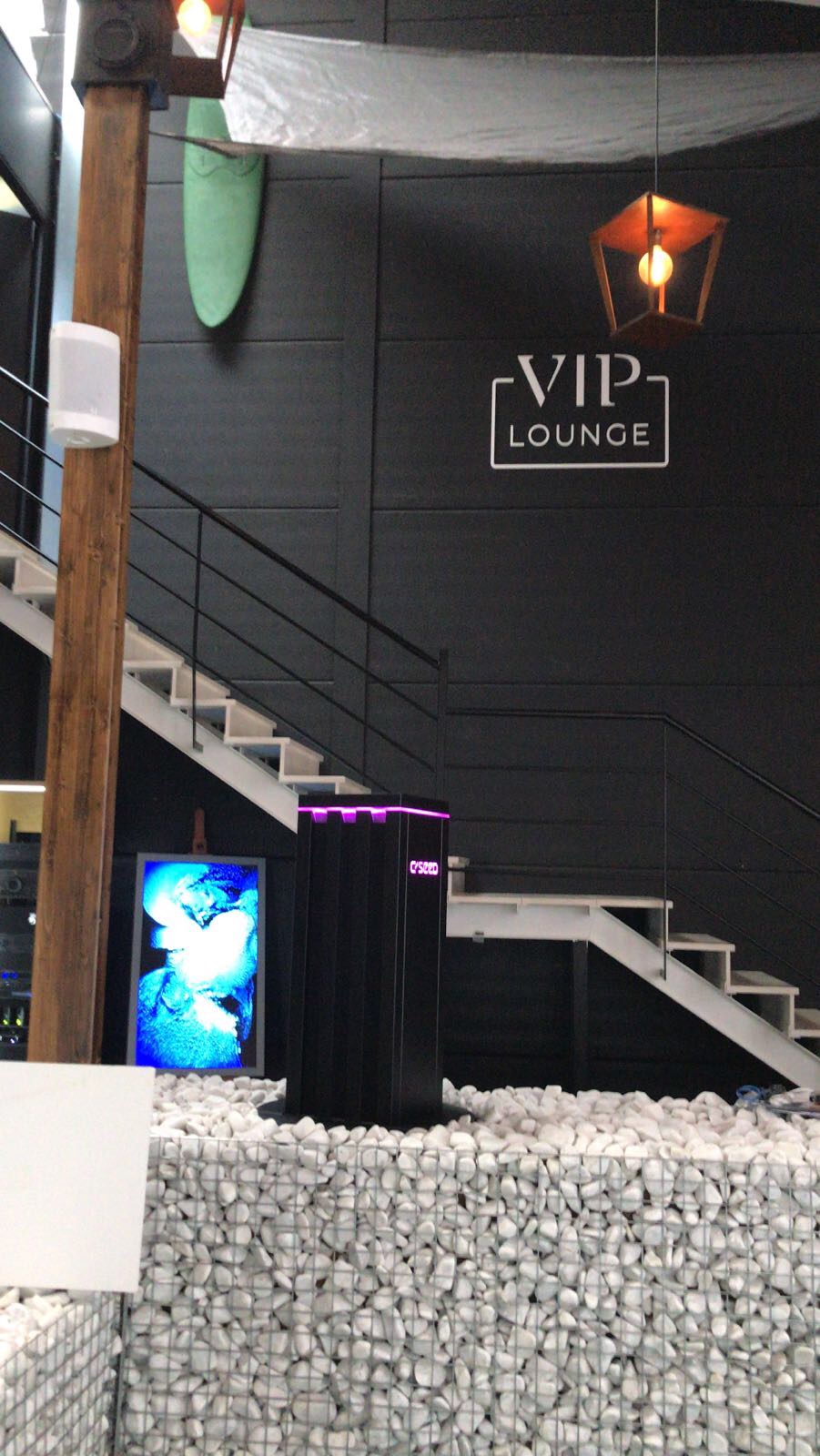
Niio & Genesis Technologies >> VIP Lounge (France & Spain)

Art, Design & Technology in France & Spain 

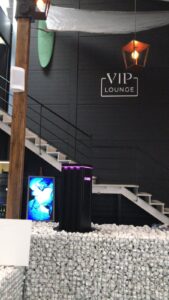
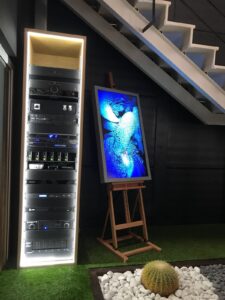
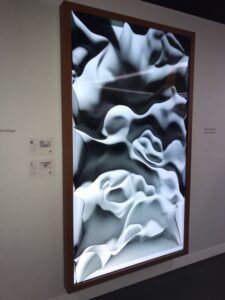
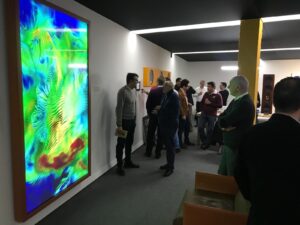
Together with our partner Genesis Technologies, one of Europe’s premiere technology integrators for luxury homes and yachts, we participated in their VIP Lounge on the Cote d’Azur and again in Marbella, Spain.

In France, participants included art collectors and prestige design professionals (architects + interior designers)  while in Spain we spent an afternoon with hardware partners and technology integrators.

We are on a mission to expose people to original, high-quality, immersive digital art experiences. With a collection of thousands of works from top artists and galleries, state-of-the-art technology, a global hardware infrastructure and white glove installation and support, Niio makes it easy to incorporate captivating digital art into any environment.

Interested in premium digital art for your home or next project? Please contact us.


VIPLOUNGESTAIRCASEWindofLinzSpainEaslerefikwhiteblackbrownframespain

VIPSpainBlueGreen92812e9d-425c-47d8-b157-0209ddec7497-2