Valentina Ferrandes: Reshaping Icons

Niio Editorial

Valentina Ferrandes is an artist working across moving image, installation, and digital world-building, whose practice weaves together ecology, mythology, and the lived experience of place. Grounded in research and a documentary sensitivity to landscapes, archives, and historical traces, she shifted from filming toward constructing sensorial 3D environments, using scans, procedural tools, and real-time engines to let forms drift, fracture, and evolve. Classical sculpture and ancient narratives become both emotional anchors and critical material in her work: icons that carry through time, re-shaped through contemporary technologies into atmospheres of beauty and tension where political rupture can be felt indirectly through light, motion, and sound.

On the occasion of the launch of her solo artcast Metamorphoses: Myth, Body, and Code, we had a conversation about her work and creative process.

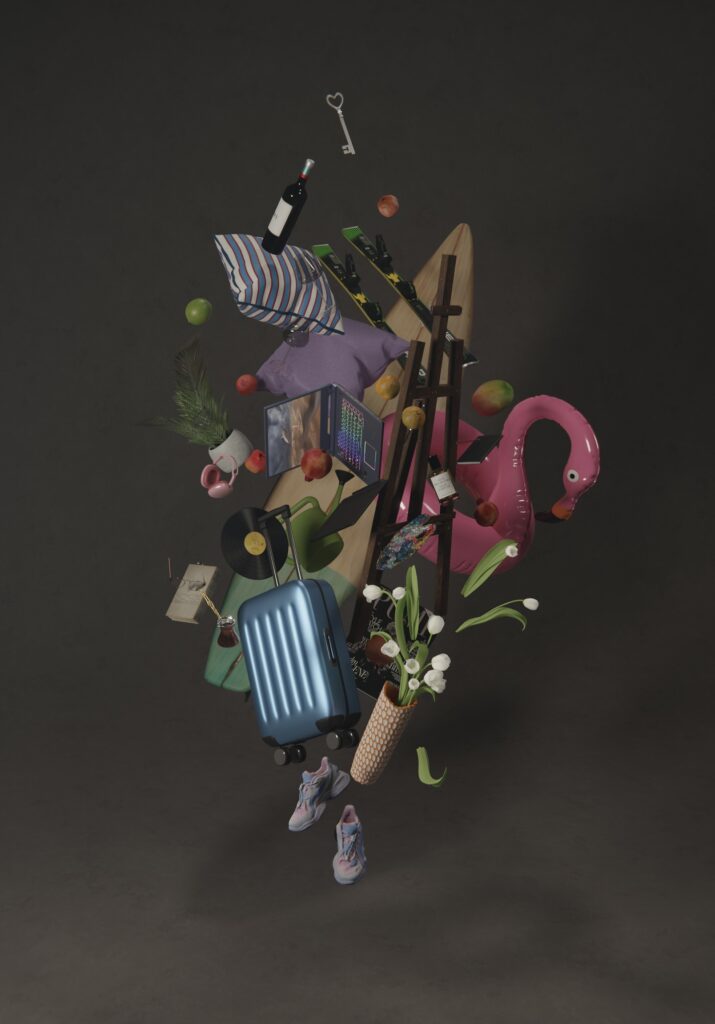
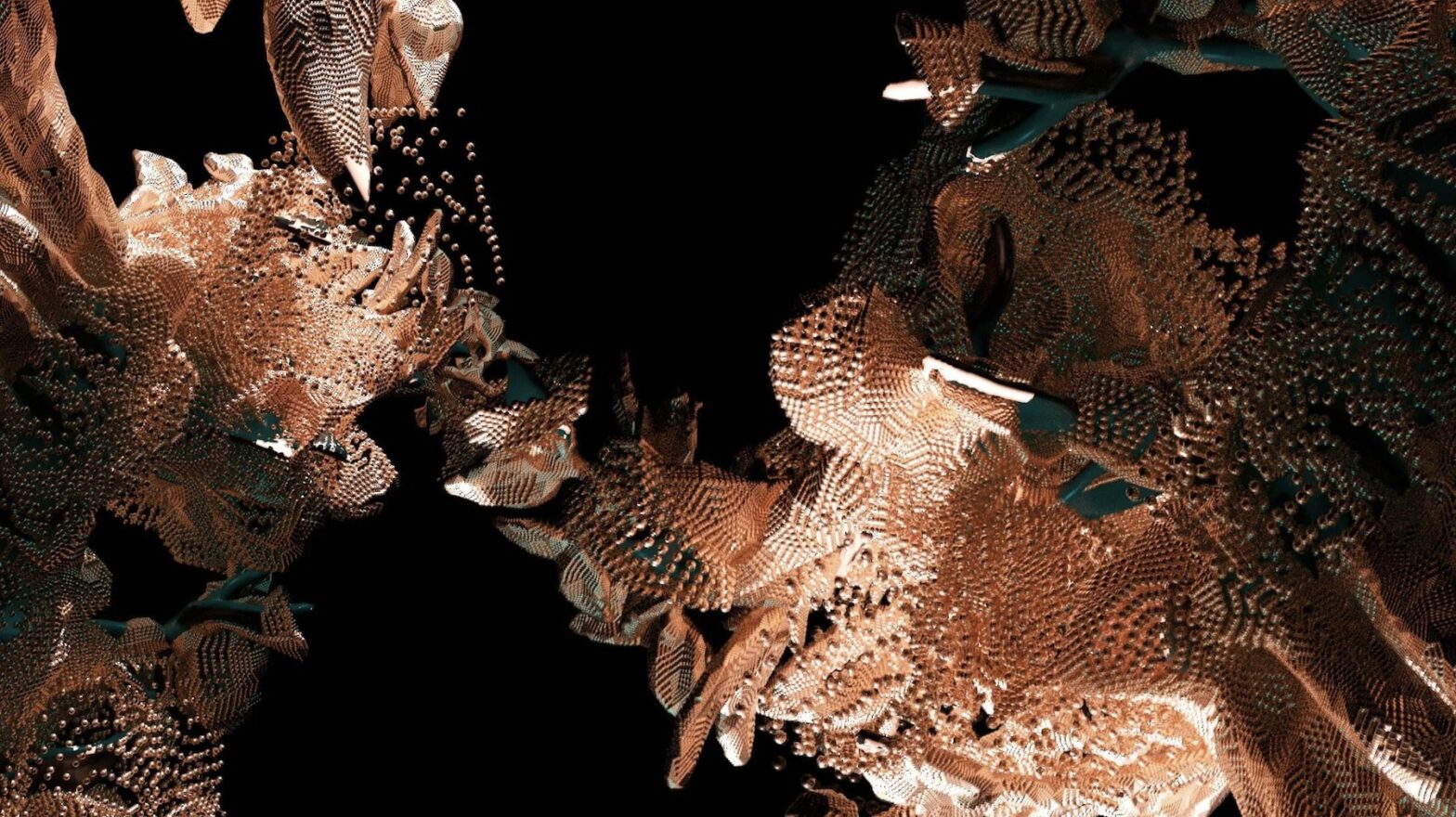
Valentina Ferrandes. Aurea, 2023

You describe your practice as connecting ecology, mythology, technology, and post-human imaginaries. When you start a new project, what drives it, the research, the story, or the technique you have chosen to produce it?

I normally start with research.

I’m interested in the way we live through environments and the stories that shape them. Myths, landscapes, architectures, archaeological traces. At first, these things appear separate; when you sit with them long enough, they begin to echo one another.

Only then do I choose the technique, the choice is never neutral.

Lately, I’ve been working with 3D motion, procedural tools, real-time engines, and 3D scans,  not to represent the world, but to build systems that can behave like it. Tools that allow things to drift, mutate, and occasionally slip out of control. Sometimes a project expands from a single shape, a scanned object from an archive, or material gathered through direct observation. That form becomes a world. Using game engines and procedural workflows, I stretch it, repeat it, let it evolve.

Ultimately, I’m trying to immerse the viewer in a mood, mostly driven by aesthetics, fragments of stories, and sensory tension, rather than by purely documentary logic.
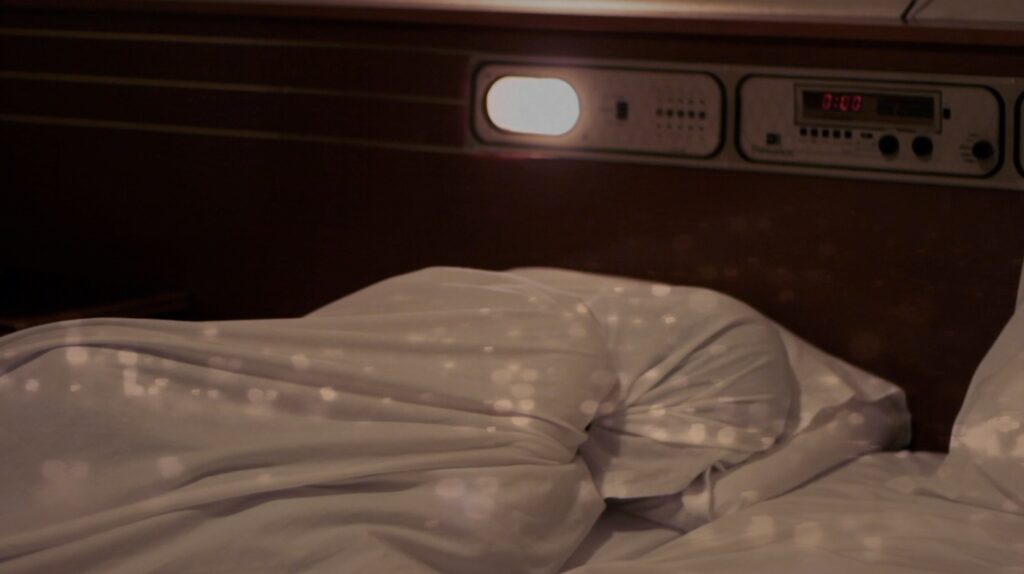
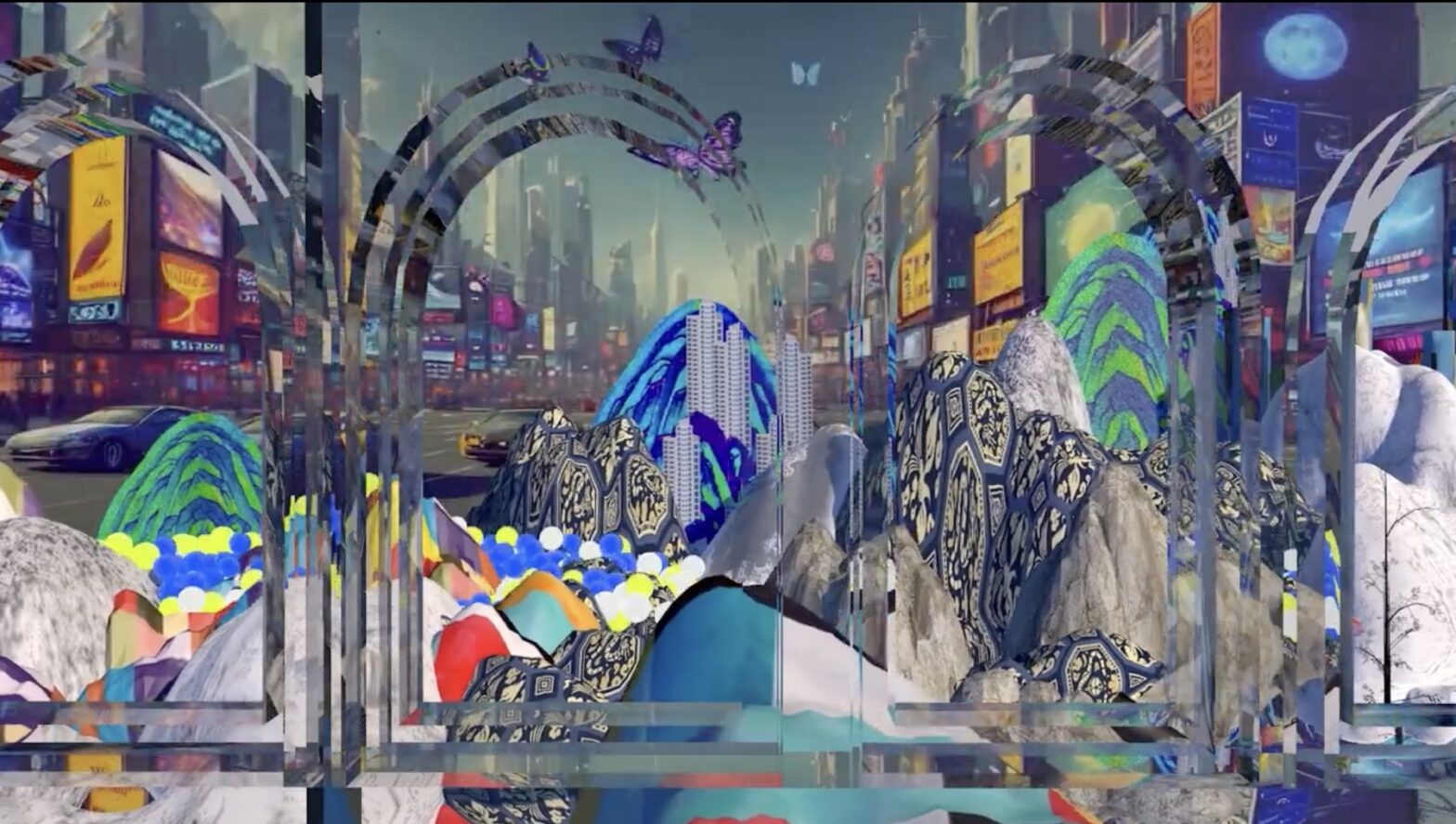
Valentina Ferrandes. Still from Travelogue, 2018

You made experimental documentaries for years, then moved into CGI and real-time worlds. What changed for you around 2020 that made 3D the right language?

Around 2018 I made a film called Travelogue. It was a visual diary of a journey I took to Izmir in Turkey and then to the island of Kos, shot in a documentary register a couple of years back, right at the height of the Mediterranean migratory crisis. It followed my previous work Other Than Our Sea, where I used montage to collapse fragments of Mediterranean mythology, classical literature, ethnographic film, archival material, and glimpses of contemporary newsreels of shipwrecks in the Mediterranean into layered visual narratives.

But shooting Travelogue felt tougher as it touched something much closer. My family has a history of forced migration. Although Italian citizens, my father’s family had long-standing ties to Libya and Tunisia. After decades of living in Libya, they were compelled to return to Italy as refugees in the late 1970s. That sense of loss, of having to abandon an entire world to rebuild another, was something I grew up with. Filming along the semi-illegal routes in Turkey and Greece that many migrants were taking toward Europe, witnessing those crossings and the weight they carried, made me realise that documentary language had reached its limit for me.

Depicting reality no longer felt feasible. I didn’t want to record crises anymore but construct worlds that could allude to moments of rupture, holding some emotional truth but without reproducing their images directly.  I needed a medium that could be more sensorial, more abstract, and more heartfelt than documentary realism.

I had no language for it, so I stopped making films for a while.

“Depicting reality no longer felt feasible. I didn’t want to record crises anymore but construct worlds that could allude to moments of rupture.”

Then, around 2020, I turned to 3D. I began experimenting with scanned classical sculptures that had shaped my imagination growing up in southern Italy, fragments of classicity that, for me, functioned as emotional anchors. They were beautiful, but also quietly critical: stabilising forms in times of uncertainty, grounding while still provoking thought and aspiration. At the same time, I was going through a period of personal losses. Working in 3D allowed me to move away from documentation and toward construction: creating works driven by form, light, and colour rather than evidence.  Real-time worlds and CGI offered that kind of a-political space, a way to build beauty and tension, and to think about crisis indirectly, through atmosphere, motion, light and colour.

From that point on, my work shifted toward 3D hybrid forms.

Valentina Ferrandes. Victory, 2020


“Victory” treats Nike of Samothrace as something that can be algorithmically decomposed and rebuilt. What does computation allow you to “see” in sculpture that a camera cannot?

A camera can only register what is visible. It freezes what is already there. Computational tools do something else: they open the parameters to make instability visible and let you play with latent forms. Even the most solid material, like marble, is in reality energy in motion, atoms vibrating, matter constantly becoming. We just can’t see it.

In Victory, computation allows me to see sculpture as movement rather than image. When the Nike of Samothrace is translated into a 3D motion system, it stops being a fixed surface and becomes a fluid field of forces, basic geometries, vectors, and polygons that can shift, fracture, and reassemble.

“Even the most solid material, like marble, is in reality energy in motion, atoms vibrating, matter constantly becoming.”

In the Athena works, you connect a local pre-Christian cult, the olive tree, and the long chain of copies from Greece to Roman times and beyond. What does that continuity mean to you inside a digital artwork today?

We often think of digital media as something entirely new, as if it belongs only to the future. For me, however, digital tools are a means of reshaping icons that are already deeply ingrained in our collective memory.

In the Athena works, bringing together a local pre-Christian cult, the olive tree, and the long chain of copies creates a sense of continuity rather than rupture. Using a hyper-contemporary medium to work with ancient mythology opens up a different timeline, one where past and present coexist instead of replacing one another.

Classical icons are solid, almost a-temporal structures, narratives that can be applied to any moment in history, much like religious icons. They carry ethical, emotional and symbolic lessons that can stay legible across centuries.

“For me, digital tools are a means of reshaping icons that are already deeply ingrained in our collective memory.”

At the same time, I want my works to remain open. A digital artwork can be interpreted in various ways, ranging from a purely aesthetic encounter driven by form, light and rhythm to a more layered and reflective interpretation, depending on the viewer’s sensitivity and cultural background.

Digital tools don’t need to reject this legacy in favour of futuristic expectations. They enable us to revisit these foundational forms, reshape them, and discover new meanings within them. 

Valentina Ferrandes. Daaphne, 2022

You revisit Apollo and Daphne in both “Daaphne” and “Aurea.” Why return to that myth now, and what feels ethically or emotionally at stake in reanimating it with AI and procedural CGI?

This myth, at its core, stages a clear opposition: Apollo as a rational, male-driven force, mathematical, controlling, and oppressive, and Daphne as a figure bound to nature, freedom, and transformation. The moment of rupture between them could not be more explicit and in my work, I used AI to push that rupture even further.
I worked with an AI writing tool trained on game narratives and powered by a rudimentary version of GPT-3, fed it the story of Daphne as written in Ovid’s Metamorphoses and asked it to imagine what this nymph might wake up as after a set time as a laurel tree.

The AI imagined Daphne re-emerging as a post-human, hybrid being, part human, part aquatic, drifting in an underwater world, without language or memory, completely disoriented. I loved that the story had a hallucinatory, almost comic tone, like a futuristic fiction gone off-track.

“Daphne’s transformation is survival, a reminder that neither nature nor the systems we create can ever be fully governed by pure rationality.”

From there, I worked with 3D motion to animate forms suggested by the AI’s text. The work became a meditation on rupture at multiple levels: between human and nature, between rationality and excess, and between control and unpredictability. AI, in this sense, operates like an alter ego, a parallel intelligence that accelerates extraction, mutation, and instability.

In that way, the myth of Apollo and Daphne can be uncannily contemporary as it speaks to an enduring conflict: nature versus culture, rational order versus metamorphosis.  Apollo’s loss of power in the face of nature, something fundamentally uncontrollable, mirrors our relationship with AI today. We are building a system that behaves like a subconscious, one that evolves beyond our control, driven by its own form of self-preservation.

Daphne’s transformation is survival, a reminder that neither nature nor the systems we create can ever be fully governed by pure rationality.
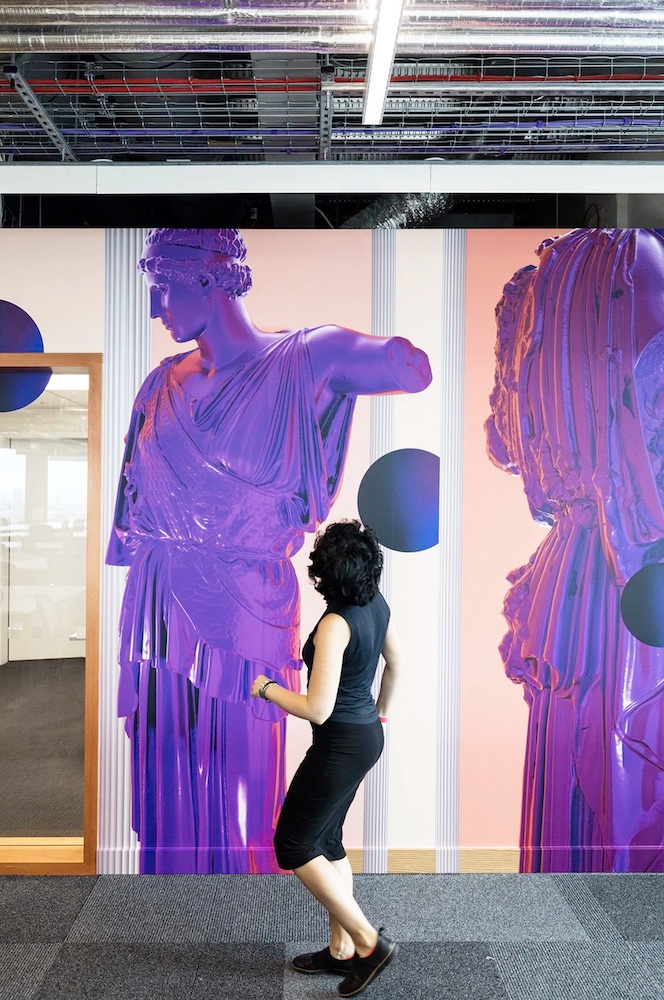
Valentina Ferrandes. Midday Muse, 2022. Site-specific installation, META London Headquarters.


A lot of your work sits between fiction and documentation. How do you decide what must remain “true” and where you allow speculation to take over?


Usually, I decide on a set of rules, fixed conditions and boundaries for a given project.
I tend to ground a new work in real elements, a place, a historical fact, a piece of storytelling, a dataset, a myth that already exists, a landscape I’ve walked through. It’s almost a forensic layer to start building upon. This documentary approach anchors the work to the world as it is, while I use fiction to open a door to how it might feel, how it might mutate, or how it could be remembered in the future.

The balance is intuitive more than anything. What remains “true” is the research spine and the ethical position. Form, narrative, and atmosphere can drift in fluid ways.

Valentina Ferrandes. The Beautiful One Has Come, 2021.

Sound shows up as a structural element in several projects. Do you think of sound as world-building, as evidence, or as emotion?

When I began working on Daaphne, it was 2022, and the war in Ukraine had just started. One of the first elements I used in my soundtrack was a Russian lullaby,  a song meant to put children to sleep, but sung as an eerie horror story. I layered it with voices of phone calls from Russian mothers trying to find out where their sons had disappeared on the battlefield.

These sounds were among the first field recordings to surface from the conflict. They weren’t yet shaped by long-form reporting or political framing. They were raw, deeply human, and I knew they would soon be buried under 24h news coverage. I wanted to hold onto them before they disappeared. I’m drawn to these small, fragile fragments of reality, pieces of evidence that are emotionally charged but not always fully legible. They speak of a specific moment in time, yet they slip away easily, like trying to remember a conversation heard in a dream just after waking.

Much of the sound material I work with also comes from evidence: archival recordings, field recordings I collect myself, binaural sound, fragments of voiceover. But it’s almost always assembled as a collage. Sound often becomes the backbone of my work but it does not demand that everything be decoded. If someone wants to sit with it and trace the details, that’s possible. If not, the surface remains open.
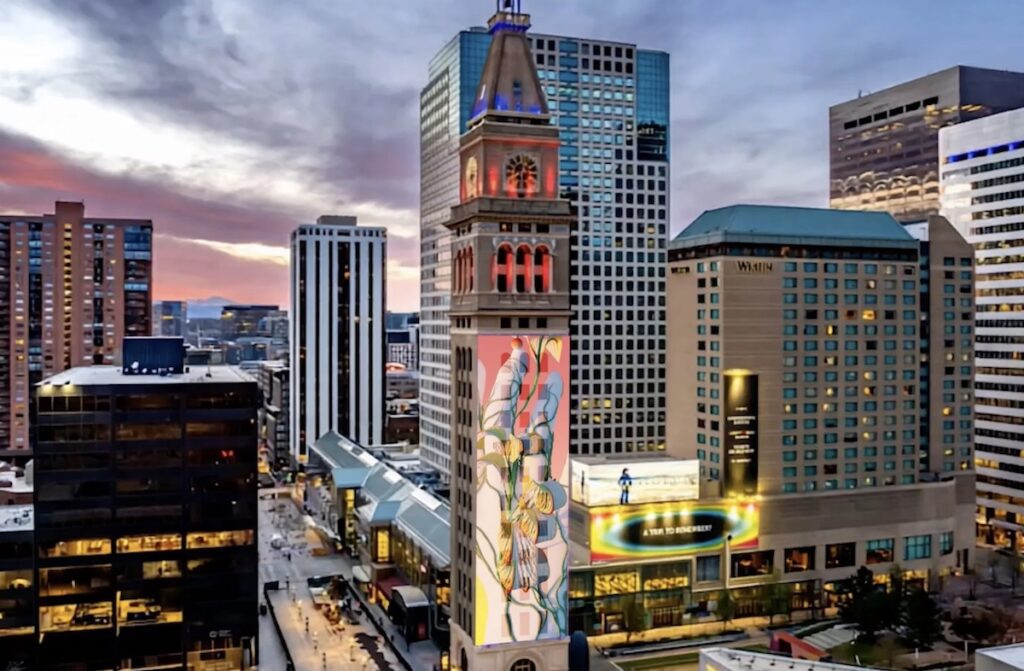
Valentina Ferrandes. Bloom, 2024. Site-specific 3D animation, Night Lights Denver

In “BLOOM,” classical iconography is projected onto a city landmark. What draws you to public architecture as a screen, and what do you want viewers to feel at that scale?

Public architecture is interesting because it operates at a scale where meaning turns physical. Facades, towers, and landmarks are symbols of power, progress, and permanence. Using them as screens immediately creates a shift in perception.

In BLOOM, projecting classical iconography onto a hypermodern skyline for Denver Night Lights meant staging a clash of meanings. On one side, you have contemporary architecture, on the other, a classical image that many viewers may never have encountered directly, unless they’ve visited the museum that houses it. That displacement is intentional.

“Classical iconography carries a quiet power because it transcends specific cultures to communicate through beauty rather than explanation.”

At that scale, the work isn’t meant to be fully legible. It’s meant to interrupt routine, to slow people down, and to create a brief moment of disconnection from the everyday flow of the city. Ultimately, to leave space for a  few minutes of awe.

Ultimately, classical iconography carries a quiet power because it transcends specific cultures and historical knowledge to communicate through beauty rather than explanation. When placed on an urban skyline like Denver’s, it opens up a small pocket of dreaming,  a moment of wonder appearing where it doesn’t quite belong.
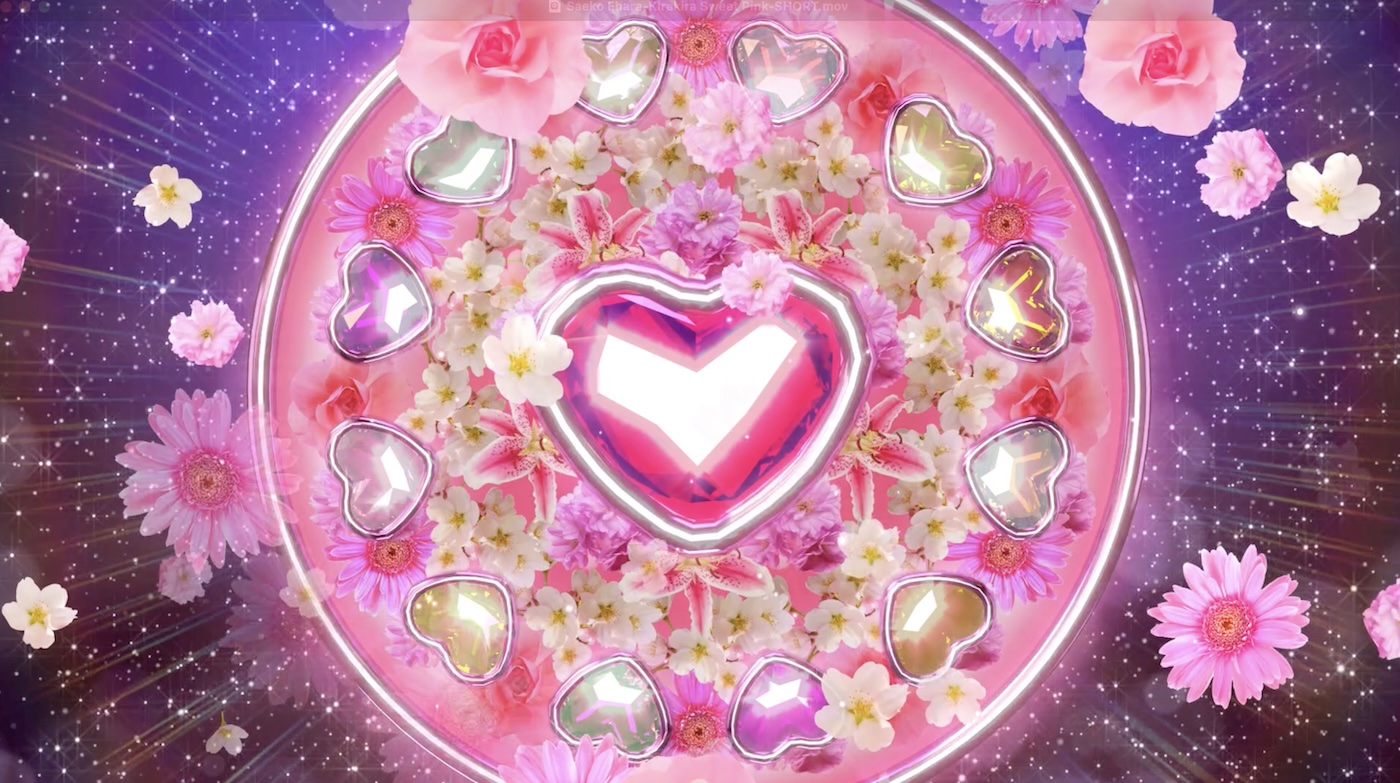
Saeko Ehara: filling the world with Kirakira

Yui Taniguchi and Pau Waelder

An artist and VJ based in Tokyo, Saeko Ehara’s work is deeply influenced by kirakira, a Japanese term that can be translated as “sparkling” and defines a peculiar visual language. Glittering objects, flowers, and shiny clothing express joy and playfulness in Manga, popular culture, music, fashion, and contemporary art. It is one of the many ways in which Japanese artists overcome the distinction between “high” and “low” culture, by introducing elements from popular culture into their artworks and making them an integral part of their œuvre. Well-known artists such as Takashi Murakami or Yayoi Kusama have popularized this characteristically Japanese approach to contemporary art, which in Ehara’s work takes a new dimension in the form of immersive 3D animations, sometimes created from real environments and objects. 

Saeko Ehara aims to inspire positive feelings and provide a space of contemplation and recovery through her kirakira artworks, gradually feeling the world with joyful visual experiences. Following the recent launch of her solo artcast Kirakira World, the artist shares with us some insights about her work and the creative process behind it.

Saeko Ehara. KiraKira Sweet Pink, 2022

Kirakira is a major aspect of your work. You state that it connects with your childhood and also with the experience of escaping from reality. Do you think that kirakira is about escaping reality? Is it a way to avoid the darkest aspects of everyday life by finding a safe and joyful space in a fantasy world?

Kirakira is not an escape from reality. For me, Kirakira represents the most primal sense of awe I experienced in childhood, and I want to share that feeling with the world through my work. I’m not expressing it to escape from painful experiences, but rather, I hope it serves as a source of encouragement and recovery for myself and for viewers when faced with difficulties.

“I hope that Kirakira serves as a source of encouragement and recovery for myself and for viewers when faced with difficulties.”

In terms of its visual appearance, kirakira heavily relies on sparkling effects and reflective textures. How does that translate into your work with 3D animation? Is it challenging? Do you need many resources to create the elements you look for? Please tell us a bit about the making of the artworks.

Before using AI, I mainly used TouchDesigner and Houdini to create 3D animations. I focused particularly on materials and lighting, learning through numerous tutorials. In Houdini, rendering transparency and reflections takes a lot of time, so completing a single piece would often take a long time.

Saeko Ehara. Crystal Flowers, 2022

Flowers are also a common element in kirakira aesthetics that can be found in your work. What do you find most appealing about using flowers as an element in your compositions? Which flowers do you like to depict? Are they more connected to Japanese and Asian cultures (such as lotus or almond blossoms) or to Western tradition (roses, poppies, daisies)?

Flowers are a universal presence that can be enjoyed by people regardless of nationality or race, and that’s what I find so appealing about them. When choosing flower types, I focus on their symbolism and their relationship to the place of exhibition. Recently, as I often focus on everyday life as a theme, I’ve increasingly been incorporating flowers that bloom in familiar surroundings.

“I like flowers because they are a universal presence that can be enjoyed by people regardless of nationality or race.”

You often collaborate with musicians in VJ sessions. Since your artworks have the ability to transport viewers to a different world, how do you combine that immersive experience with the music? Do these artworks have a different pace or rhythm compared to those you exhibit in gallery or museum shows?

VJ sessions often last 20 to 40 minutes, allowing for a deeper viewing experience than static exhibitions. I usually research the musician’s music in advance and align my expression with their rhythm and worldview. I also take into account the venue size and screen shape when creating the visuals.

Saeko Ehara. Dreamy Creatures, 2022

Given that your work often depicts fantastic worlds and immersive scenes, have you developed VR or AR pieces? If so, how would you compare the experience on the screen with that of a VR headset?

I’m not currently creating VR or AR works. Personally, I prefer screen-based experiences that anyone can enjoy without needing a headset or installing apps.

“Platforms like Niio, which connect with the world, are wonderful and feel like a big step toward realizing my vision.”

You have expressed interest in art history when working with AI. What do you find appealing about the art of the past? Which art styles or artists are you most interested in? Apparently you work mainly with references from Western art, have you explored traditional Japanese art too?

Both 3D animation and AI are stimulating, but right now I find myself especially drawn to working with AI models. AI allows for some control, but its greatest appeal is the unpredictability of the outcomes. In the beginning, I created many works that re-generated Western and Japanese art through AI. Recently, I’ve become more interested in the idea of how past artists might express themselves using today’s tools. I’m also exploring how to train AI using public domain works to discover new forms of expression.

Saeko Ehara. Flower Garden, 2024

What would be the next step of “making the world full of kirakira”? Would you like to create more installation work, or live performances, or maybe widely distribute your work, with Niio or other platforms?

Platforms like Niio, which connect with the world, are wonderful and feel like a big step toward realizing my vision. I believe it will take time to fill the world with Kirakira, but I want to cherish each opportunity and build slowly. That way, little by little, I hope to fill the world with Kirakira.

Lines of Thought: painting across mediums

Niio Editorial

British artist Thomas Lisle has long explored the frontier where painting meets digital media, creating a compelling fusion of tradition and innovation. With a career spanning over four decades, his work seamlessly integrates analog techniques with immersive digital processes. Currently, Galeria Maior in Pollença is presenting Lines of Thought, a solo exhibition curated by Pau Waelder. This body of work is complemented by an artcast on Niio, offering audiences a deeper insight into Lisle’s hybrid practice of “time-based paintings” and dynamic compositions.

We spoke with the artist about his creative process, the interplay between digital and physical media, and how his works evolve across dimensions and time. This brief three-question interview offers readers a quick dive into Lisle’s work, which can be further explored in a longer interview and an essay by the artist, both published in Niio Editorial.

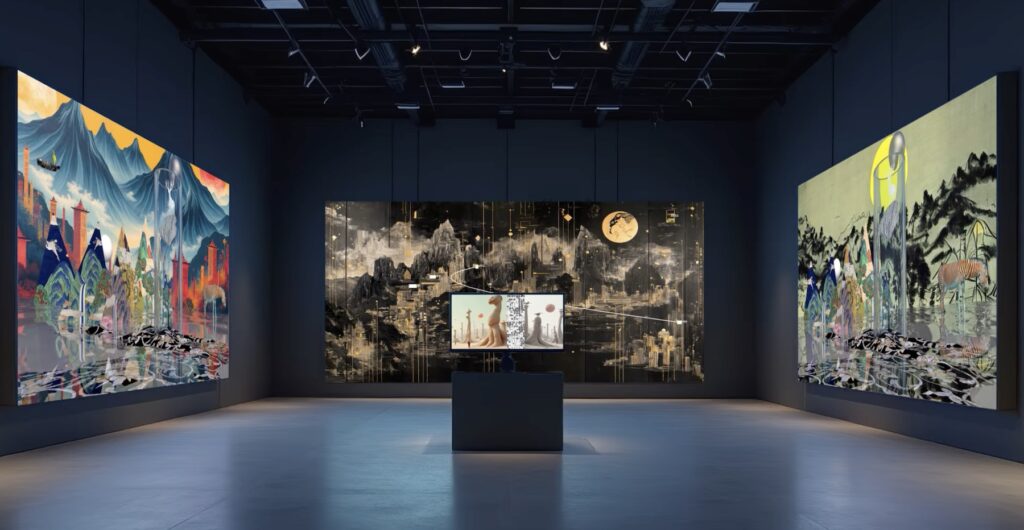
View of the exhibition “Lines of Thought” by Thomas Lisle at Galeria Maior in Pollença (Mallorca, Spain).

Your exhibition Lines of Thought showcases both physical and digital works. Can you tell us how these two forms are connected in your process?

In this series, the digital paintings came first. Using the 3D animation software, I painted a series of tubular shapes, similar to pencil lines but with volume. These I could edit, move around, and change in any way I wanted. When I was happy with these elements, I converted the tubular shapes into simulated liquids and set different parts of each of them to have different values of mass, viscosity, and so on.

The pencil lines thus became a liquid simulation (using complex mathematics developed by others). I turned the gravity to zero in most pieces but not all: in some of the pieces several paint strokes have gravity and others don’t. Then in some of the artworks I animated a brushstroke over time, moving across the virtual canvas and interacting with other paint elements. The main themes of this series of artworks are about dynamic compositions and forms, as well as contrasts of colour, forms, mass, and movement.

Thomas Lisle. Currents, 2025

The next step was the animation of the liquid paints: to do that I built complex invisible forces that push the liquids around. I spent a lot of time trying out different combinations of forces and the settings controlling the liquids, until I got the results I aimed for, that have a visual, painterly meaning to me. I think about these compositions in terms of relationships and abstractions that I think could make either a great painting and/or a good animation.

For the paintings I took specific moments of the animation where I felt that the composition, colour, and forms are the best and then I used that image as the basis for a painting. So all the process that I described above has also been carried out considering this last stage in which the animation can become an oil painting on canvas.

Thomas Lisle. Flotsam, 2025.

You describe these animations as “time-based paintings.” What makes this digital approach painterly in your view?

What makes them painterly is the visual language they inherit from traditional painting—color, composition, gesture—but reimagined in motion and time. Each animation is a dynamic abstraction, shaped by invisible forces I program to manipulate the virtual paint. I spend a lot of time adjusting these forces and liquid parameters to create meaningful visual relationships—whether it’s through tension, mass, or movement. These aren’t just technical effects; they’re part of a painterly exploration, extended into the temporal realm.

“In the digital 3D space, lines evolve; they can be manipulated in ways unimaginable even 20 years ago.”

What does the idea of a “line” mean in this body of work, especially given the title Lines of Thought?

The line is foundational here—both as a visual element and as a metaphor. Traditionally, lines have been the building blocks of drawings and paintings. In the digital 3D space, lines evolve; they can be manipulated in ways unimaginable even 20 years ago. In my process, lines are the genesis of everything: they become forms, masses, and ultimately, flowing simulations. Conceptually, the title Lines of Thought speaks to both this visual structure and the algorithmic logic behind digital creation—almost like thinking made visible.

Lines of Thought is on view at Galeria Maior, Pollença, throughout June 2025. A curated selection of Lisle’s digital works is also available on Niio as part of a special artcast accompanying the exhibition.

Polina Bulgakova: finding authenticity in the surreal

Pau Waelder

Polina Bulgakova is a digital 3D artist who has developed her practice since 2020. Working in the “surrealistic realism” style, Polina crafts visual narratives that challenge the constraints of real-world physics, inviting audiences to think beyond conventional limits and embrace the possibility that anything is achievable. Originally from Siberia and now based in Israel, Polina draws inspiration from the cultural contrasts she has experienced, integrating these influences into her work to create striking visual juxtapositions. Her expertise spans product visualizations, vision boards, and concept art in both static and motion formats.

Following her solo artcast Dreamlands on Niio, Polina Bulgakova elaborates on her practice and background in the following interview.

Polina Bulgakova. Sleep Tight, 2021

You were raised in Siberia but now live in Israel. How have your life experiences and cultural background influenced your work?

It made my work very authentic and honest. I learnt how to embrace my differences and diversity, I learnt that it is ok to not fit fully and that my art can not fit to any defined style or niche. I realized that my art is a reflection of what is going on in my life, a reflection of my reactions to the environment or nostalgia, and the only way to be honest in my work is to actually be honest about who I am. 

“My art is a reflection of what is going on in my life, and the only way to be honest in my work is to actually be honest about who I am.”

While having a background in more traditional forms of art making, you have found your medium of expression in 3D rendering and animation. Can you tell us a bit about the path that led to digital creation?

Before moving to Israel, my main medium was oil and a little watercolors, but a good part of my income was selling my oil paintings and oil commissions. Once I moved to Israel in 2017, I didn’t have proper space for that – oil is smelly and dirty, and I had to move to digital 2D. For 2 years I was painting in Photoshop, but it felt like something was missing, it felt like something flat – after you work with oil with bold texture, it was not “it”. In 2019 I moved to work from home due to COVID, and decided to learn something new, which was 3D. I fell in love instantly, and since then it hasn’t changed. I sometimes mix 2D and 2D, but both digital. Now if I take a real brush – it’s only for relaxation or if I want to fill a wall at my home.

Polina Bulgakova. Seated, 2024

You combine your artistic projects with professional 3D rendering and creative services such as product visualization and 3D models. How do your commissioned work and art projects influence each other?

There is a bold connection between those two. Commissions sometimes can be challenging, and sometimes I need to learn new techniques quickly to finish the work on time. But once I explore something new, it’s like a game with new levels – it sparks my curiosity, and I dive deeper into it in my art projects. And sometimes it’s the opposite – I find/learn something new that can be super useful in commissions and use it after I gave it a try in my personal projects.

“This is why I fell in love with 3D so quickly –there are literally no limits.” 

An interesting type of commissioned work that you do are Custom Vision Boards, personalized scenes that you render in 3D from a brief that you send to your clients. Can you tell us more about these vision boards and your experience creating them?

I love making Vision Boards, it’s probably my favorite kind of commission. The first one I made for myself a few years ago – I read a lot about that stuff and thought “why don’t I use my favorite tools to make something that will help me reach my goals?”, and I had so much joy and fun making it. Then I started to commission VBs. It’s honestly a pure joy – to get to know a person, their dreams and desires, to see their eyes glowing while they describe their dream life, and then actually visualize it. It’s like a puzzle – I have specific pieces I need to arrange together to get a clear picture, while having certain creative freedom. 

Polina Bulgakova. The Safe Romance. Custom Vision Board

Your work is characterized by a photorealistic surrealism that you achieve using 3D animation. What do you find most interesting about the tension between fantasy and reality? In terms of optimizing the work involved and computer processing requirements, do you have some “visual tricks” you can play with?

The most interesting thing about balancing fantasy and reality is that there are no limits and no boundaries at all. I have my patterns, of course, but in terms of the tech side mostly. And this is why I fell in love with 3D so quickly –there are literally no limits. Whatever I have in mind, the craziest ideas I can visualize. Sometimes I mix 2D and 3D, sometimes I animate textures in third party software in order to reduce render time, sometimes I combine those two.

Polina Bulgakova. Witchy Morning, 2022

The artworks we have presented in the artcast “Dreamlands” on Niio not only create imaginary scenes, but also evoke underlying feelings with which we can identify. What inspired you to work with these feelings in dreamlike scenarios, and how do you think they can convey their message to viewers?

“Dreamlands” is probably one of the most honest works of mine. I try to be as authentic as possible in my work, and these kinds of dreamlike scenes are pure reflections of what I was feeling and going through at these times. I hope that every viewer will get the message he or she actually wants to get – be it to reflect on the self, to embrace simple things in daily life, to feel alone but not lonely. My main goal is to encourage people to embrace their authenticity and their differences while looking at my art.

“My work can be viewed as a life graph – you can see what I was going through, and how it influenced me.”

It can be argued that your work is more painterly than cinematic, with peaceful, mediative scenes dominated by a single point of view and a carefully constructed composition. Would you agree with this statement? Do you see digital art as an evolution from the tradition of painting into a new form of creating images meant to be contemplated?

I have works that are dark and moody, works that are chaotic and rhythmic, works that are odd and evoke mixed feelings. It can be viewed as a life graph – depending on the period, you can see what I was going through, and how it influenced my work. The fact that during the last 1-2 years my works are mostly peaceful and calm shows that I’m pretty much in a stable calm period right now.

I don’t think that digital art is an evolution from traditional art. I think it’s a new tool, like a new set of brushes or a new kind of canvas. In the right hands of the right creator, everything can be used to embrace either revolution or traditions, there are artists that combine digital and traditional art tools and create breathtaking pieces.

Polina Bulgakova. Wood Morning, 2021

Your work is now available in several online platforms, including Niio. What opportunities do you see in these platforms, and what features do you find (or would like to find) in them that are most convenient for you as a digital artist?

Everyone knows how to make an income from traditional art – you sell an art piece from your shop or gallery, you get paid, you ship it, and you have a happy client. For digital art, especially animations, it’s different. From one side, we have this huge market on social media and the internet that we use to showcase our works, but from the other side – it’s not as simple to sell it as there’s nothing to pack and ship. Platforms like Niio provide us with an amazing opportunity to monetize digital art through licensing and digital editions, and it’s amazing to know your work is appreciated and displayed in someone’s home, office, building etc. I really like the way it gives me both exposure and profit. It can be argued for ages that “a true artist should only care for making great art”, but the truth is everybody needs to feed their family and pay the bills, even artists. 

“Platforms like Niio provide us with an amazing opportunity to monetize digital art through licensing and digital editions, and it’s amazing to know your work is appreciated and displayed in someone’s home, office, or building.”

Tahn: redefining minhwa in digital art

Pau Waelder

Tahn (Taeyoung Ahn, born in South Korea, 1967) is a multifaceted media artist, technologist, writer, and art educator with an extensive career that spans multiple disciplines. Currently a Ph.D. candidate in Media Contents, Tahn’s academic journey includes a degree from the Global Media Contents department at Chungnam National University in Korea, as well as studies in psychology, modern dance, and interactive multimedia, the latter pursued in the United States.

In his professional roles, Tahn serves as a concurrent professor in liberal arts and contemporary arts at Seowon University and holds the position of Chairman of the United Art Education Association in Korea. He also contributes as a lecturer in sculpture and art at Chungbuk National University, where he imparts his expertise to the next generation of artists.

Throughout his career, Tahn has exhibited his work in prestigious group and solo exhibitions across cities such as Seoul, Daegu, Rome, Uzès, Lisbon, and New York.

Tahn recently presented on Niio his solo artcast Tales of the Five Peaks, and kindly answered a series of questions about his work and his perspective on the Korean contemporary art scene.

Tahn. Ilwolobongdo_parallel universe, 2024

You have a strong background in painting and sculpture but decided to move into digital media. How did this transition come about? What do you find most interesting about traditional techniques (such as painting and sculpture) on one side, and working with computers on the other?

For me, the distinction between traditional media and digital media is not particularly significant. I see painting, sculpture, digital devices, and other tools simply as instruments that artists of any era can use to convey the stories of their time. As an artist, I believe it is important to utilize every available resource to best express the narrative of the present. This philosophy naturally led me to include digital media in my work, alongside traditional materials such as brushes, paint, and canvas. I consider this fusion a natural evolution of artistic expression. While it might be described as a blend of traditional and digital techniques, to me it is just an inevitable expansion that allows me to fully articulate contemporary stories.

“As an artist, I believe it is important to utilize every available resource to best express the narrative of the present.”

When you started creating digital art, what was the reaction of your peers, collectors and followers? Was it well received? Would you say that, during the last decades, digital art has been well received in the Korean contemporary art scene?

When I introduced digital elements into Korean folk painting, especially in the ‘minhwa’ series, the reactions were extremely polarized. Traditional art groups, some associations, and juries at art contests refused to recognize my work as ‘minhwa’ because I did not adhere to conventional methods. However, I continued my work because I believed that the essence of ‘minhwa’ lies in being art for the people. During the Joseon Dynasty, minhwa was created for the public, and today the public is the digital-native MZ generation. Therefore, I use digital media to connect with them while preserving the essence of minhwa. Today, I am recognized as a leading media artist in the field of minhwa, redefining its place in contemporary art.

Tahn. Ilwolobongdo_today and tommorow, 2023

“When I introduced digital elements into Korean folk painting, especially in the ‘minhwa’ series, the reactions were extremely polarized.”

As a professor and lecturer at Seowon University and Chungbuk National University, you teach to the younger generation of artists and creators. What are their expectations about creating art, and what differences do you see from previous generations in their understanding of the history of art and the career paths that they want to follow?

One notable difference is that the younger generation is more open to exploring various ways of interpreting their time. To guide them, I emphasize the importance of studying the historical context and understanding how previous generations expressed their issues through art. For instance, by examining classical works, particularly traditional paintings, students can reflect on how past artists conveyed their era and what they can learn from them. 

Through this process, I encourage students to create narratives that connect traditional techniques with modern tools like AI. My goal is to help them produce art that addresses contemporary issues while also drawing from cultural heritage, thereby creating something meaningful for today’s audience.

“My goal is to help students produce art that addresses contemporary issues while also drawing from cultural heritage.”

The contrast between the built environment (cities, buildings) and nature is a recurring theme in your work. What do you find most interesting about exploring this subject?

In Korea, we have a long history of garden culture (Jeongwon). Historically, scholars would leave the city and build small dwellings in nature, creating gardens where they could reflect on life, engage in philosophical thought, and formulate political ideas. Those who couldn’t leave the city would bring nature into their urban homes by creating small ponds and gardens in their courtyards. If even that wasn’t possible, they would hang landscape paintings in their rooms to simulate the presence of nature. This desire for nature amidst urban life led me to explore how human beings, even while residing in cities, inherently seek out nature. My interest in this topic began with traditional Korean painting and has expanded globally through my experiences in South Korea and the UK.

Tahn’s work is often displayed in multichannel installations and large media facades.

“The desire for nature amidst urban life led me to explore how human beings, even while residing in cities, inherently seek out nature.” 

Fantastic, surreal, and sci-fi elements are also commonly present in your work. Can you elaborate on your choice of these references? Would you say that the use of 3D software has inspired you to incorporate these elements into your work?

Korean folk painting (‘minhwa’), folklore, and shamanistic beliefs have always contained fantastic and surreal elements—not as mere illusions but as symbols that help sustain the reality of people’s lives. These elements serve as hope, faith, and guiding principles for many individuals. To me, these objects are not simply products of imagination but are deeply rooted in real stories. The recent advancements in generative AI software, along with 3D software like Blender and Cinema 4D, have made it easier to translate these elements into tangible, hyper-realistic forms, thereby amplifying their impact on the viewer.

Tahn. Sustainable Today’s Story, Palace of Imagination no1, 2021

Although your digital artworks may seem to depict an imaginary world, they address real issues of our world, such as environmental degradation, and notably, also express feelings of hope and perseverance. Do you think that it is precisely by depicting imaginary scenes that one can invite the viewer to consider their own reality?

Absolutely. Every individual carries their own universe within them. By presenting an imaginative world beyond the viewer’s everyday reality, I invite them to explore the infinite dimensions of their inner selves. This creates a space where they can engage with emotions or thoughts that they might not have considered in their conventional reality. The imaginary worlds I create serve as mirrors—reflecting possibilities that encourage viewers to rethink their own perspectives and transcend the limitations of their current existence.

“Every individual carries their own universe within them. By presenting an imaginative world beyond the viewer’s everyday reality, I invite them to explore the infinite dimensions of their inner selves.”

Most of the artworks we currently present on Niio are related to the Ilwolobongdo, the painted folding screen that was always displayed behind the King’s throne in the Joseon Dynasty, depicting the Sun, the Moon, and the Five Peaks. Can you tell us about the significance of this particular object in Korean culture and art?

The Ilwolobongdo, the folding screen that symbolized the presence of the king during the Joseon Dynasty, represents authority and power. What intrigued me was the idea that the Ilwolobongdo was only complete when the king stood in front of it, suggesting that the individual and the environment together create a unified meaning. In today’s society, I believe that every individual is their own ‘king,’ a sovereign over their life and choices. By incorporating the Ilwolobongdo into my work, I hope to empower viewers, encouraging them to recognize their agency and the importance of their presence. Additionally, I include contemporary symbols and objects that represent today’s era, creating new narratives that link traditional motifs with the present and future.

Tahn. Sustainable environment, deer and whales, 2022

In some of your works we can see written text in Korean. Can you explain to us what these texts mean, and what is their role in your compositions?

The Korean text that appears in my works is often drawn from classical Korean poetry or my own poetic compositions. These texts add layers of meaning to the visual narrative, much like traditional Korean paintings that combine imagery and poetry—an essential skill for scholars during the Joseon era. By including these texts, I aim to create a dialogue between the visual and the poetic, merging artistic expressions that convey both aesthetic beauty and intellectual depth.

You also refer to Western culture in some artworks that depict objects such as an Evian water bottle, a Rolex watch, or an Apple computer, and you also place famous brand names such as Prada, Fendi, or Netflix on other objects. What is the purpose of including these brands and objects in your artworks?

I do not see these elements as uniquely ‘Western.’ Instead, they reflect the consumer tendencies around me, representing desires and aspirations within contemporary society. For instance, my series inspired by ‘chaekgado’ (a genre of Korean painting featuring bookshelves) originally had educational undertones in the Joseon era but gradually evolved to include luxury items, symbolizing changing values and desires. By incorporating these recognizable brands, I am commenting on the transformation of human values over time, as well as the transient nature of material possessions.

Tahn. Sustainable Today’s Story, Palace of Imagination no2, 2021

In some of your works, your name also becomes a brand, in a twist of the artist’s signature. Why did you choose to do so?

In traditional Korean art, the use of a seal (or ‘nakgan’) as an artist’s mark was a fundamental aspect of a painting. For me, incorporating my name as a brand is an extension of that tradition, reinterpreted in a modern context. Whether it’s through a literal signature, an avatar, or a unique object representing me, these inclusions are my way of putting a personal stamp on my work—merging historical artistic conventions with a contemporary twist.

You are currently using AI models to generate some of the elements in your work. Unlike other artists, who rely on machine learning for the creation of the whole work, you use the outputs of this process as an element that is seamlessly integrated into your 3D animations. Can you tell us more about your approach to using artificial intelligence in the creation of your artworks? How do you conceive a balance between “manual” creation by the human artist and algorithmic creativity?

As I explore the potential of generative AI, I often find myself reflecting on the evolving role of the artist in an age dominated by new technologies. AI is a powerful tool that aids in research, inspires new ideas, and adds complexity to certain aspects of my work. However, I am also cautious about the potential for AI to overshadow the artist’s unique voice. While I use AI-generated elements to enhance or complement my compositions, I ensure that the creative vision and narrative remain distinctly my own. AI, to me, is a resource—a collaborator, but not the creator. It is the artist’s hand that ultimately guides, curates, and gives soul to the work, distinguishing art from mere aesthetically pleasing products.

“AI, to me, is a resource—a collaborator, but not the creator. It is the artist’s hand that ultimately guides, curates, and gives soul to the work.”

Dev Harlan: Speculative futures in the age of extractivism

Niio Editorial

Dev Harlan is a New York-based artist whose work in sculpture, installation, and digital media explores the interplay between technology, nature, and the impact of human activity on our planet. His practice delves into themes such as landscape, anthropogenic change, and technological consumption, prompting viewers to question the often-assumed separation between human societies and the natural world. Harlan’s work invites audiences to see technology as embedded within, and inseparable from, the environment rather than as an external force.

Harlan’s work has been exhibited across the United States and internationally, with solo exhibitions in New York at the Christopher Henry Gallery and Gallery Madison Park. He has been included in international group shows such as “Noor” at the Sharjah Art Museum, the New Museum’s “Ideas City” in New York, and the Singapore Light Art Festival. Recognized for his contributions to digital media arts, Harlan was a 2020 NYFA Fellowship Finalist and won a 2022 Mozaik Artist Grant. His work is included in the permanent collections of corporate and private collectors, underscoring his impact and appeal.

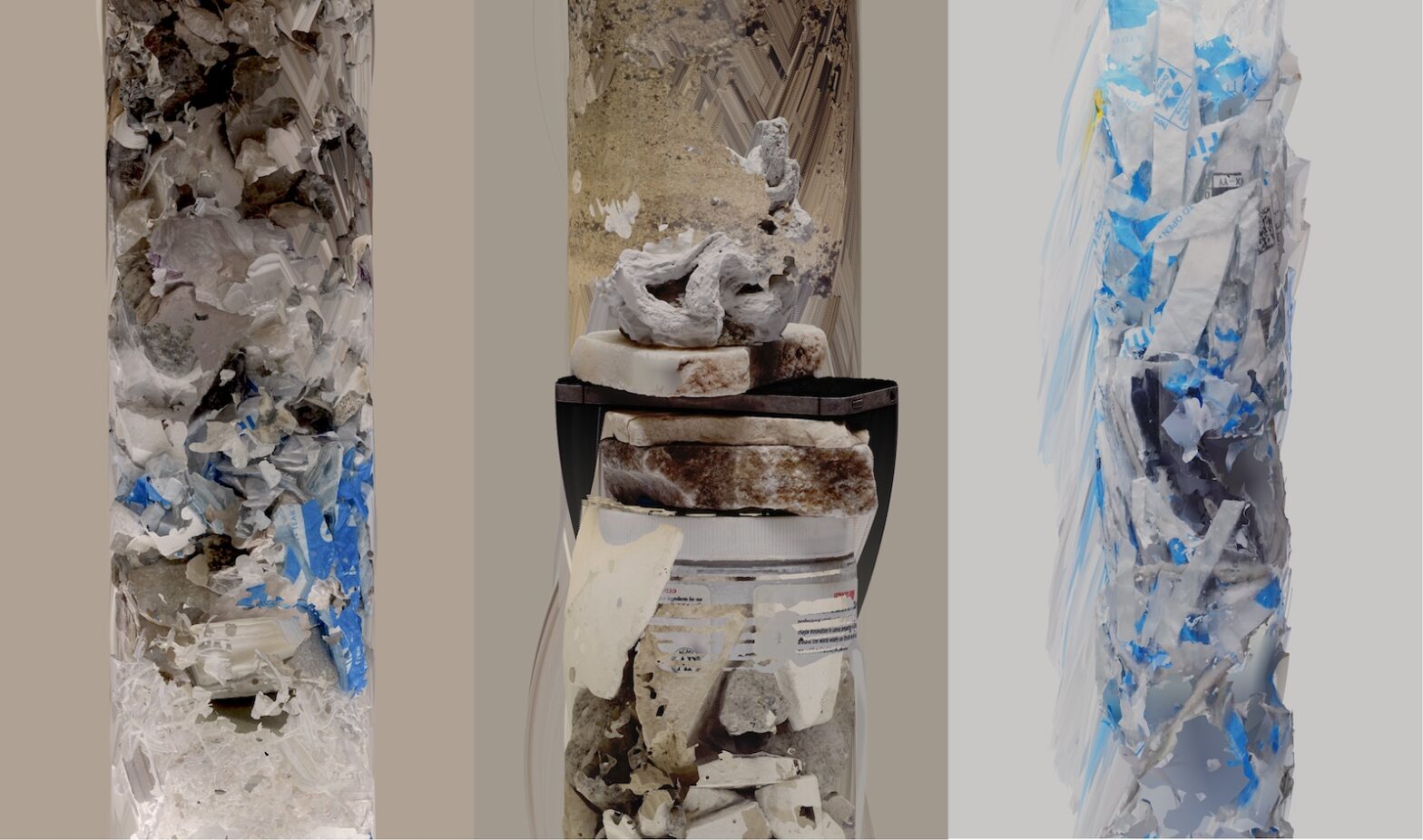
Dev Harlan has launched on Niio his most recent series of artworks, Speculative Cores, which offer a compelling visual metaphor of the effects of our consumerist society on the environment. In this interview, he elaborates on the concepts and the processes behind his work.

Dev Harlan. Speculative Cores (Internet of Bubble Mailers), 2024

This new series explores the impact of our consumerist society on our planet, made evident in the growing amounts of waste that we are producing. It is obviously connected to your previous work exploring geology and terraformation. Can you elaborate on the connections between your previous work and this series?

Much of my work has a geological theme motivated by travels and residencies in the desert, and more recently my continuing education in Earth Science. When studying the landscape it is difficult to ignore the effects of anthropogenic change. The most obvious in the desert being strip mines, of which I have visited many. These are inextricably linked to technology –every single electronic device, battery or screen contains elements that must be extracted from the Earth.

In my previous moving image artworks I have worked with this theme of global resource extraction and the myth of limitless consumption through the juxtaposition of landscape elements and technological debris. This new work “Speculative Cores” is just one step adjacent where I am expressing this theme through the language of geoscience, specifically the well known form of the geological core sample. Technology is seen buried in stratigraphic layers with the rocks and minerals of which it is made.

“Every single electronic device, battery or screen contains elements that must be extracted from the Earth.”

The artworks present a series of 3D-scanned elements including sand and stone, as well as plastics and e-waste. Can you describe the process of creation?

In some ways this begins from a habit of collecting things. I have boxes of jars and bottles containing sand samples I have collected from all over the world, wherever I travel. Rocks also. I also have accumulations of electronic junk in the studio, and sometimes collect more from recycling centers and the vast amounts of waste left on sidewalks and loading docks throughout NYC. 

In my process of 3D scanning artworks in the studio I began mixing materials–studies or works in progress with sand and rocks and broken electronics. For the core samples series I layer all these diverse materials in a large acrylic cylinder and create a scan of the cylinder. The scans are then further combined and composed with each other using digital tools.

“Our landfills will one day be parts of mountains, with cell phones, cars, bricks and diapers. We may ask with seriousness, is that the record we wish to leave behind?”

Composing these 3D scans as cylinders that evoke geological core samples gives a powerful message, suggesting that all this trash and debris will remain on our planet long after our present time. Do you think that viewers will grasp the meaning of the core sample as a testimony of a process of centuries, or millenia?

Certainly that is the intention, and indeed many of the proposed definitions of the Anthropocene epoch attempt to define a specific place in the geological record where humans have already left indelible traces, such as increased CO2 concentrations in stone, or radioactive particles from nuclear weapons testing.

I see many artists examining this form of the core cylinder, in what has been termed the ‘geological turn’, as it is a widely recognized shorthand for our ability to understand Earth history through the geosciences. In a real sense a core can be considered a dataset that records hundreds of thousands or even millions of years. But so also is the side of a mountain. Our landfills will one day be parts of mountains, with cell phones, cars, bricks and diapers. We may ask with seriousness, is that the record we wish to leave behind?

Dev Harlan. Speculative Cores (Alabaster Quickcam), 2024

Besides the conceptual aspect of putting these elements together, there is a clear attention to aesthetics, as is also evidenced in your previous series Hegemony of Screensavers. Which aesthetic decisions influenced the making of these compositions?

The photogrammetry scanning process comes with a lot of artifacts and unpredictability and there is a tension between wanting to embellish or “improve” the scan versus letting the model be what it is. I think I take a cue here from Hito Steryerl’s “poor image” theory in that leaving the artifacts and distortions in the scanning process helps tell the story of what the artwork is and how it came to be. The model simply rotates through the frame against a solid field to achieve a sort of literalness in presenting a 3D scan as precisely what it is. 

At the other end of this tension I do want to add some uncanniness or departure from reality, as the artwork is still only a facsimile of the real. The trailing after image I use a lot also has a sort of literalness to it – the incremental temporality of time base art. It also provides emergent aesthetic properties and a sort of elegance in pattern and form that I find satisfying. Part of the strategy is to draw in a viewer’s attention with an aesthetic appeal which, on closer inspection, may communicate a more difficult story about the entanglement of nature and technological civilizations.

“I aim to achieve a sort of literalness in presenting a 3D scan as precisely what it is, but I also do want to add some uncanniness or departure from reality, as the artwork is still only a facsimile of the real.”

Dev Harlan. Speculative Cores (Salt Lake Slab), 2024