
Pau Waelder
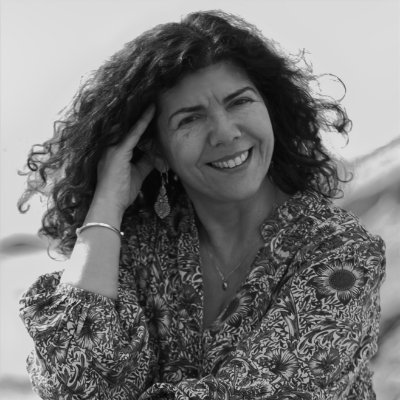
Elsa Carvalho’s path into visual art began not in a studio, but in the structured logic of computer science. A Portuguese software engineer with a PhD completed in 2012, she turned toward artistic creation in 2021, at a moment when the NFT movement opened new doors for digital experimentation. On the occasion of her solo artcast The Unfolding on Niio, we asked her a series of questions about her artistic practice and creative process.
In this conversation, Carvalho reflects on how poetry and coding share a common ground in working within constraints, how open access to AI tools made image-making accessible to her as a newcomer to visual art, and how she gradually moved from early experimentation toward a more personal visual language.
Elsa Carvalho. TheUnfolding#1, 2025.
You work as a software engineer but you have also always been interested in the arts, and have written poetry and prose. How would you relate poetry and literature to creative coding?
In my professional practice I always felt that coding is a very creative activity. Although this may seem counterintuitive, because it is full of rules and constraints, the fact is that you are creating something and, in the end, a result will emerge. There are different ways of achieving the same result, and the process of searching for and choosing a path is something I find very appealing. Often, what matters is not only the final output, but the decisions made along the way.
The same happens with writing. There are rules in language as well, but they can be bent or broken for poetic reasons. In creative coding I feel a similar freedom: working within constraints, but still allowing intuition, experimentation, and small deviations that can change the outcome.
“Creative coding means working within constraints, but still allowing intuition, experimentation, and small deviations that can change the outcome.”
You decided to dive into visual art in 2021, at the time of the NFT boom. How did the NFT scene shape your understanding of art, and how has it evolved over the last years?
The NFT movement was the trigger for me to start exploring digital art. It felt like something important was happening and I wanted to be part of it, not to be left out of what seemed like a meaningful way to step into digital creation. In many ways, it was the entry point that allowed me to discover this artistic side of myself.
At that time, I had no experience with digital art, and that was one of the reasons AI attracted me so much. It opened the possibility to experiment visually without a traditional background. In that sense, AI felt very democratizing, allowing many people, including myself, to explore image-making in a more accessible way.
More recently, my relationship with that space has changed. I became more interested in slower processes and in developing a personal visual language. Discovering platforms like Niio, where my work can exist on large screens or in people’s living spaces, appeals to me more now than the NFT space itself. Still, I feel I will always be connected to that movement, as it was the precursor to my entry into the artistic world, and I owe a lot to it for opening that door.
Elsa Carvalho. TheUnfolding#2, 2025.
As a software expert, you know how software can shape what a user is able to do or even think they can do. Over the last decades, artists working with code have developed new tools that allow them to bypass the limitations of commercial software, and created a community around sharing. What do you think of this open source movement and how has it helped you as an artist?
I think the open source movement is very relevant and powerful. One of its biggest strengths is that it allows people to bypass the high costs of commercial software and to build tools together that anyone can use. This kind of shared effort has a real impact and reaches millions of people.
In my own practice, I did not take full advantage of artist-led open source tools, but open access to AI algorithms was essential for me in the beginning. Having Google notebooks available, with increasingly better GAN models and later other algorithms, was what allowed me to start experimenting with AI and image generation.
I also used non-paid platforms like Artbreeder, especially in my early exploration, alongside commercial AI tools. So my path was a mix of open, shared resources and proprietary software. Without that initial access to open algorithms and notebooks, I probably would not have entered this field in the same way.
“Discovering platforms like Niio, where my work can exist on large screens or in people’s living spaces, appeals to me more now than the NFT space itself.”
You use creative coding to generate visuals that then feed into an AI model to create a unique visual language. Can you take us through this process?
My process usually starts with creative coding. Through code, I generate images with more geometric structures, and this is where the core aesthetic of the work is defined. At this stage, I also establish the color palette and the visual coherence that runs through the series.
These images then become the starting point for the use of AI. AI allows me to introduce more organic qualities into the visuals, inspired by natural forms. It transforms the geometric structures and adds a layer of complexity and softness that I could not achieve through code alone.
From there, I curate the resulting images and use them as the basis for video works. I use AI tools to create the videos, either by introducing movement into the images or by morphing between different images. This final step allows the work to unfold over time and reinforces the idea of transformation that is central to my practice.
“I started my artistic practice with a mix of open, shared resources and proprietary software. Without that initial access to open algorithms and notebooks, I probably would not have entered this field in the same way.”
Both creative coding and artistic creation with AI deal with the tension between controlling the output and letting the program surprise you. How do you manage this tension? Do you sometimes fear that a good visual might be ruined once interpreted by the AI?
There is always a balance between control and surprise in my process. With creative coding, I have more control over structure, color, and overall direction. With AI, I accept that the visuals will change in ways I cannot fully predict.
Of course, there is always the risk that a visual I like might be altered in a way that does not work. But one of the pleasures of working with AI, and also with creative coding that includes some degree of randomness, is precisely the possibility of being surprised by the process.
Unexpected results often become important. Sometimes they even guide the direction I decide to follow. Rather than trying to protect a single image, I work through many variations and curate carefully, trusting that the process itself will lead me to the right outcomes.
Elsa Carvalho. TheUnfolding#3, 2025.
You have stated that your interest in organic forms stems from your childhood experiences in a farm, surrounded by animals and nature. Yet the forms you create are abstract and strongly evoke Surrealist painting. Why have you chosen this aesthetic?
Organic forms appeal to me a great deal, and that comes from growing up surrounded by animals and nature. Those experiences stayed with me, even if they are not represented in a direct or literal way.
At the same time, I am not interested in reproducing nature as it is. I prefer to work with suggestion rather than representation. By keeping the forms abstract, I can give hints instead of clear answers and leave space for the viewer’s own interpretation.
This approach allows me to connect personal memories with a more open visual language. The work does not describe something specific, but it can still evoke familiar sensations or emotions linked to nature.
Your early work shows more “mainstream” experimentation with AI, first applying textures to photographs of nature, then generating portraits of women with surreal elements, then moving into classical painting and surreal scenes that remind the work of Max Ernst and Paul Delvaux, as well as some photorealistic imaginary landscapes. What didn’t work for you in all these phases, that made you move forward? How have the advances in AI image generation contributed to this process?
It is interesting that you ask this question. When I started this path, not long ago, I met several Portuguese artists who were also involved in NFTs. I remember speaking with one of them about how to find my own style, and she explained it very simply: it can only happen with time, experimentation, and by understanding what makes sense for you at each moment.
In the early days, I was mainly exploring the tools. I was trying different approaches, testing what AI could do, and learning through practice. What did not work for me in those phases was the feeling that the results were too dependent on existing visual references, and that they resolved too quickly.
I enjoy experimenting, and I tend to move on when repetition becomes too comfortable. Over time, and with the advances in AI image generation, I was able to refine my process and gain more control. Now that my creation pipeline is better defined, it is easier for me to explore different themes while keeping a consistent process and aesthetic, which I hope is becoming more recognisable.
“One of the pleasures of working with AI, and also with creative coding, is precisely the possibility of being surprised by the process.”
Color plays an important role in your compositions, which feature deep blues and bright oranges and yellows, as well as a wide range of strongly contrasting colors that underline the constant changes taking place. How do you work with color? Does it serve purely compositional concerns or does it incorporate a particular meaning?
I work with a small set of color palettes that I use in a more or less random way during the creative coding phase. This helps give consistency to the final works, even when the forms and structures change.
I am very drawn to strong colors. Sometimes the world feels very grey, especially in the period we are going through, and I feel that people need strong colors in their lives. For me, color brings energy and intensity to the work.
There is no specific meaning attached to the colors I choose. Intuition plays an important role. In the end, the resulting colors are a mix of what comes from the initial coded image and what comes from the AI prompts, and I curate the results by choosing the images that appeal to me the most.
“Sometimes the world feels very grey, and I feel that people need strong colors in their lives. For me, color brings energy and intensity to the work.”
In the series tran·sience you collaborated with Bruno Miranda, who created a musical score for your compositions. Seeing the artworks with music almost feels as if the shapes are reacting to the score. How did this collaboration come to be? What does music bring to your work?
Bruno Miranda is my husband, and although music is not his day-to-day work, he has a strong passion for composition. The collaboration came very naturally, as it felt like a way to give the videos a stronger impact.
The process usually starts with the visuals. Once a video is ready, I ask him to create a musical composition for it, sometimes suggesting a mood or style. Music adds rhythm, movement, and emotional depth that the visuals alone cannot convey, making the work feel more alive and immersive.
Elsa Carvalho. TheUnfolding#4, 2025.
You have stated that impermanence is one of the most fundamental truths of life. Following this line of thought, where do you think your work might take you next? Have you considered video mapping, installation, sculpture, or other forms of creation?
Like my works, I tend to let life and intuition guide me. After several years working consistently on my process, sharing my work on X (ex-Twitter), and selling NFTs occasionally on different platforms, I began receiving more recognition. Instead of going after opportunities, I started getting invitations.
First, I was invited to sell my videos as NFTs on a well-known AI video platform. Later, platforms like Niio, which provide video artworks to be shown in public spaces or companies, invited me to submit my work so their clients could choose from my artworks. More recently, I was invited to create pieces for an important event here in Portugal. Challenges make our minds search for creative solutions, and if somebody challenges me to show my work in a different or innovative way, I will certainly try to make it happen. I prefer to let these kinds of invitations guide me and shape the work I explore next.