
Niio Editorial
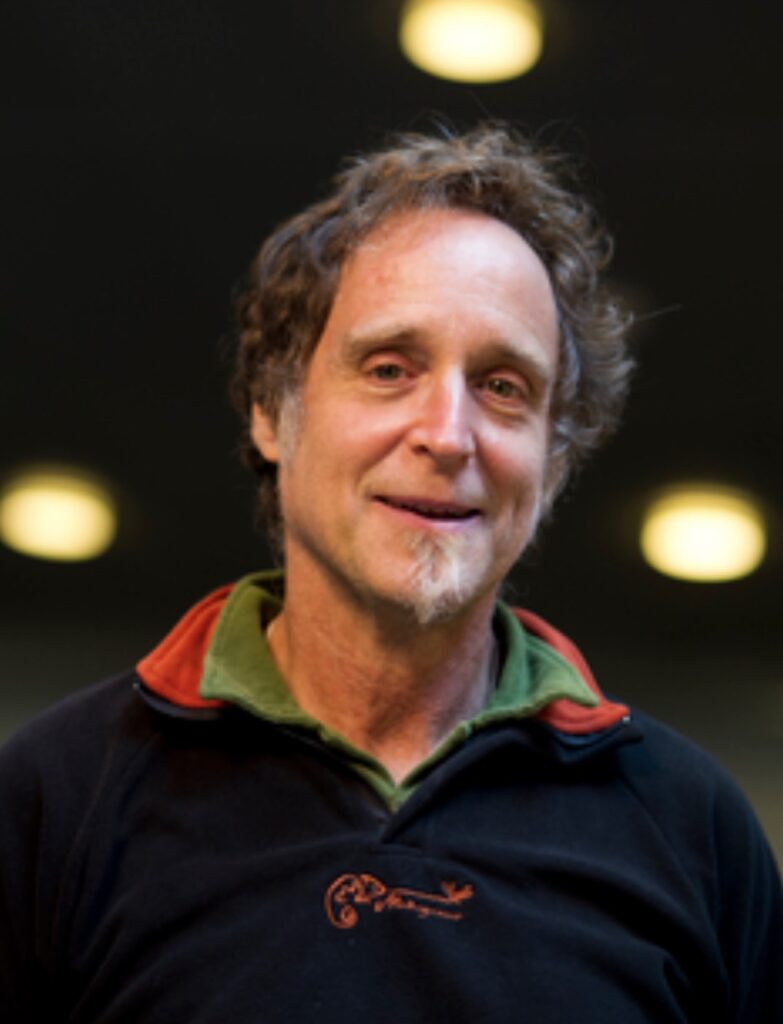
Dennis H. Miller’s career bridges modern concert music, digital media, and contemporary art. Trained as a composer at Columbia University, Miller spent almost four decades as a professor at Northeastern University, where he taught composition and multimedia art while refining an interdisciplinary practice that treats the digital canvas like a musical score.
His work is an exploration of the potential for Artificial Intelligence to extend the boundaries of visual expression. Leveraging an extensive personal archive of tens of thousands of photographs, Miller engages in a dialogue with technology, using specific algorithms and generative systems to create environments of color and motion that feel both fluid and mathematically precise.
In this interview, Miller discusses the “composer’s mindset,” the ethical necessity of original source material in AI, and why the most profound artistic meanings are those that emerge slowly through time.
Dennis H. Miller, In Living Color #8, 2025
How does music theory influence your AI-generated work?
I approach everything as a composer – though the medium might change, the thinking doesn’t. I’m focused on pacing, proportion, and how something develops over time. This works especially well for animation, as both it and music are time-based. Color relationships function a lot like harmony, and the interaction between elements feels very much like counterpoint. Even in a still image, I’m thinking about movement—how the eye travels through it, where it settles, how it resolves. AI is just another way to generate material that I can shape and structure.
Dennis H. Miller, Materialism 2, 2025
Can you explain the process of selecting a seed image? Do imperfect photos ever work better?
When I consider a photograph as source material, I’m looking for underlying structure. Things like tonal balance, spatial relationships, and irregularities matter more than subject. In fact, imperfect images often work better. A technically flawed photo—uneven lighting, distortions, artifacts—can give the AI something more interesting to work with. A “perfect” image is often too complete; it leaves less room for transformation.
“I approach everything as a composer – though the medium might change, the thinking doesn’t.”
Why prioritize a more cerebral engagement rather than immediate emotional impact?
I’m not against a viewer having an emotional response to one of my works – I just don’t want to force them into feeling any specific way or impose specific associations on them. Kandinsky noted that viewers often search for subject matter in abstract work, imposing meanings that were never intended and missing what is actually there. By removing obvious cues—faces, narratives, familiar imagery—the viewer has to spend a little longer with the piece, and the experience builds gradually. It’s closer to how music works—meaning emerges through engagement, not instantly. Work that relies on an immediate emotional impact tends to deliver a quick response and then fade. I’m more interested in something that holds attention over time.
Dennis H. Miller. In Living Color #6, 2025
How do you resist AI’s tendency toward realism and popular aesthetics?
Left on its own, most AI models will default to familiar imagery and polished effects. I spend most of my time pushing against that. Prompts are kept tight and specific, with a strong emphasis on abstraction. Negative prompting also plays a big role in removing recognizable elements. There are also new tools that let the artist build his/her own models that are based on abstract work – I use these extensively. Just as important, I discard most outputs, often 70-80%. Acting as a “curator,” I filter aggressively until something aligns with the work I’m trying to make.
“Abstract art is closer to how music works—meaning emerges through engagement, not instantly.”
When AI suggests an unexpected direction, how do you decide whether to follow it or steer it back?
The question is whether it strengthens the piece. If the result has more clarity—better form, stronger structure—I’ll follow it. If it introduces noise or weakens the composition, I pull it back. It’s really pretty simple – does it make the piece stronger or not?
Dennis H. Miller. 1944, 2025
Is there a consistent sense of completion across music, animation, and still images?
Yes, but it doesn’t come from traditional ideas of harmonic resolution or preexisting formal structures. My music is atonal, so there’s no inherited roadmap, such as ending in the same key it started in. The decision is intuitive, based on years of listening, composing, and recognizing when something is working and when it isn’t. There’s a point where the piece feels resolved, not because it arrived somewhere prescribed, but because adding more would start to weaken it.
That carries across to animation—it’s when the main thematic elements I’m working with have played out to some logical conclusion – they are resolved in terms of what I set out to explore. In shorter works, there often isn’t the time to fully develop those ideas, so the ending is more compressed. In longer pieces—especially those meant for theatrical screening—I can really let those elements unfold and evolve, and that’s where the work fully becomes “visual music.”
In a still image, it’s when the elements sit together in a way that feels stable and complete. Different medium, same instinct.
“There’s a point where the piece feels resolved, not because it arrived somewhere prescribed, but because adding more would start to weaken it.”
There’s also the practical side. Often there’s a fixed duration required by a venue or a commission, and that can really help. I’d rather have a clear time constraint—it gives the work a frame. Stravinsky talked about how starting from a blank page can be the hardest situation, and I agree. Give me limits—time, scale, instrumentation—and the work tends to become more focused. The constraints don’t get in the way; they help define the piece.
Dennis H. Miller. In Living Color #12, 2025
With so many iterations, how do you identify which images truly resonate?
Most of them don’t. I go through things pretty quickly. If something doesn’t read clearly or feels like it’s relying on surface detail, I move on. The ones I keep usually have a kind of internal order—you can feel that they’re holding together in a meaningful way.
“Most of what we see is fast, direct, and constantly demanding attention. This work does the opposite. It doesn’t push or explain; it just unfolds at its own pace.”
What do you hope viewers experience with your slower, atmospheric work?
I’m not trying to deliver a message or change how people think. What I’m after is much simpler—giving someone a few minutes where things might slow down a bit. Most of what we see is fast, direct, and constantly demanding attention. This work does the opposite. It doesn’t push or explain; it just unfolds at its own pace.
Because of that, the experience changes the longer you stay with it. At first, it might just register as an image or a field of motion, but over time the relationships inside it become clearer—how things shift, how they balance, how they change. I’m not asking the viewer to figure anything out – just to see what is there. If that works, maybe it gives a little boost to their day.
Dennis H. Miller. Pyrology #9, 2026
What did you take from directing the Visual Music Marathon, and how can platforms like Niio help today?
The Marathon made it clear how much strong work exists, and how little of it people actually encounter. We had over 300 submissions from 23 countries, and about 70 works were selected. The 12-hour program also included an hour of historical work presented on film, along with two hours curated by guest curators. It gave a clear sense of both the range of what’s being made and how much of it remains largely unseen.
What we did see was a consistent audience—there was a packed house for nearly the entire program. That suggests there is real interest when this kind of work is actually made available.
“With so many screens now everywhere, there’s an opportunity to place abstract art where people will come across it as part of everyday life.”
That’s where platforms like Niio can help. With so many screens now—in homes, public spaces, and commercial environments—there’s an opportunity to place abstract, non-narrative work where people will come across it as part of everyday life. Over time, that kind of visibility can make this work feel less peripheral and more like a natural part of the visual landscape.
Dennis H. Miller. Dance Glass 1, 2026
What is the most important ethical consideration for artists working with AI?
For me, the issue is avoiding dependence on other artists’ work. A lot of AI output draws heavily on existing styles, and it’s easy to end up producing images that feel derived rather than independent. That’s where the ethical concern sits.
The way I address that is by keeping the work grounded in my own material. I don’t use artist prompts, and I train models on my own imagery so the results come out of my own practice, not someone else’s.
“The work has to come from your own decisions, your own source material, and your own direction.”
You see a lot of images now that look interchangeable, often coming from the same systems and settings. The important thing is not to let the software or its presets determine the result. The work has to come from your own decisions, your own source material, and your own direction. That’s what keeps it distinct and avoids crossing into someone else’s territory.