The Meditative Surrealism of MiraRuido

Niio Editorial

Joseba Elorza—the Spanish artist from Vitoria-Gasteiz better known by his synesthetic moniker MiraRuido—delves into the delicate balance between tranquil aesthetics and underlying tension that defines his signature form of collage surrealism. Originally trained as a sound technician before his passion for visual collage took over, Elorza has spent the last two decades building an impressive portfolio with clients like National Geographic, The Wall Street Journal, and Green Day. In this interview for Niio Editorial, the artist discusses his evolving creative process, from meticulously hunting for found footage to carefully building his intricate digital collages.

MiraRuido. 2 Lands, 2026

You have ample professional experience as an illustrator and creator of music videos. In both these types of creative projects there is a strong narrative element that guides each composition or animation. How do you work with this narrative aspect in your work? Does it drive your choice of elements, aesthetics, and the development of each scene, or do you keep to a central form of narration that is the core of your artistic practice?

Two decades of creative work give you room to experiment, and along the way I’ve realized I basically work in two different but complementary ways. One is the obvious one: I open a blank notebook, think about what I want to say, and start sketching whatever visual forms come to mind to say it. The other starts somewhere else entirely. I open the archive of photographs and footage I’ve been collecting for years and just browse through it. Sometimes a photo of a person doing one very specific thing triggers an idea, and I connect it straight to whatever commission or project is sitting on my desk. From there a snowball starts rolling and there’s no stopping it.

The narrative is usually the spine, but it doesn’t always come first. Sometimes I know the story and go looking for the image. Other times the image arrives before I know what it’s about, and the meaning surfaces while I’m building it. What stays constant in both cases isn’t a plot so much as a single situation, usually a figure who’s witnessing something rather than acting on it.

MiraRuido. Hold, 2023

Your visual style could be described as “sunny day surrealism” for its uplifting themes, bright colors, and overall positive and calming atmosphere. What leads you to create this particular ambience in your compositions? Which are your sources of inspiration?

I understand why it gets described that way, though I’d add a layer to it. The bright skies and the calm are deliberate, but they’re a hook, not the subject. What I’m really after is the moment right before discomfort, a beautiful space with something slightly wrong in it that you can’t immediately name. The light and the color are there precisely so the unease lands softer and stays with you longer.

The difference between a piece and a decorative image, for me, is whether something in it quietly refuses to let you feel entirely comfortable. My inspiration comes less from other image-makers than from cinema and from certain everyday situations that already feel surreal on their own.

“What I’m really after is the moment right before discomfort, a beautiful space with something slightly wrong in it that you can’t immediately name.”

Collage animation is a particular form of artistic expression that requires the ability to find the right elements and create a living scene from still, bidimensional images. Can you walk us through your creative process and the making of your animations?

Finding the right elements for a piece eats up a huge part of my time, and it’s something I’ve always loved, that search. They say a person spends a third of their life asleep; I’ve easily spent a third of my working life looking for photos and footage.

These days you can generate your own assets with AI, but my process hasn’t really changed. An animation always begins with a composition in Photoshop. Sometimes I detail it heavily, sometimes less, but the image has to hold up on its own first. Once it does, I rebuild everything in After Effects and the animation begins. Water moves, clouds drift, a flock crosses, but the figure usually stays still. And it’s during that search for material that the work itself can take directions I hadn’t planned, which is the part I find most rewarding.

MiraRuido. Life, 2026

“I’d rather create an artwork on two levels and let the viewer choose their depth than spell out the theme”

Some of your artworks have been conceived as NFTs. What has been your experience in the NFT community and market?

It’s a complicated world that’s lived through its own bubble. But at the time it mattered to me for a very concrete reason. As a digital artist who’d spent nearly twenty years handing his work over for other companies to monetize without ever seeing a cent of it, that moment opened a door: the door to actually living off my personal work. Client illustration and animation have always been my livelihood and I’m grateful for that, it’s wonderful work. But getting to live off the pieces that genuinely resonate with you, with no client brief in sight, is the best thing there is for an artist like me. It was impossible to turn down. 

MiraRuido. Roomscape 01, 2023

The Roomscapes series was created during the pandemic, but it still resonates with our daily experience of the spaces we live in and the places we would like to escape to. You have expressed that this project was well received. Can you tell us about its development and what has fascinated viewers about it?

Roomscapes grew out of a previous series called ‘Inside Worlds’, which I made in 2021 with the lockdown still fresh, landscapes folded inside four walls. But I quickly realized those rooms meant something more personal than the pandemic. I’m an extremely introverted person, and my home has always been a refuge that also makes me feel slightly guilty for staying in. That tension, where the interior keeps me safe but the exterior keeps pulling at me, is what the rooms are really about. I think it resonated because everyone recognizes it now: the comfort and the quiet claustrophobia of the space you live in. With Roomscapes I cut the pandemic thread and left the concept open, so each viewer could furnish the room with their own version of that feeling. 

“Roomscapes resonates with people because we all experience the comfort and the quiet claustrophobia of the space you live in.”

Decoupled is a particularly evocative and fascinating artwork that has been very favorably received among our audience at Niio. Despite its apparent simplicity, it is an elaborate combination of different animations that has been presented in different formats and contexts. Can you tell us more about this artwork and its making?

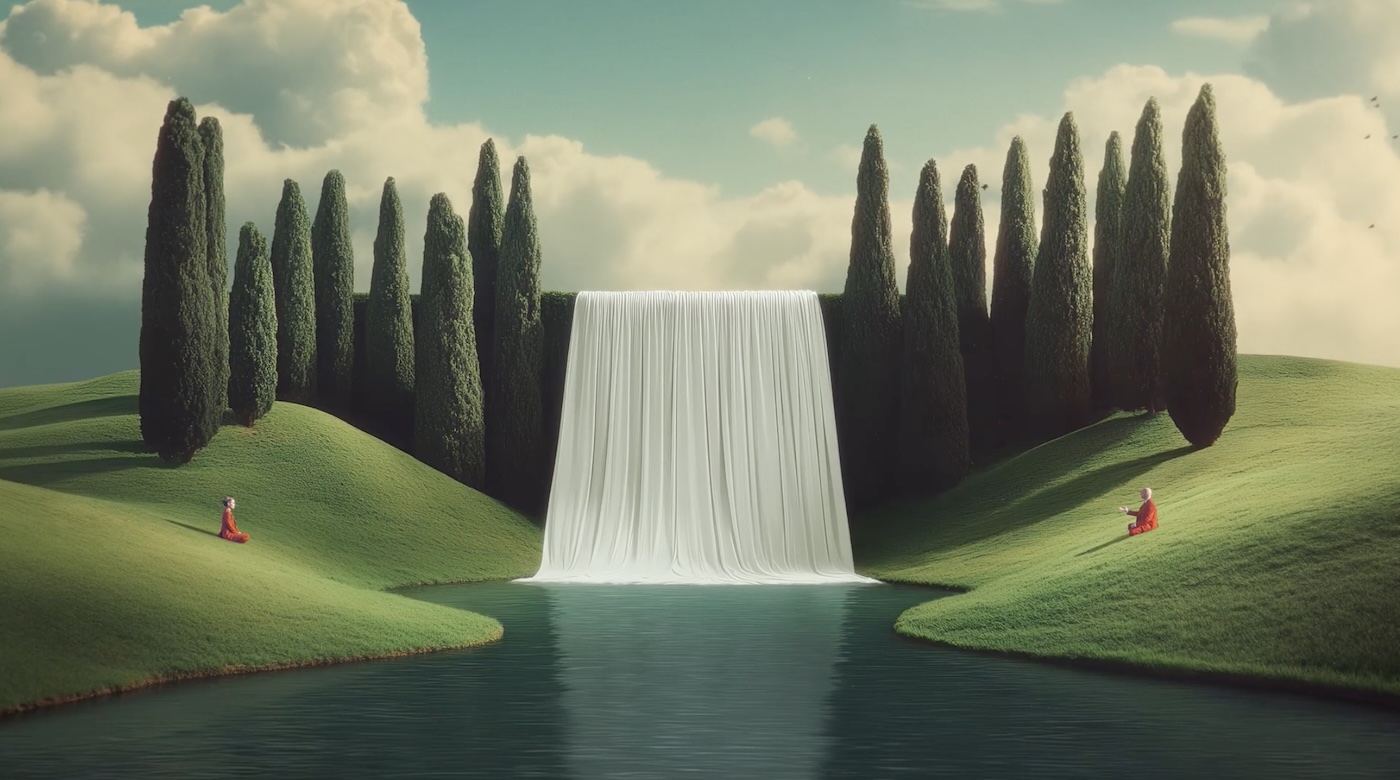
It looks simple, but it’s the opposite. The piece is about the sterile dialogue a couple ends up trapped in, the one where you’re not really listening, just waiting for the other person to stop talking so you can say your part. Two figures exchange gestures that never quite connect. The cypresses are their shared world, swaying back and forth in a loop that goes nowhere. And the veil running down the center is the distance growing between them, beautiful and indifferent. I always saw Magritte’s Les Amants as a painting about frustrated passion. Decoupled is what I imagine comes after: the veil is still there, but the passion’s gone and what’s left is the silence.

Technically it’s a combination of separate videos and images that come together to compose one enormous piece. 

MiraRuido. Decoupled, 2026

The Afterlife series depicts a series of calm, dreamlike scenes which actually illustrate reflections about life, death, and eternity. The contrast between the peaceful images and the profound themes they address is particularly interesting, but it also might lead to misunderstanding what the artworks are about. How do you deal with the multiple readings of your work?

I don’t try to control the readings, and the contrast you mention is intentional. Afterlife places very heavy subjects, death, eternity…. The risk is obvious: someone sees only a peaceful image and stops there. But I’ve made my peace with that. I’d rather create an artwork on two levels and let the viewer choose their depth than spell out the theme and kill it. The serene surface isn’t a disguise for the dark content; they’re the same thing. Death is dramatic, but it’s peaceful too. It’s the final stillness, the total stop, the most peaceful and the most dramatic thing at once. The series itself is about how I imagine life after death, if it existed at all: as an infinite tension, eternally unresolvable. 

MiraRuido. Cloud, 2021

In a similar vein, Death addresses the end of life but it does so through a beautiful depiction, a composition whose theatricality is inevitably mesmerizing. Considering this series, as well as Afterlife, and Life, how do you imagine the emotional response of viewers? 

I don’t aim for a specific emotion, and I’m wary of artists who claim they do. What I hope for is recognition more than reaction, that someone stands in front of one of these and feels something they were already carrying but hadn’t seen put into an image. With the death pieces especially, I’m not after sadness or fear. If anything I want a strange calm, the kind you feel looking at a landscape that’s completely indifferent to you. In Death the grand architecture adds the theatricality, that melodrama we’ve all collectively built up around dying over the centuries. The beauty isn’t there to soften the subject. It’s there because I think these themes really are beautiful, in a way we’ve been taught to find frightening.

“The real challenge is keeping the work recognizably yours as it moves between contexts that each pull it in a different direction.”

You have exhibited your work in art galleries, festivals, public spaces, streaming platforms such as Niio, and have even created merchandise. What can you tell us about the possibilities and challenges that artists face when distributing their work through these different spaces and channels?

Each channel asks for a different version of the same work, and each one teaches you something. Galleries and festivals give you context and credibility but reach few people and move slowly. Public space is the opposite, enormous reach and almost no context, so the work has to land in three seconds. Streaming platforms like Niio are the most interesting shift for me, because screens are everywhere now and a moving piece can finally live in a space the way a painting does, only designed for light and time instead of canvas. Merchandise is humbler but honest; it’s how people who can’t collect a piece still get to take it home. The real challenge isn’t picking one channel. It’s keeping the work recognizably yours as it moves between contexts that each pull it in a different direction.
Addy Feuerstein: “Live Your Own Time, Child”

Pau Waelder  

Addy Feuerstein is a tech entrepreneur, designer, and AI artist. On the occasion of the launch of the “Artificial Nostalgia” artcast on Niio, we talked about his retro-futuristic universe, where he utilizes generative AI tools like Midjourney to recreate the elegant, optimistic machine aesthetics of the 1950s and 60s as a way to explore how the past envisioned our present. Throughout the conversation, Feuerstein reflects on his collaborative relationship with Midjourney in the creation of this series and addresses the contemporary skepticism surrounding AI art, sharing his insights on how modern artists must become multi-faceted curators of their own distribution channels while embracing the cultural shifts of our digital era.

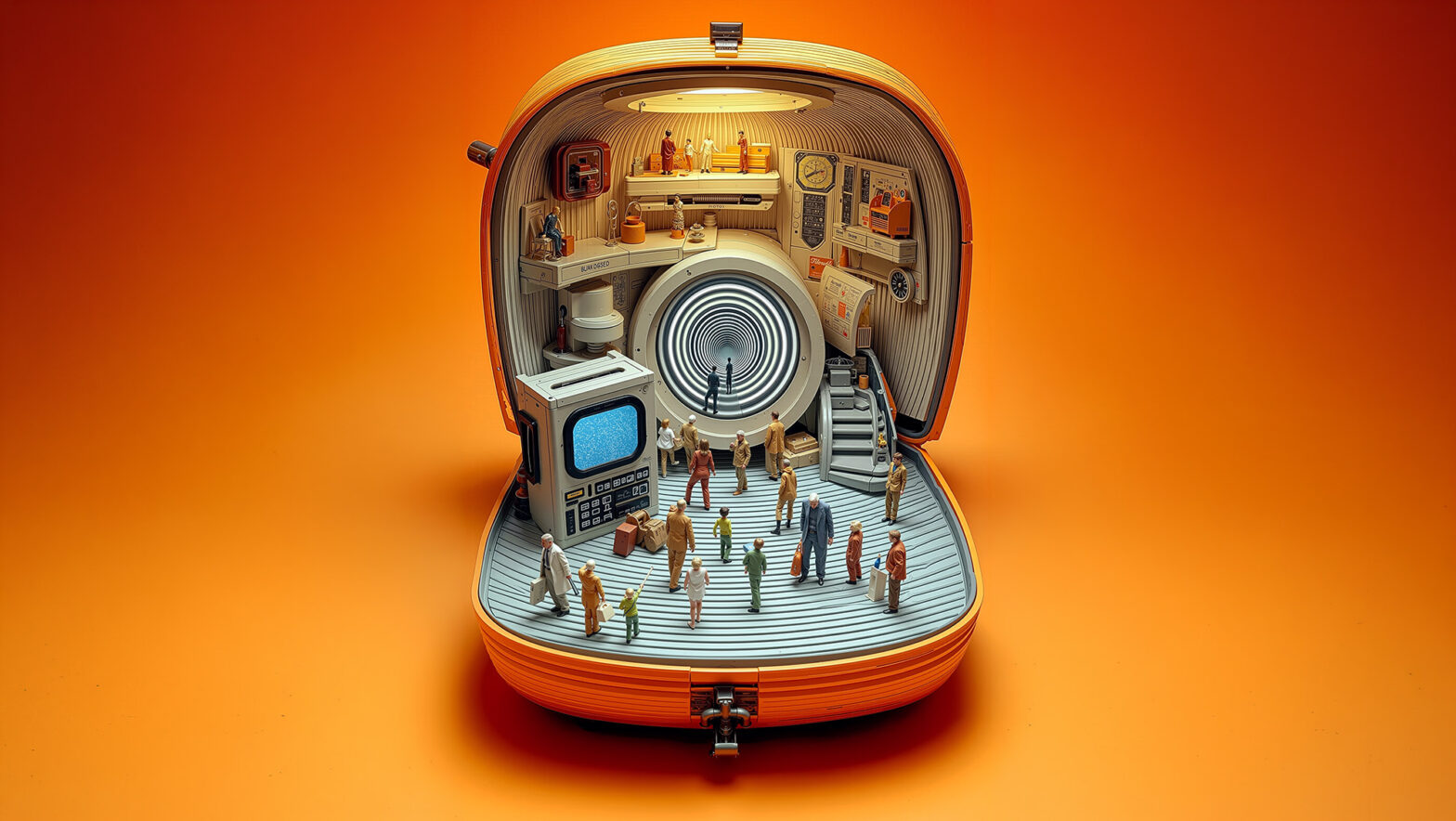
Addy Feuerstein. Artificial Nostalgia – Triptych #1, 2026

As a tech entrepreneur and designer, you have extensive experience in the tech and design industries. What drove you to develop an artistic persona, and how do you navigate the art world compared to the tech and design communities?

I never experienced these worlds as separate. I studied art and design, and although after school I was immediately drawn to tech, it was always there in the background, so in a way I feel like I’m coming full circle now.

The same topics that I explore in my art, such as time, the relationship between people and technology, and the sense of an individual within a crowd, were always present in my entrepreneurial career, mainly in my first startup, AllofMe, which explored personal memory through digital timeline representations. For example, you could explore your life in parallel with a historical technology timeline and examine how you were affected by it.

The interesting aspect here is that AI artists are very much tech entrepreneurs themselves. The development of the tools is happening so fast that you must be very tech-oriented to keep up. So, it actually feels very familiar to tech.

For me personally, generative AI is particularly rewarding. I was always a very visually oriented person. My dream was to become an architect, but unfortunately, I can’t draw very well. AI allows me to “paint with my mind” and create visuals that were not possible for me before, so it feels like I was suddenly awarded a new limb. It’s like a dream come true, and in a way, I feel like I have been waiting for it my whole life.

“AI artists are tech entrepreneurs themselves. AI is evolving so fast that you must be very tech-oriented to keep up.”

Artists often describe their relationship with AI tools as a “collaboration,” in which the AI system has a certain agency that can shape the outcome beyond the artist’s imagination. In this sense, how is your relationship with the tools that you use? How do you balance the willingness to control the outcome and the openness to be surprised by it?

Oh, it’s definitely a collaboration, and possibly even more. When I first exhibited the Artificial Nostalgia series at Reichman University, I gave the AI full credit. The sign next to the work read: “By Addy Feuerstein and Midjourney”.

When I work with AI, I sometimes intentionally try to confuse it using contradictory prompts mixed with poetic phrases, just to see where it takes me. Those are often the moments when I get the most surprising results. Then I take the variations that resonate with me and regenerate them again and again, gradually narrowing toward a direction that feels right.

In a way, I feel like my process mirrors the AI’s ‘diffusion’ process itself: the AI extracts an image out of noise, and I extract meaning and direction out of the AI’s noise. We are both reducing randomness, just at different levels. A single image can sometimes go through more than 100 variations before I feel like we finally “got it right”.

Addy Feuerstein. Artificial Nostalgia – The Mix, 2026

The artist Gregory Chatonsky has coined the term “Artificial Imagination (AIm)” to describe the idea that in the context of AI, an image is not a trace of reality but one in many possibilities within a latent space, and therefore it is a type of imagination not grounded in real experience but in mathematical probability. What is your take on this concept, and how would you relate it to your work?

I didn’t know that term. This is a very interesting claim.

I think that AI is basically a gigantic vocabulary of everything that has happened so far. Generative AI is, in a way, a visual index of human history that was fed into it. So one could argue, however, that it is in fact based on “grounded real-life experiences,” which also raises another question: isn’t our own human imagination itself based on a kind of mathematical probability?

“A single image can sometimes go through more than 100 variations before I feel like we finally «got it right».”

For example, when we watch a really good movie that moves us emotionally, we often develop a sense of “false nostalgia” for the time and place it represents. Are those feelings based on “grounded real-life experiences,” or on the fictional movie we just saw? And what about books, paintings, or photography?

This is exactly the “big question” I was trying to explore in Artificial Nostalgia, and I don’t have the answer. Instead, I now have even more questions. But I might have some observations: I can say that AI does an amazing job of rendering false memories that emotionally move me, perhaps more than any other medium I know.

Addy Feuerstein. Artificial Nostalgia – Triptych #2, 2026

You have expressed your preference for Midjourney. Can you elaborate on it and on how the choice of tools can determine the path of an artistic project?

It’s true. While generative AI models have developed at an amazingly rapid pace, Midjourney still stands out as a tool that enables extremely strong visual interpretations. This is not an accident. It works differently from many of the other tools. It relies on large-scale human crowd rating of “what is beautiful,” and therefore it has a massive aesthetic bias. It is heavily optimized to prioritize lighting, composition, atmosphere, and artistic flair, and most of all, it enables users to build their own personal “style” and teach the model what they themselves find beautiful.

When I work with it, it feels like we’re collaborating. I suggest directions, and Midjourney reacts with dozens of variations. I choose what I like, and it takes it from there and creates additional variations. It often surprises me with visual ideas I hadn’t thought about myself. I love this process. It feels like a ping-pong game.

The bottom line is that before Midjourney, I wasn’t creating the kind of work that I do today, and I probably could not have done it with any other tool. It allows me to create images I could previously only imagine.

“When I work with Midjourney, it feels like we’re collaborating. It often surprises me with visual ideas I hadn’t thought about myself. I love this process. It feels like a ping-pong game.”

Artificial Nostalgia uses AI to imagine a retrofuturistic world. What fascinates you about the technology and aesthetics of the 1950s and early 1960s? Is it the perception of technology as something bright and full of promise, in contrast to the more somber and dystopian views that have dominated since the 1970s?

I never really lived through the 1950s, and I was an infant in the 1960s, so obviously this is, in itself, a kind of “artificial nostalgia.”

It seems to me, however, that after World War II, which was probably the great shaping and provoking event of modern history, the world entered an unbelievably creative and, more importantly, liberating period. You can see it in art, in industrial design, in cinema, and in the music of that era. People in that period imagined the future as elegant, domestic, and almost theatrical. Technology appeared to be something understandable and aspirational rather than invisible and overwhelming.

From a design perspective, it was the era of machinery that was clear and visible. Form followed function. Bauhaus, the International Style, and even Streamline Moderne. This aesthetic simply moves me.

Today, in a way, technology itself has become hidden. Hardware has become software, as much of the technology we use now is concealed inside computers and networks, so the design often becomes just an empty UX shell. A simulacrum. I wanted to explore that emotional contradiction in Artificial Nostalgia.

By recreating imagined past futures with contemporary AI tools, the project creates a layered time loop: people from the present generating images of how people in the past imagined our present.

Addy Feuerstein. Artificial Nostalgia – The Film Drive, 2026

This series features both still images and short animations. How would you compare them, in terms of their production, the narrative, and the viewer’s experience?

The original installation of Artificial Nostalgia is exhibited as a three-screen triptych that randomly cycles through over 360 images and runs endlessly. Currently, about 70 of them include motion.

I wanted to find a way to surprise the viewer with a very subtle, almost unnoticeable difference between the still images and the videos. When you look at the installation, sometimes you’re not sure whether the image you just saw had actually moved or not.

I use a “time remapping” effect to start the motion very slowly, accelerate it momentarily, and then gradually freeze the frame again. This effect is very engaging because viewers stand in front of the piece and try to “catch” the motion.

The funny thing is that since some of the visuals are presented both as still images and as videos, I myself sometimes don’t know whether a piece is going to move or not, and occasionally I’m not even sure whether it actually did.

“Artificial Nostalgia creates a layered time loop: people from the present generating images of how people in the past imagined our present.”

You have participated in Peter Gabriel’s 50:50, a project inviting creators to imagine music videos for his songs. How was your experience participating in this project? Besides this particular project, you frequently create music videos with your studio UrbanOrigami.art. Is AI creation, with its unlimited possibilities of image creation, its tendency to surrealism, and its ability to create seamless flows between images, particularly apt for music videos? How do you integrate each song’s lyrics and music into your creations?

I think that music is probably one of the genres in which the sense of false “Artificial Nostalgia” feels especially strong. I see my children listening today to The Beatles, Pink Floyd, and Neil Young. What does this mean? It seems to me that this world is full of nostalgia by definition, and that we are all constantly trying to reimagine the past.

Participating in Peter Gabriel’s 50:50 project was, first of all, a great honor, as he is one of my all-time favorite artists. It was particularly exciting because it enabled me to interpret his beautiful 1977 song ‘Here Comes the Flood’ from today’s perspective. If you read the lyrics and Gabriel’s own expansion of them, you could see that he almost predicted today’s internet flood of information, and in a way even the AI revolution, back in the 1970s. I find that amazing.

“I love creating music videos because they leave vast room for imagination and storytelling, which is perfect for generative AI.”

I love creating music videos because they are usually open to interpretation, so they leave vast room for imagination and storytelling, which is perfect for generative AI. Besides, I guess I envy musicians. I wish I could write music. It’s a very liberating art form with an immediate emotional reward. So, I guess this is the closest I can get to it.

Addy Feuerstein. Artificial Nostalgia – Triptych #3, 2026

You have exhibited your work in art galleries, museums, festivals, online marketplaces, streaming platforms such as Niio, and have even created merchandise. What can you tell us about the possibilities and challenges that artists face when distributing their work through these different spaces and channels?

Well, I think the main challenge for AI artists is overcoming people’s fear, or even hatred, toward generative AI. It has a very bad reputation, and I can understand why. Much of the AI imagery currently being created does not feel very original. Frankly, it is a world that is full of crap, especially given the huge amount of fake and cringe imagery out there. Because of this, many people automatically reject anything that carries an “AI” label. I see that often on my Instagram.

At the same time, there is a growing movement of artists who are seriously trying to understand this new medium, explore what it means, and discover what can be done with it artistically. I think we are still in the very early stages of that process.

“Artists are no longer just creating art. We are also constantly curating ourselves, promoting ourselves, building audiences, and adapting work to very different environments.”

Additionally, one of the most interesting shifts happening today is that distribution itself has become part of artistic practice. Artists are no longer just creating art. We are also constantly curating ourselves, promoting ourselves, building audiences, and adapting work to very different environments such as galleries, streaming platforms, social media, merchandise, and digital installations.

You mentioned festivals. In a way, I think FilmFreeway has done to the film festival industry something a little similar to what Airbnb did to the hosting industry. It lowered the barrier to entry so much that suddenly there are far more festivals than before. So it became very difficult to understand which ones are actually worth your time and money.

Each space changes the way the work is experienced. A gallery invites contemplation, while Instagram encourages speed and endless scrolling. A museum creates context, while merchandise turns an artwork into an object people can physically live with. Navigating between all these worlds has become part of the creative process itself, and it is very much a full-time job.

Addy Feuerstein. Artificial Nostalgia – The Jellyfish Triptych, 2026

Nowadays even the Pope warns us about the dangers of AI. Do you think that artistic creation with AI tools can provide a more positive perception of artificial intelligence or help us understand it better, both with its bright and dark sides?

When I first wrote about Artificial Nostalgia, my first question was: “If you had a time machine, would you travel to the past or to the future?” I got surprisingly mixed answers, but for me, I’m pretty sure I would choose the future. I never feared technology, and I have always embraced it with excitement and curiosity.

So, to answer the question, I never fully understood the fear surrounding AI. I think that part of the artist’s “job” is to try to understand and express the world they are living in, and we are currently living in an AI world.

One of my favorite movies is Todd Haynes’s ‘I’m Not There’, the fictionalized Bob Dylan biography. I always remembered one quote from it, when the kid who plays the supposedly young Dylan, while performing old country music, is told by an elderly woman: “Live your own time, child.” I love that quote, and I try to live by it. The Times They Are A-Changin’, and we are all living in an AI world now. So, live your own time, child.

“The artist’s «job» is to try to understand and express the world they are living in, and we are currently living in an AI world.”