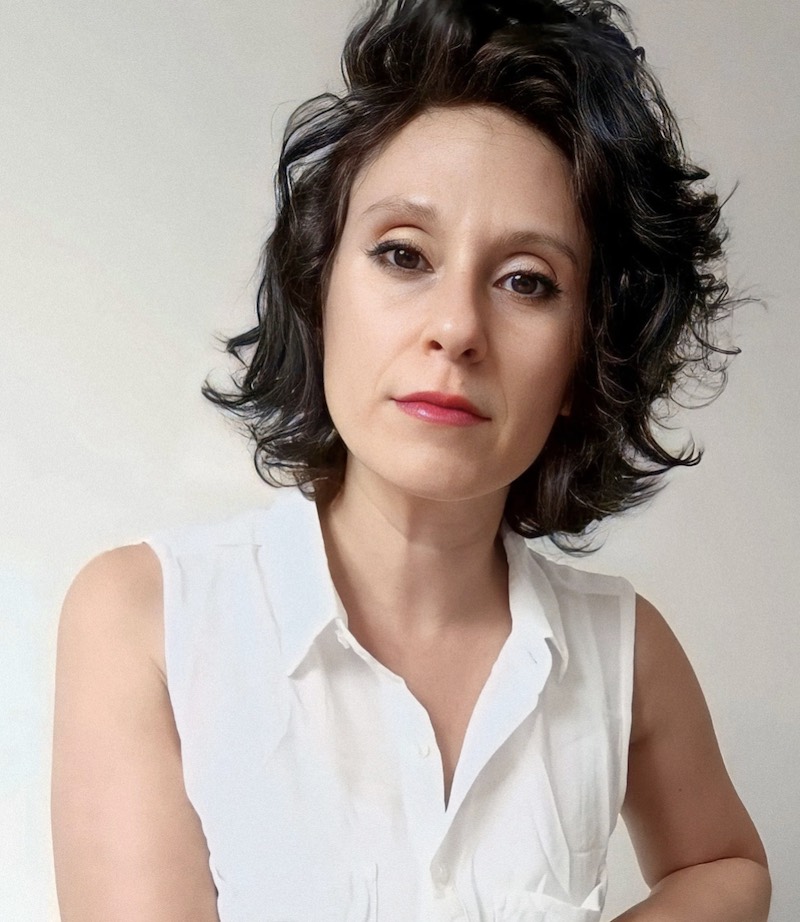
Valentina Ferrandes: Reshaping Icons

Niio Editorial

Valentina Ferrandes is an artist working across moving image, installation, and digital world-building, whose practice weaves together ecology, mythology, and the lived experience of place. Grounded in research and a documentary sensitivity to landscapes, archives, and historical traces, she shifted from filming toward constructing sensorial 3D environments, using scans, procedural tools, and real-time engines to let forms drift, fracture, and evolve. Classical sculpture and ancient narratives become both emotional anchors and critical material in her work: icons that carry through time, re-shaped through contemporary technologies into atmospheres of beauty and tension where political rupture can be felt indirectly through light, motion, and sound.

On the occasion of the launch of her solo artcast Metamorphoses: Myth, Body, and Code, we had a conversation about her work and creative process.

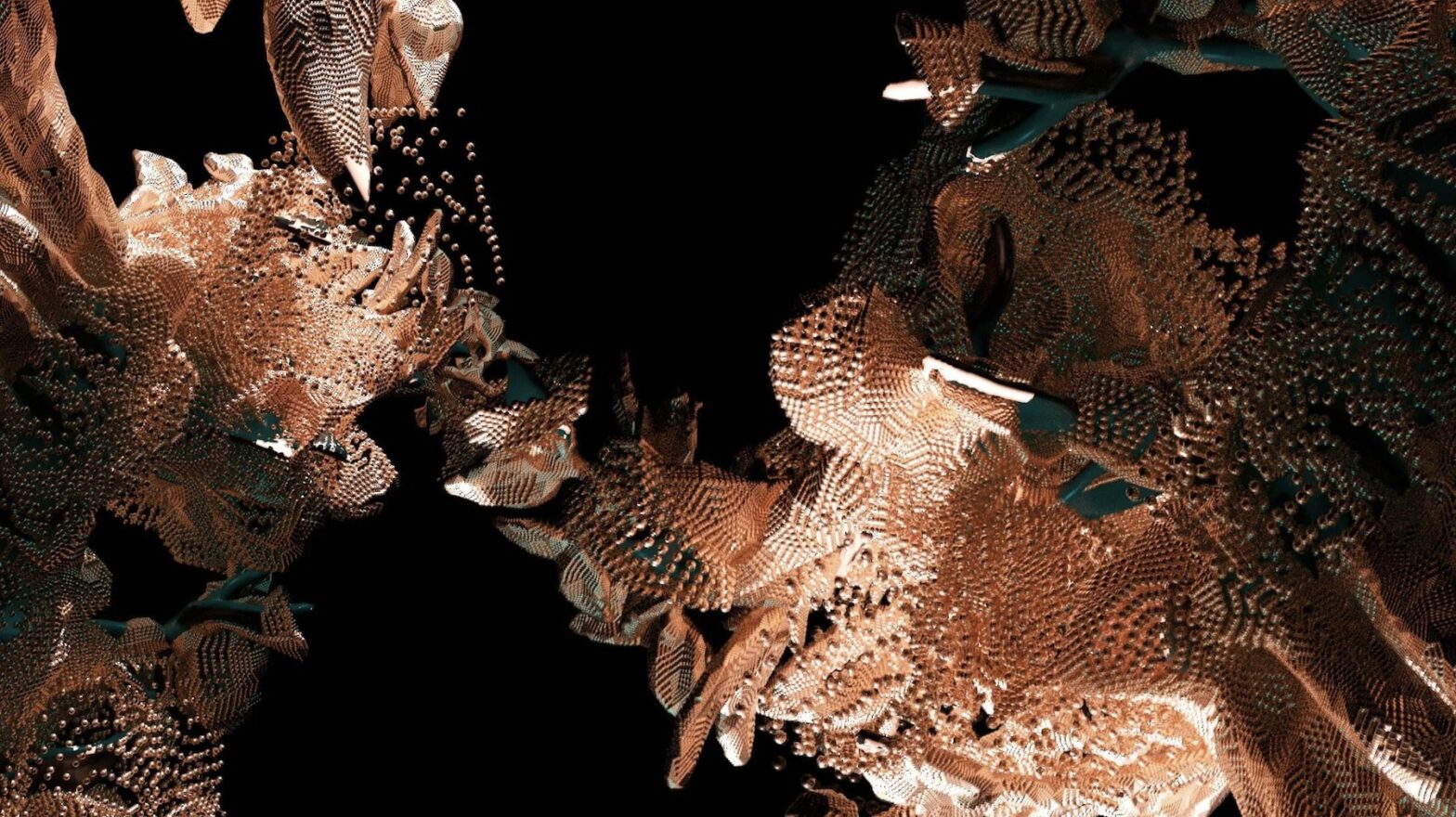
Valentina Ferrandes. Aurea, 2023

You describe your practice as connecting ecology, mythology, technology, and post-human imaginaries. When you start a new project, what drives it, the research, the story, or the technique you have chosen to produce it?

I normally start with research.

I’m interested in the way we live through environments and the stories that shape them. Myths, landscapes, architectures, archaeological traces. At first, these things appear separate; when you sit with them long enough, they begin to echo one another.

Only then do I choose the technique, the choice is never neutral.

Lately, I’ve been working with 3D motion, procedural tools, real-time engines, and 3D scans,  not to represent the world, but to build systems that can behave like it. Tools that allow things to drift, mutate, and occasionally slip out of control. Sometimes a project expands from a single shape, a scanned object from an archive, or material gathered through direct observation. That form becomes a world. Using game engines and procedural workflows, I stretch it, repeat it, let it evolve.

Ultimately, I’m trying to immerse the viewer in a mood, mostly driven by aesthetics, fragments of stories, and sensory tension, rather than by purely documentary logic.
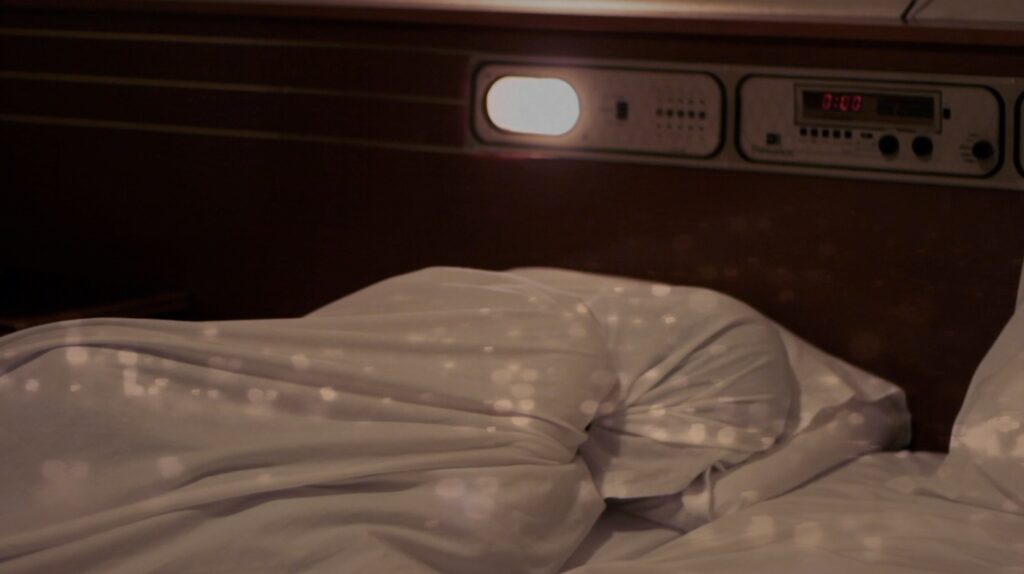
Valentina Ferrandes. Still from Travelogue, 2018

You made experimental documentaries for years, then moved into CGI and real-time worlds. What changed for you around 2020 that made 3D the right language?

Around 2018 I made a film called Travelogue. It was a visual diary of a journey I took to Izmir in Turkey and then to the island of Kos, shot in a documentary register a couple of years back, right at the height of the Mediterranean migratory crisis. It followed my previous work Other Than Our Sea, where I used montage to collapse fragments of Mediterranean mythology, classical literature, ethnographic film, archival material, and glimpses of contemporary newsreels of shipwrecks in the Mediterranean into layered visual narratives.

But shooting Travelogue felt tougher as it touched something much closer. My family has a history of forced migration. Although Italian citizens, my father’s family had long-standing ties to Libya and Tunisia. After decades of living in Libya, they were compelled to return to Italy as refugees in the late 1970s. That sense of loss, of having to abandon an entire world to rebuild another, was something I grew up with. Filming along the semi-illegal routes in Turkey and Greece that many migrants were taking toward Europe, witnessing those crossings and the weight they carried, made me realise that documentary language had reached its limit for me.

Depicting reality no longer felt feasible. I didn’t want to record crises anymore but construct worlds that could allude to moments of rupture, holding some emotional truth but without reproducing their images directly.  I needed a medium that could be more sensorial, more abstract, and more heartfelt than documentary realism.

I had no language for it, so I stopped making films for a while.

“Depicting reality no longer felt feasible. I didn’t want to record crises anymore but construct worlds that could allude to moments of rupture.”

Then, around 2020, I turned to 3D. I began experimenting with scanned classical sculptures that had shaped my imagination growing up in southern Italy, fragments of classicity that, for me, functioned as emotional anchors. They were beautiful, but also quietly critical: stabilising forms in times of uncertainty, grounding while still provoking thought and aspiration. At the same time, I was going through a period of personal losses. Working in 3D allowed me to move away from documentation and toward construction: creating works driven by form, light, and colour rather than evidence.  Real-time worlds and CGI offered that kind of a-political space, a way to build beauty and tension, and to think about crisis indirectly, through atmosphere, motion, light and colour.

From that point on, my work shifted toward 3D hybrid forms.

Valentina Ferrandes. Victory, 2020


“Victory” treats Nike of Samothrace as something that can be algorithmically decomposed and rebuilt. What does computation allow you to “see” in sculpture that a camera cannot?

A camera can only register what is visible. It freezes what is already there. Computational tools do something else: they open the parameters to make instability visible and let you play with latent forms. Even the most solid material, like marble, is in reality energy in motion, atoms vibrating, matter constantly becoming. We just can’t see it.

In Victory, computation allows me to see sculpture as movement rather than image. When the Nike of Samothrace is translated into a 3D motion system, it stops being a fixed surface and becomes a fluid field of forces, basic geometries, vectors, and polygons that can shift, fracture, and reassemble.

“Even the most solid material, like marble, is in reality energy in motion, atoms vibrating, matter constantly becoming.”

In the Athena works, you connect a local pre-Christian cult, the olive tree, and the long chain of copies from Greece to Roman times and beyond. What does that continuity mean to you inside a digital artwork today?

We often think of digital media as something entirely new, as if it belongs only to the future. For me, however, digital tools are a means of reshaping icons that are already deeply ingrained in our collective memory.

In the Athena works, bringing together a local pre-Christian cult, the olive tree, and the long chain of copies creates a sense of continuity rather than rupture. Using a hyper-contemporary medium to work with ancient mythology opens up a different timeline, one where past and present coexist instead of replacing one another.

Classical icons are solid, almost a-temporal structures, narratives that can be applied to any moment in history, much like religious icons. They carry ethical, emotional and symbolic lessons that can stay legible across centuries.

“For me, digital tools are a means of reshaping icons that are already deeply ingrained in our collective memory.”

At the same time, I want my works to remain open. A digital artwork can be interpreted in various ways, ranging from a purely aesthetic encounter driven by form, light and rhythm to a more layered and reflective interpretation, depending on the viewer’s sensitivity and cultural background.

Digital tools don’t need to reject this legacy in favour of futuristic expectations. They enable us to revisit these foundational forms, reshape them, and discover new meanings within them. 

Valentina Ferrandes. Daaphne, 2022

You revisit Apollo and Daphne in both “Daaphne” and “Aurea.” Why return to that myth now, and what feels ethically or emotionally at stake in reanimating it with AI and procedural CGI?

This myth, at its core, stages a clear opposition: Apollo as a rational, male-driven force, mathematical, controlling, and oppressive, and Daphne as a figure bound to nature, freedom, and transformation. The moment of rupture between them could not be more explicit and in my work, I used AI to push that rupture even further.
I worked with an AI writing tool trained on game narratives and powered by a rudimentary version of GPT-3, fed it the story of Daphne as written in Ovid’s Metamorphoses and asked it to imagine what this nymph might wake up as after a set time as a laurel tree.

The AI imagined Daphne re-emerging as a post-human, hybrid being, part human, part aquatic, drifting in an underwater world, without language or memory, completely disoriented. I loved that the story had a hallucinatory, almost comic tone, like a futuristic fiction gone off-track.

“Daphne’s transformation is survival, a reminder that neither nature nor the systems we create can ever be fully governed by pure rationality.”

From there, I worked with 3D motion to animate forms suggested by the AI’s text. The work became a meditation on rupture at multiple levels: between human and nature, between rationality and excess, and between control and unpredictability. AI, in this sense, operates like an alter ego, a parallel intelligence that accelerates extraction, mutation, and instability.

In that way, the myth of Apollo and Daphne can be uncannily contemporary as it speaks to an enduring conflict: nature versus culture, rational order versus metamorphosis.  Apollo’s loss of power in the face of nature, something fundamentally uncontrollable, mirrors our relationship with AI today. We are building a system that behaves like a subconscious, one that evolves beyond our control, driven by its own form of self-preservation.

Daphne’s transformation is survival, a reminder that neither nature nor the systems we create can ever be fully governed by pure rationality.
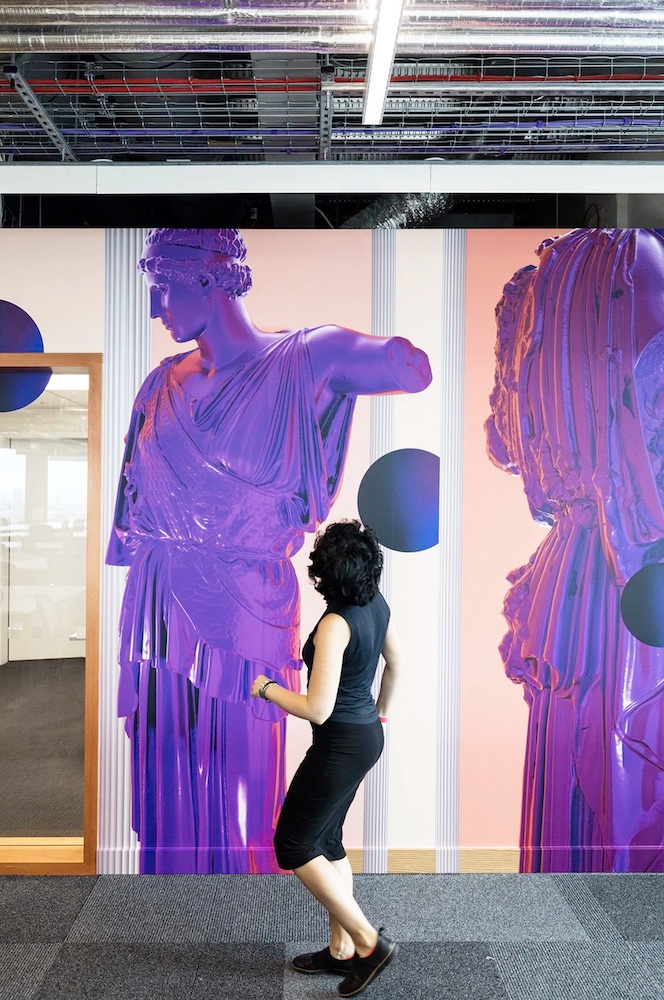
Valentina Ferrandes. Midday Muse, 2022. Site-specific installation, META London Headquarters.


A lot of your work sits between fiction and documentation. How do you decide what must remain “true” and where you allow speculation to take over?


Usually, I decide on a set of rules, fixed conditions and boundaries for a given project.
I tend to ground a new work in real elements, a place, a historical fact, a piece of storytelling, a dataset, a myth that already exists, a landscape I’ve walked through. It’s almost a forensic layer to start building upon. This documentary approach anchors the work to the world as it is, while I use fiction to open a door to how it might feel, how it might mutate, or how it could be remembered in the future.

The balance is intuitive more than anything. What remains “true” is the research spine and the ethical position. Form, narrative, and atmosphere can drift in fluid ways.

Valentina Ferrandes. The Beautiful One Has Come, 2021.

Sound shows up as a structural element in several projects. Do you think of sound as world-building, as evidence, or as emotion?

When I began working on Daaphne, it was 2022, and the war in Ukraine had just started. One of the first elements I used in my soundtrack was a Russian lullaby,  a song meant to put children to sleep, but sung as an eerie horror story. I layered it with voices of phone calls from Russian mothers trying to find out where their sons had disappeared on the battlefield.

These sounds were among the first field recordings to surface from the conflict. They weren’t yet shaped by long-form reporting or political framing. They were raw, deeply human, and I knew they would soon be buried under 24h news coverage. I wanted to hold onto them before they disappeared. I’m drawn to these small, fragile fragments of reality, pieces of evidence that are emotionally charged but not always fully legible. They speak of a specific moment in time, yet they slip away easily, like trying to remember a conversation heard in a dream just after waking.

Much of the sound material I work with also comes from evidence: archival recordings, field recordings I collect myself, binaural sound, fragments of voiceover. But it’s almost always assembled as a collage. Sound often becomes the backbone of my work but it does not demand that everything be decoded. If someone wants to sit with it and trace the details, that’s possible. If not, the surface remains open.
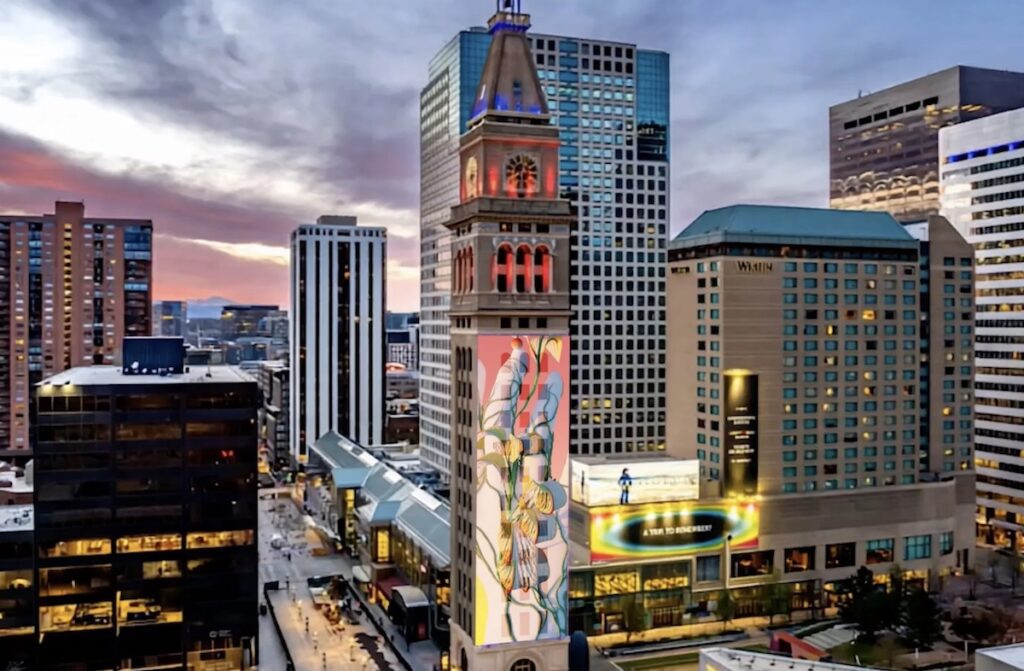
Valentina Ferrandes. Bloom, 2024. Site-specific 3D animation, Night Lights Denver

In “BLOOM,” classical iconography is projected onto a city landmark. What draws you to public architecture as a screen, and what do you want viewers to feel at that scale?

Public architecture is interesting because it operates at a scale where meaning turns physical. Facades, towers, and landmarks are symbols of power, progress, and permanence. Using them as screens immediately creates a shift in perception.

In BLOOM, projecting classical iconography onto a hypermodern skyline for Denver Night Lights meant staging a clash of meanings. On one side, you have contemporary architecture, on the other, a classical image that many viewers may never have encountered directly, unless they’ve visited the museum that houses it. That displacement is intentional.

“Classical iconography carries a quiet power because it transcends specific cultures to communicate through beauty rather than explanation.”

At that scale, the work isn’t meant to be fully legible. It’s meant to interrupt routine, to slow people down, and to create a brief moment of disconnection from the everyday flow of the city. Ultimately, to leave space for a  few minutes of awe.

Ultimately, classical iconography carries a quiet power because it transcends specific cultures and historical knowledge to communicate through beauty rather than explanation. When placed on an urban skyline like Denver’s, it opens up a small pocket of dreaming,  a moment of wonder appearing where it doesn’t quite belong.
Steve Schapiro: what is special about people

Pau Waelder

Niio is proud to introduce a selection of artcasts by celebrated photographers in collaboration with Fahey/Klein Gallery, the leading contemporary photography gallery in Los Angeles. Curated by Nicholas Fahey, these selections dive into the work of the artists, presenting key series and iconic images, and are available to our members for a limited time only.

Interview with photographer Steve Schapiro (July 21st, 2017). Courtesy of Fahey/Klein Gallery

Steve Schapiro (1934-2022) was one of the most prominent figures of documentary photography in the United States in the second half of the twentieth century. An exceptional witness of the civil rights movement, his camera captured key moments in American history with a sharp eye and caring attention to the subjects of his portraits. 

Devoted to photojournalism from a young age, he was inspired by Henri Cartier-Bresson and took lessons from W. Eugene Smith, whose teachings marked a profound influence in Schapiro’s work throughout his career. In 1961 he traveled to Arkansas and photographed a camp for migrant workers. Jubilee, a small Catholic magazine, published his photos as an eight-page picture story. The New York Times picked up one of the photos and used it as the cover for the New York Times Magazine section. That was his first real break. Schapiro continued showing his pictures to Life while doing essays on “Narcotic Addiction in East Harlem”, “The Apollo Theatre”, “Women of New York”, and “Jazz Sessions for Riverside Records.” Finally Life gave him an assignment which worked out and he began freelancing for Life and other magazines such as Time, Newsweek, the Saturday Evening Post and Paris Match. 

“There’s so many pictures I look at which have an iconic feel to them. And yet, you can’t explain what it is in the picture that’s causing you to feel that way.”

Steve Schapiro

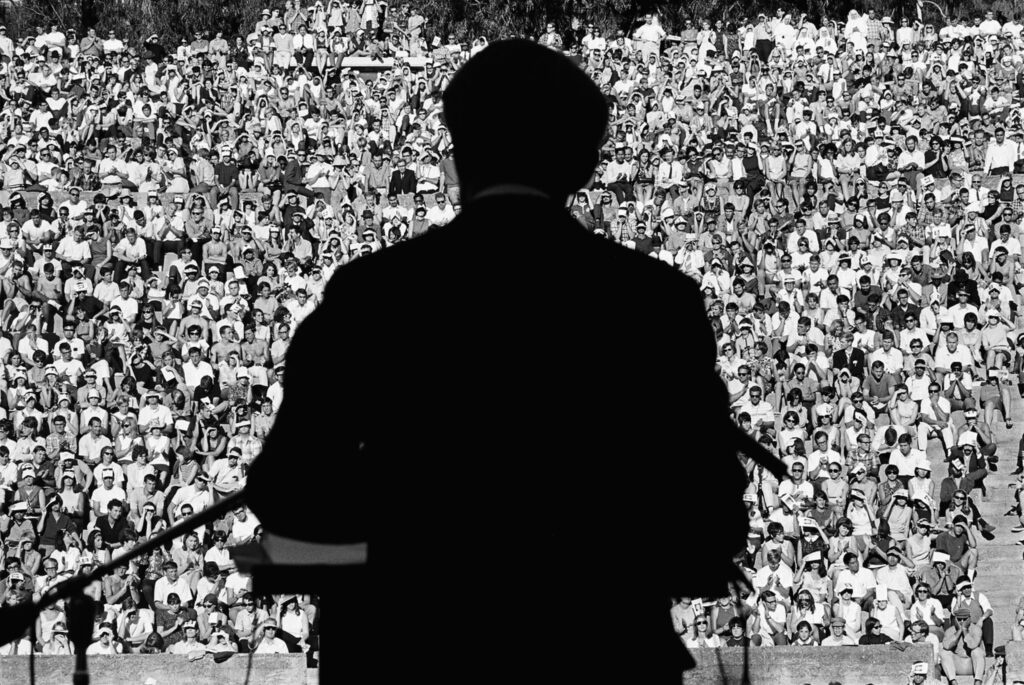
He closely followed the political and social changes of the 1960s in the United States, accompanying Robert F. Kennedy during his presidential campaign and the civil rights movement’s March on Washington for Jobs and Freedom, and the Selma to Montgomery march. In the 1970s and 1980s, Schapiro turned his attention to film set photography. He was hired by Paramount Pictures and worked on the set of famous films such as Francis Ford Coppola’s The Godfather (1972), Roman Polanski’s Chinatown (1974), and Martin Scorsese’s Taxi Driver (1976). 

Steve Schapiro. Robert Kennedy at Berkeley, California, 1966

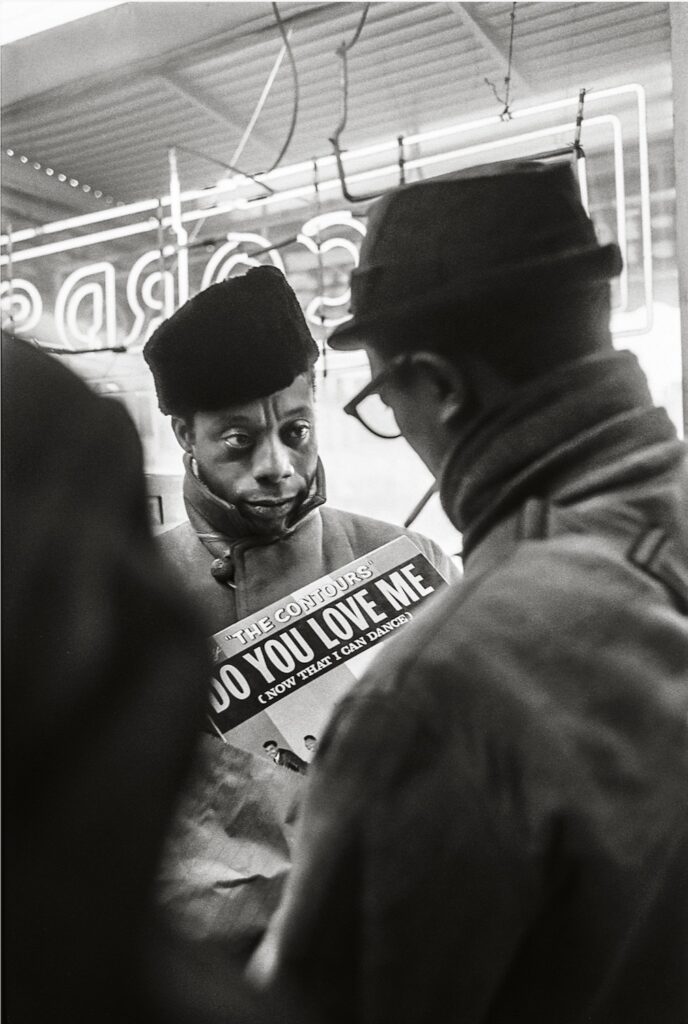
The series of photographs of the American Civil Rights Movement is among Schapiro’s finest. In late 1962, he read James Baldwin’s essays in the New Yorker which became the book The Fire Next Time. Schapiro asked Life if he could do a photo essay on Baldwin. They agreed and for the next month Steve traveled with Baldwin to Harlem, North Carolina, Mississippi, and New Orleans. He met many leaders of the non-violent civil rights movement and saw real segregation for the first time. Schapiro notes of meeting and traveling with Baldwin, “Here was an intellectual, a brilliant man, and a black leader who never seemed to forget the importance of relating to each other as human beings. He had a hunger for love and believed in its power.”

Steve Schapiro. James Baldwin, Do You Love Me, 1963

This portrait of Baldwin is particularly telling of a quality that Schapiro sensed in him: his loneliness. Describing the photograph, he confesses: “every time I look at that picture, I feel an emotional moment. Because it seems to me it really points out the loneliness that he had, during 1963, which was the time when I first met him.”

After Schapiro’s photo-essay ran in Life in March of 1963, he was assigned to cover the South in even greater depth. These assignments produced images that are now part of the American collective subconscious: George Wallace standing in the schoolhouse door at the University of Alabama, the March on Washington, Civil Rights leader John Lewis in Clarksdale, Mississippi, and Dr. Martin Luther King Jr. leading the march from Selma to Montgomery in 1965. Schapiro’s photographs from this time are some of the most important historical documents of the American 20th century. While his photographs certainly document the darker side of the struggle, Schapiro also manages to relay the constant reliance upon love, community, and faith that became the legacy of King and his Civil Rights Movement.

“It is looking for that specialness in people, what makes someone unique, which I really treasure, either in a person or in an event.”

Steve Schapiro

The way in which the photographer became part of the people he was portraying speaks of his care and attention to the human side of the stories he was telling through his pictures: “I really enjoy being a fly on the wall,” he says. “And really waiting for that moment when I sense something about someone, particularly in a portrait that really conveys something.” 

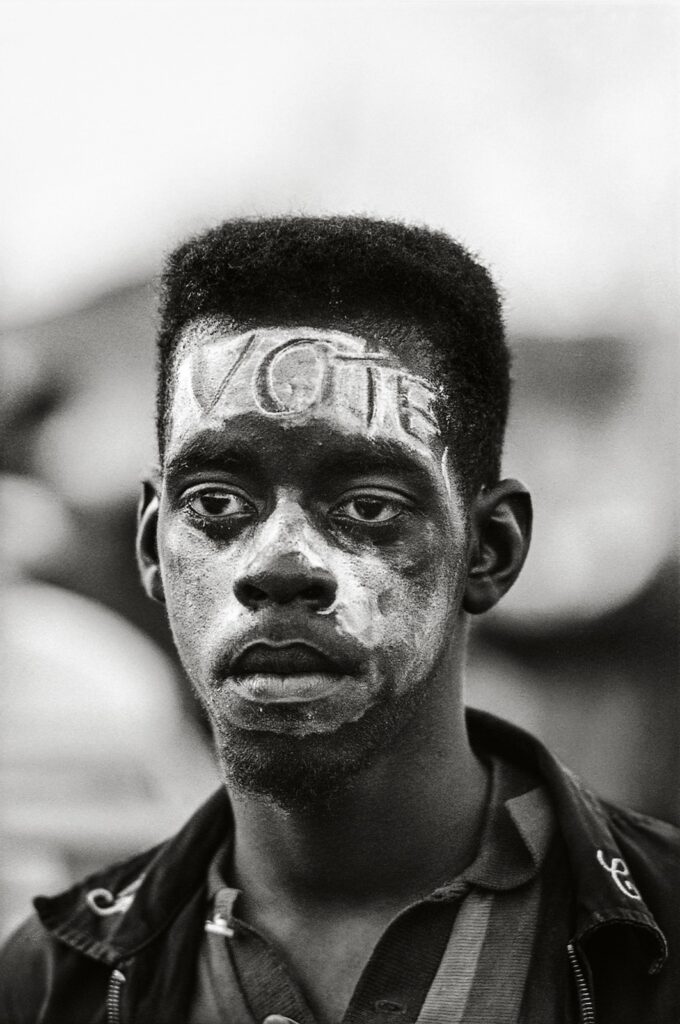
Steve Schapiro. Vote, Selma March, 1965

The images from the Selma march are among his most iconic, with this one being particularly symbolic: “[The vote picture] conveyed a sense of what the civil rights struggle was about,” he says, “because it was about gaining the vote for black people in America. There’s so many pictures I look at which have an iconic feel to them. And yet, you can’t explain what it is in the picture that’s causing you to feel that way.” 

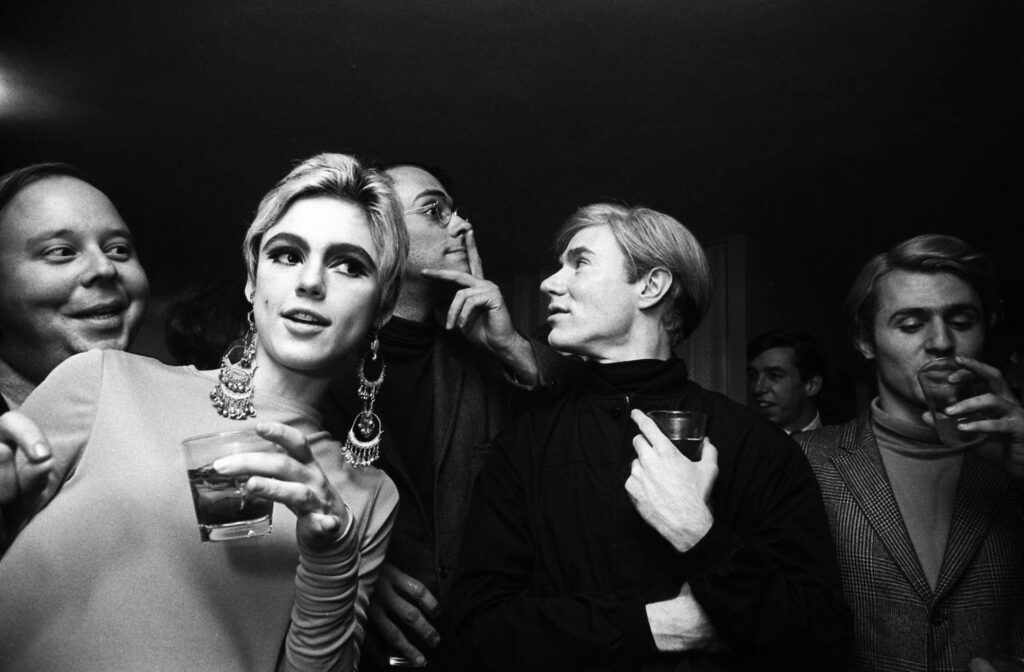
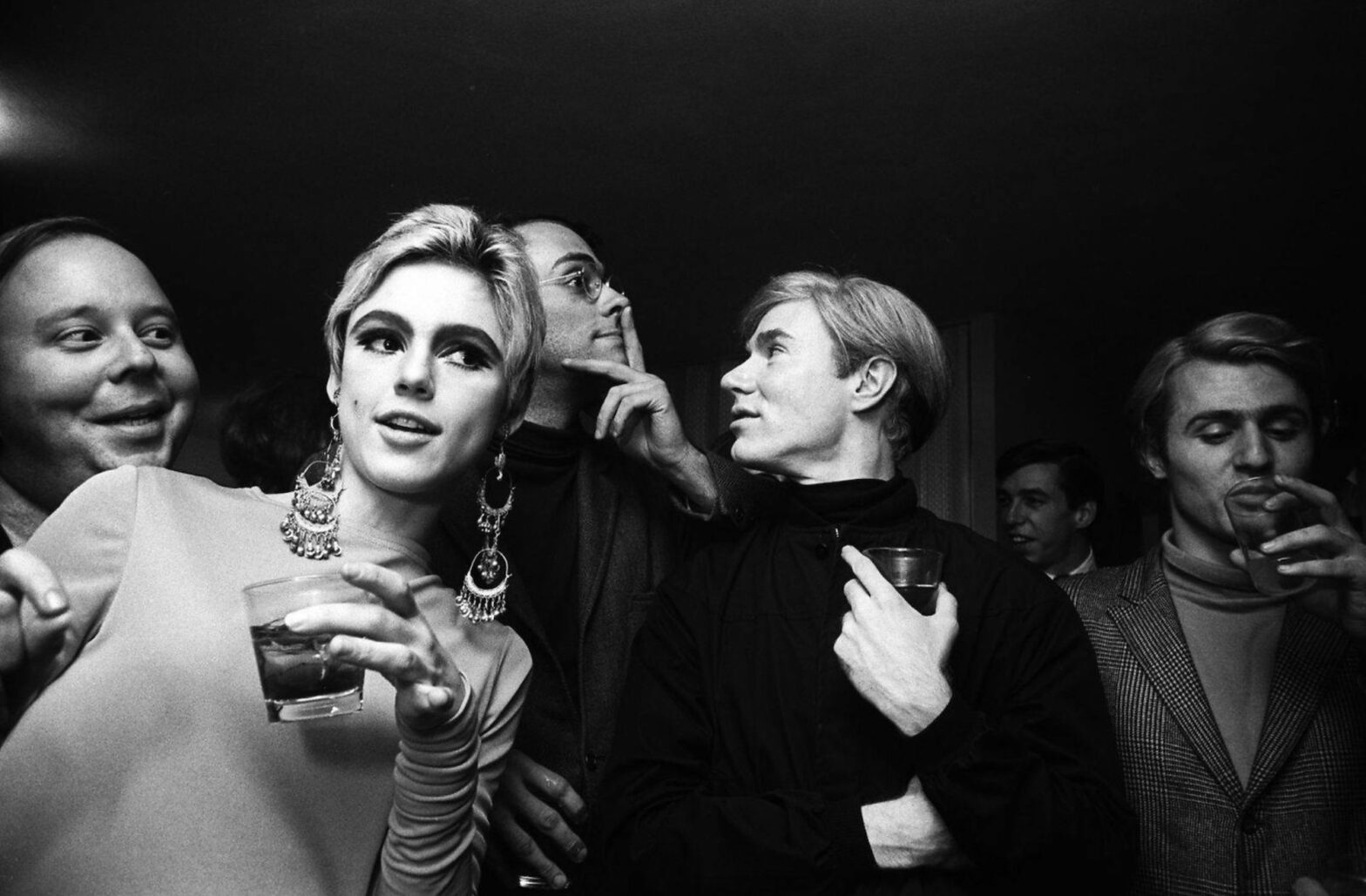
Schapiro’s unique ability to blend in with the crowd and capture spontaneity also allowed him to take candid photographs of movie stars, musicians, and artists that communicate a strong feeling of intimacy. His technique basically consisted in being there and assuming he would be allowed to take the picture: “If you’re a photographer, and you smile at people, they feel good about it,” he states. “Most people don’t mind being photographed, unless they feel that you’re going to do something to harm them in some way. So basically, if you’re just matter of fact photographing people in terms of who they are and what they’re doing, you don’t have any trouble.”

Steve Schapiro. Andy Warhol, Edie Sedgwick and Entourage, New York, 1965

“If I have a philosophy on life, it’s that we should care more about people.”

Steve Schapiro

Steve Schapiro was a great photographer not only because of his technique and his instinct for a perfect composition in the frame, but also because he cared about the stories he told and the people whose lives are part of that story. Without this sensibility and empathy, the images would appear perfect but distant, devoid of the human breath and the beating hearts that one feels in each of his pictures. Schapiro made this clear in one of his last interviews: “If I have a philosophy on life, it’s that we should care more about people. And we should have more of a humanitarian view of things. And I’m concerned that there are important, powerful people who don’t have that, and they don’t value human life. But life is so precious.”

Testimonies: video art at the Berlin Biennale

Pau Waelder

The Berlin Biennale is celebrating its 12th edition with a program of exhibitions and events that take place in six venues around the city, until September 18th. The four main exhibitions are hosted by the KW Institute for Contemporary Art, the Hamburger Bahnhof, and the spaces of the Akademie der Künste at Hanseatenweg and Pariser Platz with a total of nearly 90 artworks by more than a hundred artists. Titled Still Present!, this year’s Biennale is curated by artist Kader Attia, with the support of an artistic team composed by Ana Teixeira Pinto, Đỗ Tường Linh, Marie Helene Pereira, Noam Segal, and Rasha Salti.

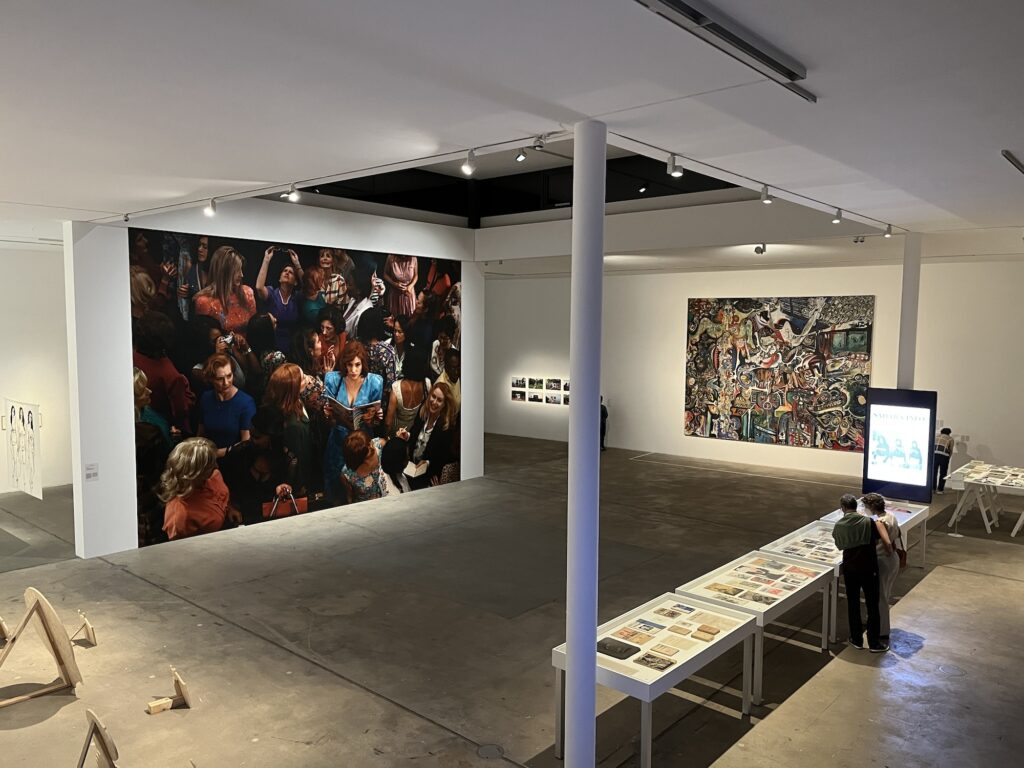
View of the exhibition at Akademie der Künste (Hanseatenweg)

The main theme addressed by the current edition of the Biennale is the effect of colonization, in land and history as well as in bodies, people’s lives, identities, and mindsets. This subject touches cultural institutions too, by pointing out the presence of looted artifacts and forms of presenting colonized cultures that only contribute to open the wounds of a history of colonial abuse. In a text written for the catalogue, Kader Attia denounces the hatred of others (whether foreigners, people from nomadic cultures, those experiencing marginalization and anyone not submitting to heteronormative patriarchy) and the invisibility of the wounds that inequality and exploitation have caused:

“Invisibility is discourse’s preferred weapon of control: always in denial of the crime, the enunciator claims victory while disavowing all responsibility.”

Kader Attia, Still Present! Berlin Biennale for Contemporary Art (Kunst-Werke Berlin, 2022), p.24

The concepts of wound and reparation are key to Attia’s work, and he finds in the processes of decolonization and the way in which Western societies have sought to build an image of a perfectly homogeneous modernity, in itself blind to the wounds it has created, an ideal framework in which to suggest forms of reparation through art. Art, he claims, can resist political and religious obscurantism precisely because it is unpredictable and constantly aims to reclaim people’s attention. He also states that artists seek to capture the present at a time when algorithmic governance collects data from our past actions in order to predict our future behavior. Trapped in this calculation of probabilities, the present no longer belongs to us, stresses Attia, and for this reason it must be recovered by means of the experience of art:

“Standing before a work of art, the spectator is plunged into another temporality, radically different from that of their environment, inaccessible to the insatiable appetite of algorithmic governance. […] art deconstructs so that it may repair and evolve, generating new forms of interpreting the present.”

Kader Attia, Still Present!, p.34,40
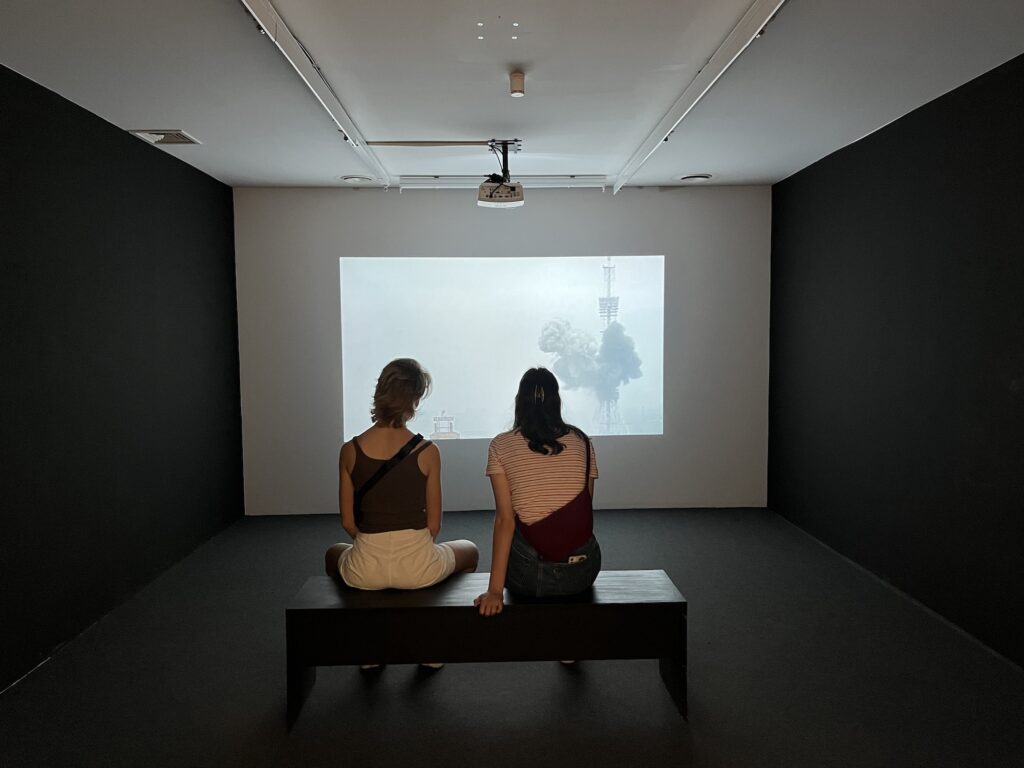
Center for Spatial Technologies & Forensic Architecture, Russian Strike on the Kyiv TV Tower (2022)

Being present

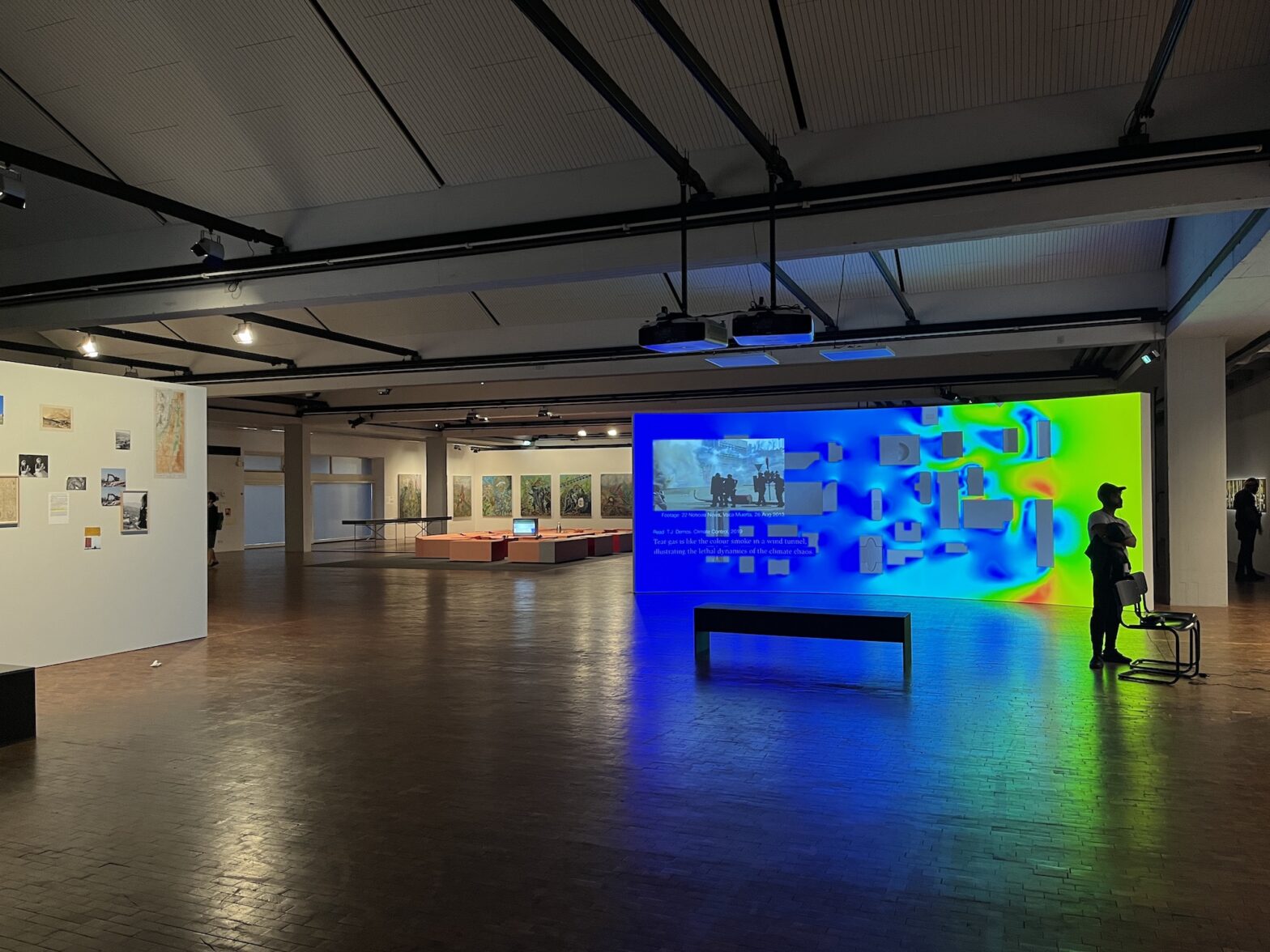
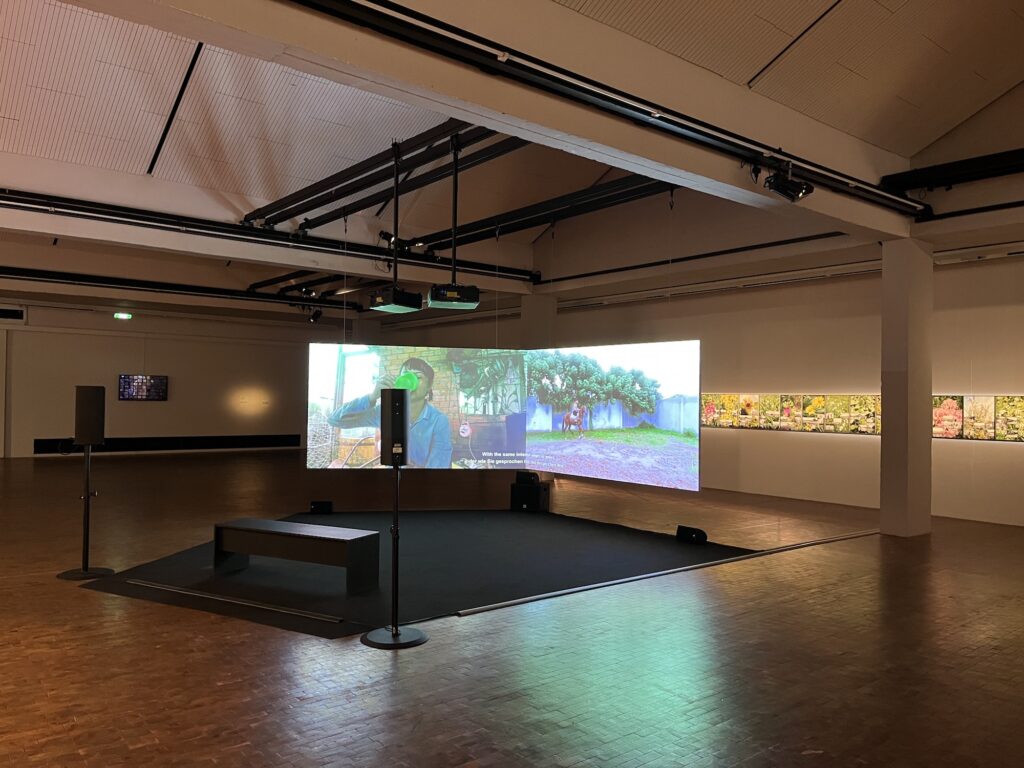
The artworks exhibited at the Berlin Biennale show that artists increasingly use video, 3D animation and data visualization in their portrayal of the present. Reality is captured through live footage, digital images, and all sorts of visual documentation. The exhibition spaces are filled with screens and projectors, sometimes extending their presence in the room with objects and imposing installations. The rooms at the Akademie der Künste, the Hamburger Bahnhof, and the KW Institute are dimly lit and labyrinthine, with displays creating areas of attention, that lend each artwork a space of its own, secluded in itself and rarely enabling a dialogue with nearby pieces. The documentary nature of most artworks also forces viewers to read the descriptions on the wall labels and concentrate on the story that each artist is telling. In this sense, as Kader Attia suggests, the artworks succeed in plunging viewers into a different temporality and making them fully present.

Artists increasingly use video, 3D animation and data visualization in their portrayal of the present

This temporality is both created and controlled by the artwork: as philosopher Boris Groys points out, video and time-based arts determine the time of contemplation. Through moving image and sound, notably the voice of a narrator, the artworks capture the viewer’s attention and force her to remain attentive while the story unfolds. This creates a particular pace for the visitor that demands more time and less distractions: these are not instagrammable exhibitions, in which to portray oneself in front of a tremendously huge object or a fiercely immersive installation, but rather spaces of discussion filled with the voices of the unheard. The enormous amount of footage to watch, the complexity of the narratives and the information one is required to process may seem overwhelming to a regular visitor. However, it is worth taking the time to patiently examine the artists’ exhibits, both in the sense of their public presentation and in the sense of producing evidence in a fictional court. 

View of the exhibition at Akademie der Künste (Hanseatenweg)

Visual records, both images and videos, have been considered irrefutable evidence of a fact until digital technologies and fake news finally put every image into question. Obviously, the depiction of historical events has always been subject to the interpretation of the victors, with visual artists being complicit in the creation of a narrative dictated by those in power. Today, artists addressing social, environmental and political issues are well aware of how images and messages are constantly manipulated, and therefore tend to avoid a position of authority, providing instead bare data, appropriated or filmed footage, witness recollections, and the stories told by those who ask to be heard. In this manner, the artist acquires an aura of neutrality, an actor who exposes facts with fair intentions in the form of a cultural product that, as the space that hosts it, is far removed from the complexities of real life. While this may seem to neutralize the political involvement of the artists and the educational (or indoctrinating) power of the artworks, it is actually the contrary. Art exhibitions enable a space where politics and society can be observed with detachment, as though one was reading a fictional story, and this allows one to confront other voices, other mindsets and realities that would otherwise be quickly ignored or dismissed. Being present thus also means being receptive, and willing to, at least, accept the existence of realities other than those we have created for ourselves.

Fragments of a reality

Fragmentation is a salient feature in many artworks, which rely on a variety of elements such as photos, maps, written documents and found objects. In 24°3′55″N 5°3′23″E (2012/2017/2022), Ammar Bouras addresses the consequences of the so-called Béryl incident, an explosion that occurred on May 1, 1962 while the French carried out underground nuclear tests near In Ekker in the Algerian desert. He creates a photographic montage and a video piece that explore both the geological layers of the area and the long-term consequences for the land through the testimonies of its inhabitants. The multiplicity of perspectives described both by the photographs and the video footage question the official history, which buried this event, and the possibility of an objective truth. 

Basel Abbas and Ruanne Abou-Rahme, OH SHINING STAR TESTIFY (2019/22)

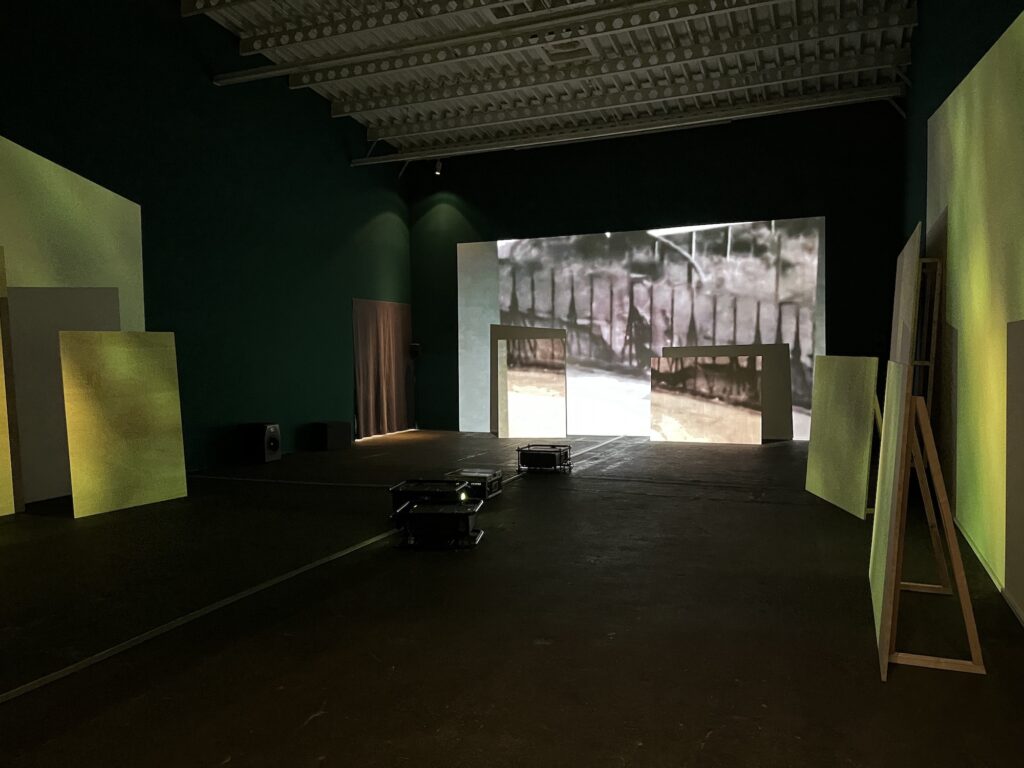
Using CCTV footage of an Israeli military surveillance camera, Basel Abbas and Ruanne Abou-Rahme tell in OH SHINING STAR TESTIFY (2019/22) the story of 14-year-old Yusef Al-Shawamreh, who on March 19, 2014 crossed the Israeli separation wall to pick akkoub (an edible plant important in Palestinian cuisine) and was shot dead by Israeli forces. This footage, which circulated online and was later removed, is projected onto a series of wooden panels that capture, distort and hide the projected image in their shadows, as other filmed and appropriated sequences enrich the context of the grainy scene and its crude depiction of the facts. Fragmentation in this case conveys the multiple layers of this event, framing it in a wider social and political context while avoiding the obscene spectacle of death that media outlets have made of drone footage since the Gulf War.  

Poison Soluble. Scènes de l’occupation américaine à Bagdad (2013) by Jean-Jacques Lebel, dives into this morbid spectacle by collecting and enlarging the snapshots taken by US military personnel while torturing and humiliating prisoners at the infamous Abu Ghraib prison in Iraq. With these magnified pictures, the artist builds a labyrinthine installation in which the visitor gets lost, surrounded by horrifyingly graphic depictions of violence and sadism, and the no less upsetting portraits of the proud torturers, smiling at the camera. The artist sought to force an involvement of the viewers, but the harshness of these massively distributed images also calls into question whether Lebel has not created yet another spectacle, this time for an art audience. Such criticism was raised by Iraqi curator Rijin Sahakian shortly after the opening of the Biennale and has finally led artists Layth Kareem, Raed Mutar, and Sajad Abbas to withdraw their work from the exhibition in protest. 

CCTV and drone footage have been used by the media in sensationalist reporting, to a point where their value as evidence is replaced by their effect on the audience

This controversy illustrates the power of the photographic image as both evidence and raw material subject to manipulation. This is particularly true for digital photography. The low resolution snapshots from Abu Ghraib, with their pixelated, badly compressed textures, can be immediately identified as a private record of an event, not meant to be seen outside a closed circle. CCTV and drone footage also belong to this category of images that have been continuously used by the media in sensationalist reporting, to a point where their value as evidence is replaced by their effect on the audience. 

Data speaks for itself

In contrast to the first-hand, visual testimony found in grainy digital footage from CCTV, drone, and smartphone cameras, data analysis and visualization provides a much more detached and abstract, but equally telling, presentation of evidence. Photographs and video clips remain important, but generally as a complement of graphs, simulations, and diagrams mapping the collected data in a meaningful way. 

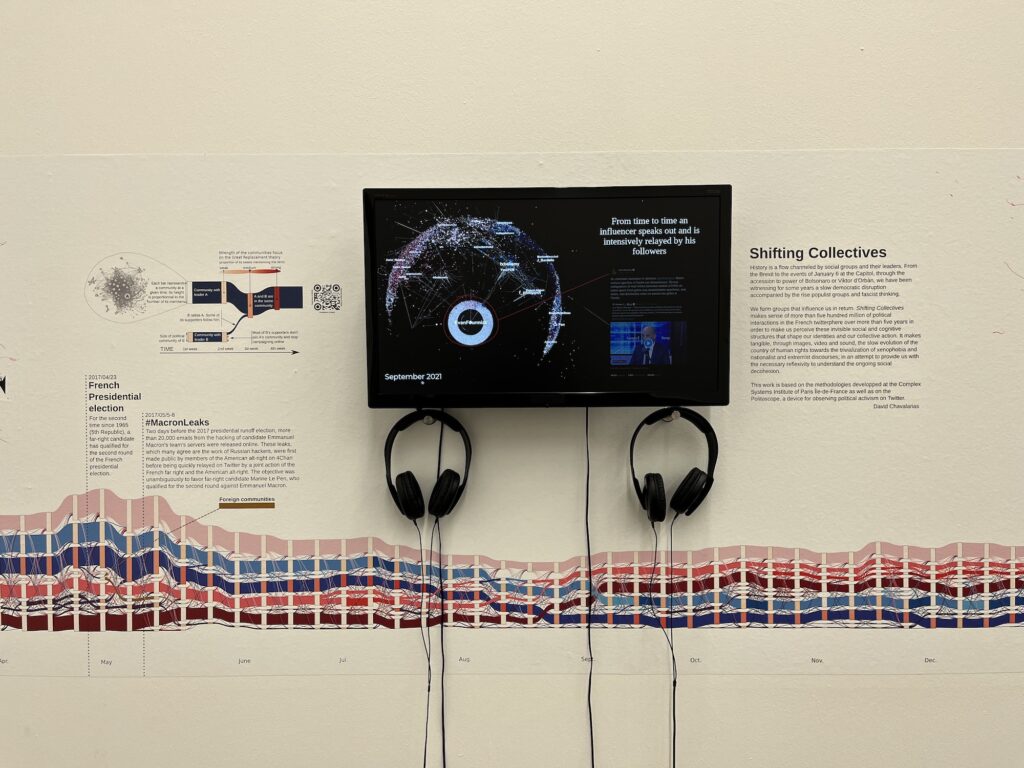
David Chavalarias, Shifting Collectives (2022)

David ChavalariasShifting Collectives (2022) exemplifies this turn towards data visualization in a detailed observation of the French political landscape. A researcher at the French National Center for Scientific Research (CNRS) in Paris, Chavalarias explores the degradation of democratic values and the trivialization of xenophobia and ethnic nationalism through a timeline extending the long of a wall accompanied by a series of graphs, images, video and sound. The display of information aims to disentangle the complex interplay between political candidates, ideologists, social and workers groups, and the media, in order to provide quantifiable evidence of the rise of populism and right-wing extremism. Again there is here a collage of fragmented documentation, although it is presented under a unifying graph and the authoritative voice of science: the orderly display of facts, names, and numbers builds the narrative by itself.

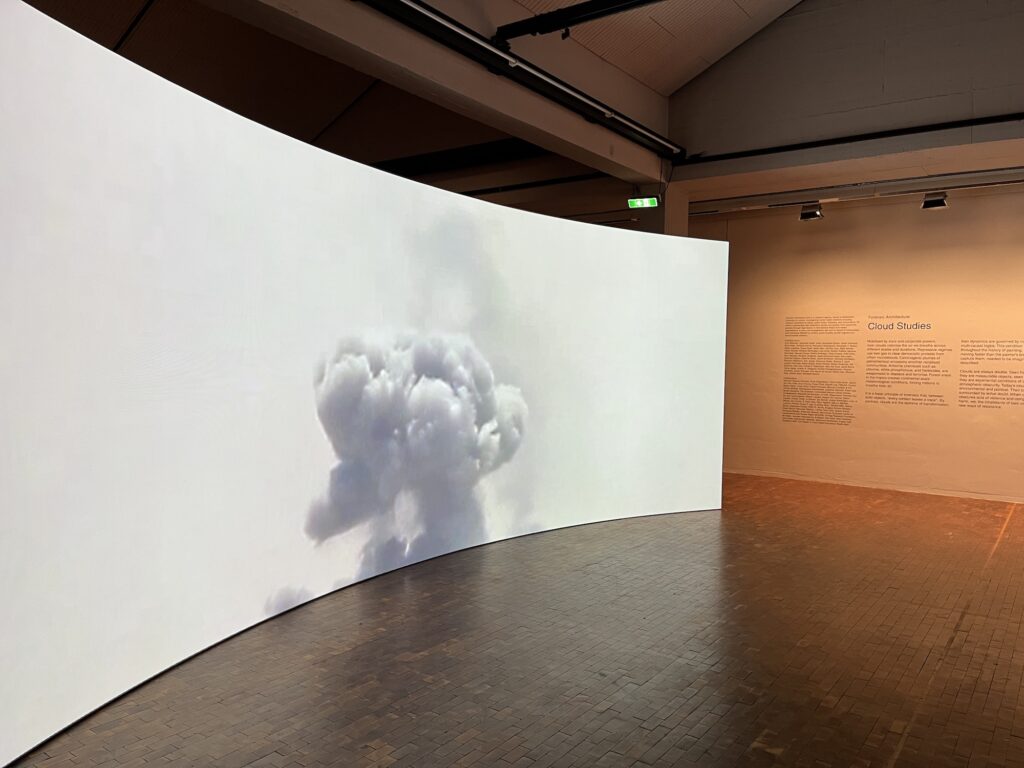
Forensic Architecture, Cloud Studies (2021)

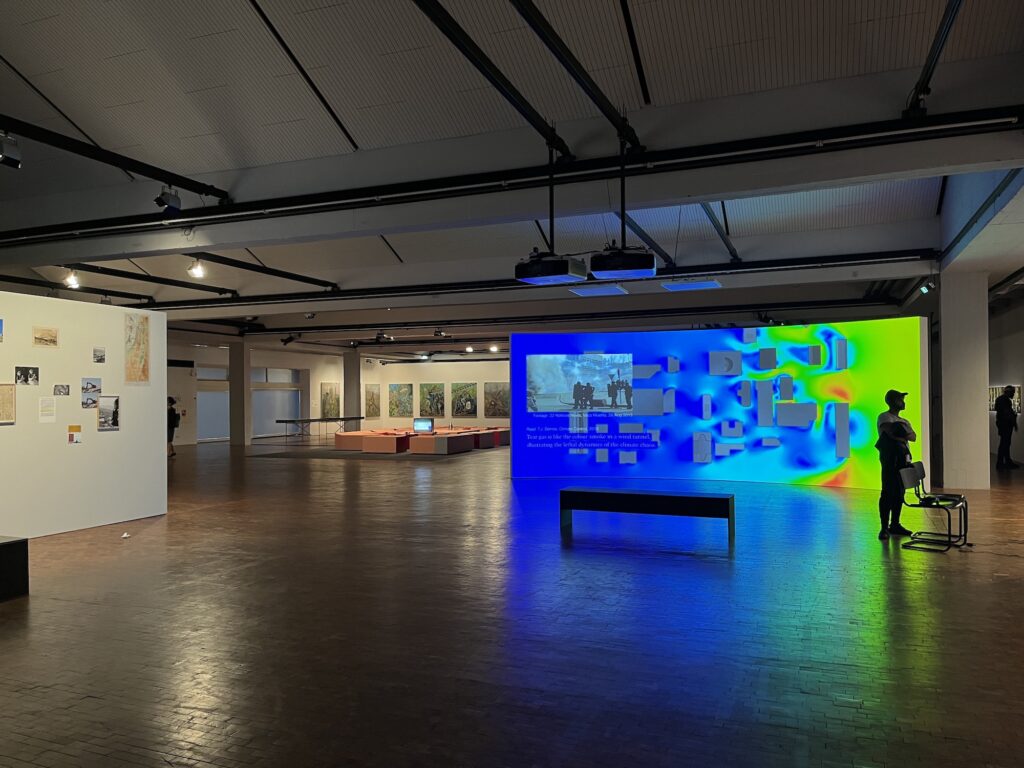
The collective Forensic Architecture is well known for their detailed research of cases of state violence through the analysis of architectural spaces and materials, using simulation techniques and information collected from witnesses. In Cloud Studies (2021) they address a type of aggression that, unlike bullet holes and broken glass, leaves no visible trace but causes permanent damage: the toxic clouds created by tear gas, airborne chemicals and petrochemical emissions. Fused in a single video, the collected documentation including video footage, 3D animations, fluid dynamics simulations, and countless photographs analyzed using machine learning techniques, is presented in a linear narrative in the form of a lecture that nevertheless includes certain dramatization. As in Chavalarias’ work, the display of information speaks for itself although here it is more scripted and lends itself to aesthetic concerns that confer the video its own identity as an artwork. 

In both artworks the presence of video and computer generated images denote the central role that this kind of imagery has adopted in the depiction of events by news outlets, at a time when the dominating perspective of a satellite or drone view and the tidy simplicity of a computer simulation can provide a much clearer and seemingly indisputable perspective than any number of witnesses’ accounts.

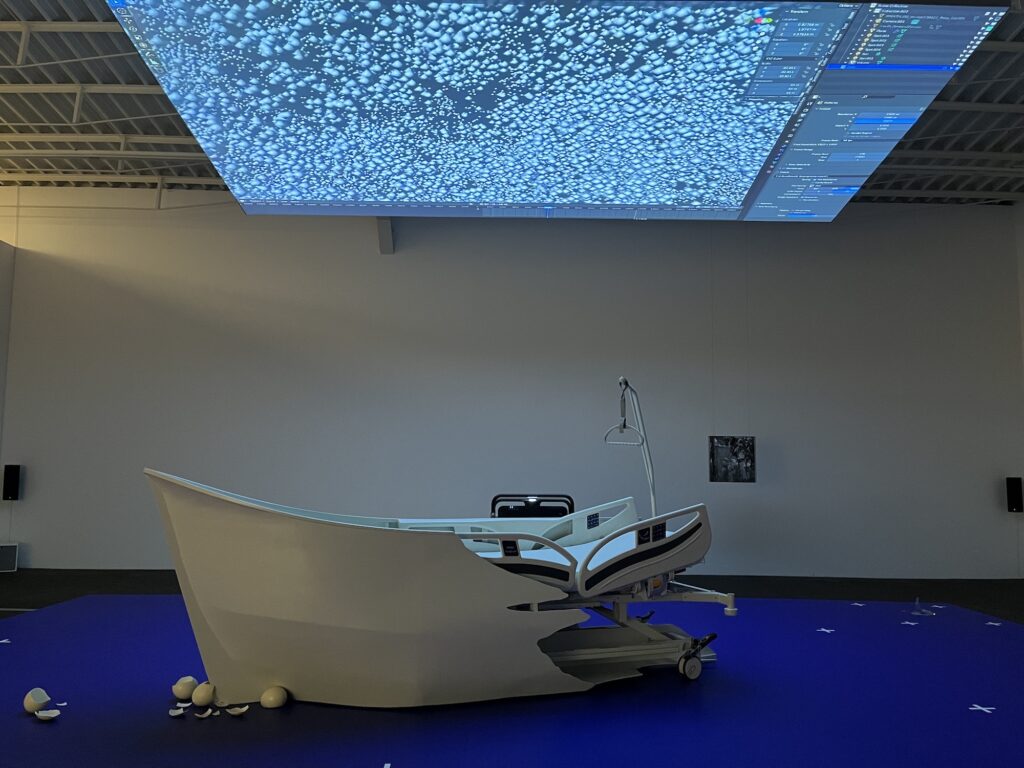
Thuy-Han Nguyen-Chi, THIS UNDREAMT OF SAIL IS WATERED BY THE WHITE WIND OF THE ABYSS, 2022

Eyewitnesses

The voices of those who were there, the victims, the passersby, also the perpetrators, the plotters and the followers, tell stories that contain their own truths and commonly share the authenticity of a firsthand account. Every person describes their experiences with a mixture of truth and fiction, as a result of their interpretation of reality mediated by their beliefs. Thus, in every witness account there is a margin of doubt, an uncertainty that artists can explore in the depiction of their stories.

Omer Fast’s A Place Which Is Ripe (2020) presents the testimonies of two former London police officers who explain the ubiquitous presence of surveillance cameras in Great Britain in connection with the murders of two-year-old James Bulger in 1993 and fourteen-year-old Alice Gross in 2014, two notorious crimes that were solved thanks to CCTV footage. The footage showing Bulger taking the hand of one of his murderers was in turn widely distributed by the media and contributed to popularize the notion of the surveillance camera as a reliable witness. Fast films the officers from behind, to protect their identities, and combines their interviews with Google image searches based on their words, all displayed in three smartphones placed inside a drawer. The Google searches illustrate the officer’s accounts with a detachment that echoes the monotone sound of their voices and produces an eerie effect of repetition and normalization. The automated selection of the images also points to the development of surveillance cameras managed no longer by people, but by artificial intelligence programs. The terrible images that have transitioned from unquestionable evidence to morbid spectacle now become simple indexers of events for a computer to identify them.

In every witness account there is a margin of doubt, an uncertainty that artists can explore in the depiction of their stories.

View of the exhibition at KW Institute for Contemporary Art

A different form of indexing can be found in Elske Rosenfeld’s AN ARCHIVE OF GESTURES (2012–22), an exploration of the revolutions and revolts of 1989/90 surrounding the fall of the Berlin Wall and the re-unification of Germany. Through the notion of “gestures,” she proposes a blueprint for understanding how these uprisings lead to collective action and how the events are recorded and told. Again, the witness is a camera. The gesture of “interrupting” is analyzed by editing a video recording of the first session of the Central Round Table of the GDR, in which members of the new political groups and citizens movements and of the established parties came together to discuss the role of the Round Table in aiding the democratic transformation of the country. Rosenfeld focuses on a moment in which the meeting was interrupted by the voices of protesters out in the street. Going back and forth through the footage, she divides the scene in two, repeats certain gestures of the participants, captures their reactions and hesitation upon being told what is happening outside. As with Fast’s film, editing is a key element in building the narrative. Both artists, as interpreters of the witnesses’ accounts, make the story their own.

Beyond fiction

Our perception of the present is clearly mediated by the eye of a camera, but not only a photographic or surveillance camera. The virtual camera of a simulated environment in a video game or a 3D animation also creates a reality of its own, that can be experienced as intensely as our physical surroundings. Video game worlds, with their endless possibilities, can also hold a hyperbolical mirror to our reality, making visible those aspects that are hidden or ignored.

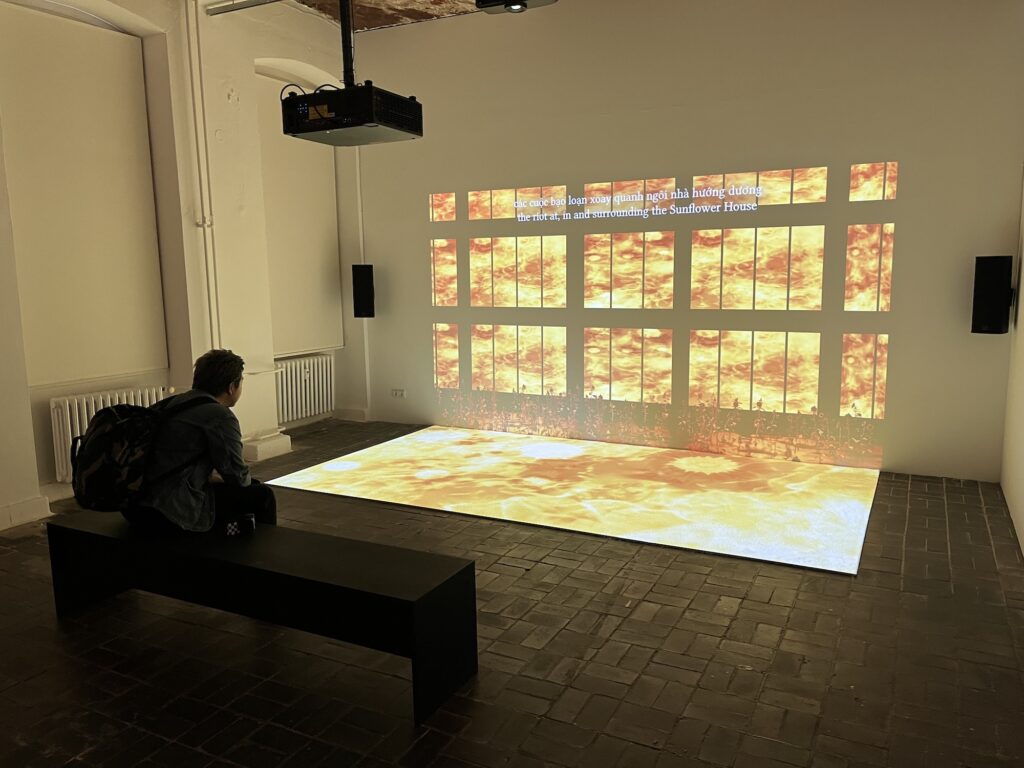
Maithu Bùi, Mathuật – MMRBX (2022)

Maithu Bùi’s Mathuật – MMRBX (2022) is a video installation based on a virtual reality game that addresses the Vietnamese diaspora through mythology and magic rituals for communicating with the dead. The virtual space here allows for a suspension of disbelief and the assimilation of a set of cultural codes that belong to the artist’s personal memory and the country’s collective history. The video installation occupies the room in a way that invites to perceive the projected images as a real space and immerse oneself in the narrative that the artist has created.

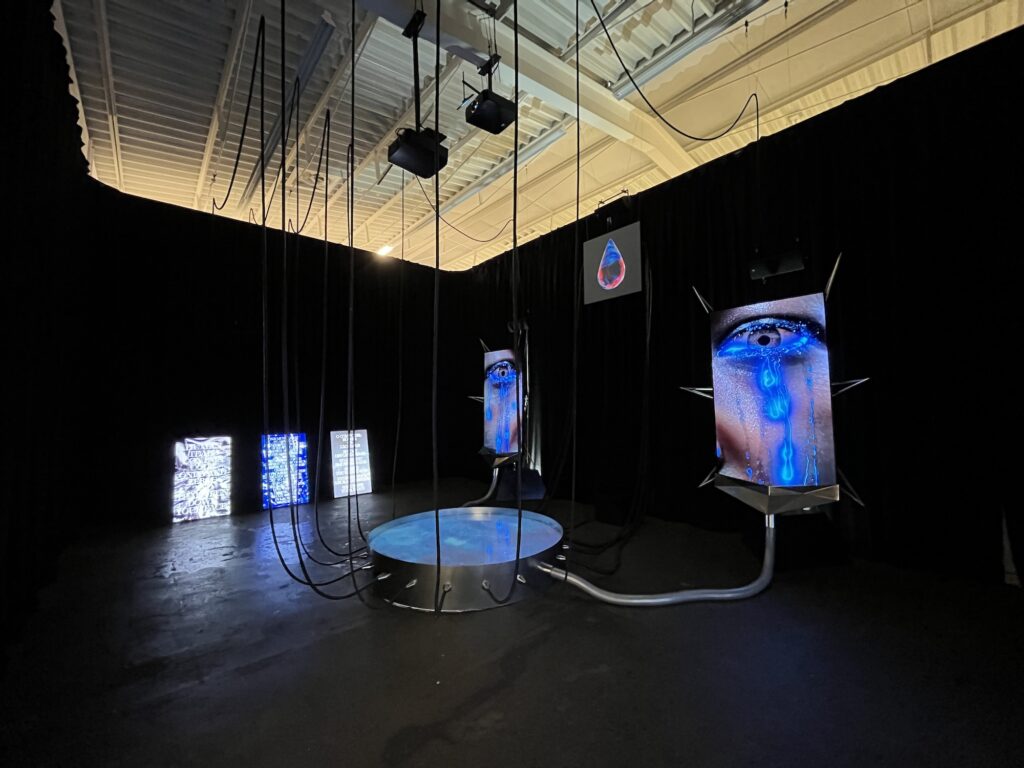
Zach Blas, PROFUNDIOR (LACHRYPHAGIC TRANSMUTATION DEUS-MOTUS-DATA NETWORK) (2022)

Zach Blas goes one step further in this direction by creating a theatrical setup in PROFUNDIOR (LACHRYPHAGIC TRANSMUTATION DEUS-MOTUS-DATA NETWORK) (2022). An ambitious installation composed of eight screens and two projections, the piece presents a fictional AI god that feeds on the emotional tears of simulated humans. The tears are transformed into text, images, and sound, in what is seemingly an autopoietic system that seeks to compute human emotion. Continuing his exploration of the politics and imaginaries surrounding facial recognition and predictive policing based on artificial intelligence algorithms, Blas creates a dystopian world in which humans have been replaced by their avatars and emotions have become data. While this overtly fictional story seems to be far removed from the reality depicted by Bouras, Abbas and Abou-Rahme, or Lebel, it is nevertheless deeply rooted in our present. Blas’ subject matter requires a different form of expression, which is more effective as an extravagant fiction than it would be as a collection of documents and people’s accounts.

Media art has often been described as the “art of the future,” but as these works show, it is an art of the radical present.

This selective vision of the artworks on display at the Berlin Biennale aims to point out how artists address the present through moving images, appropriated footage that was leaked online, witnesses’ accounts recorded on smartphones, simulated environments and 3D-rendered fictions. These contents, and the way they are presented, allow in turn to create a different temporality, as stressed by Kader Attia, that leads the viewer to a state of presence. If, as the artist and curator suggests, we must be “still present,” this can only be achieved through art that does not claim to be atemporal, but that is time-based. Media art has often been described as the “art of the future,” but as these works show, it is an art of the radical present.