Philippe Ceulemans: Creating Conditions for Contemplation

Pau Waelder

Based in Antwerp, Belgian artist Philippe Ceulemans approaches both oil painting and digital art not as opposites, but as two different ways of exploring the same underlying questions of perception, structure, and space. Moving away from generative AI models to write every line of his algorithms by hand, he treats code as a raw, tactile material—much like the pigments and metal leaf he applies to his physical canvases. Here, Ceulemans discusses how the quiet, un-spectacular beauty of the Kempen landscape shapes his minimalist ethos, why he uses light-absorbing pigments like Black 3.0 to explore silence, and how slow, intentional digital movement can create a space for contemplation in a moving world.

Philippe Ceulemans. Power Flower I — Electric Orchid, 2025

Looking at your oil paintings, particularly the abstract compositions, as well as your interest in stillness and silence, I wonder if this has been influenced by the natural surroundings of Turnhout and its natural reserves. Can you elaborate on the connections between the Kempen landscape and your work?

Very much so.

The Kempen landscape is not spectacular in the way mountains or coastlines are spectacular. Its beauty is quieter. It reveals itself slowly. I think that has influenced me deeply.

I spend a lot of time walking in the forests and nature reserves around Turnhout. What stays with me is not a particular tree or view, but a feeling: the silence, the openness, the changing light, the sense that everything is moving while appearing still.

That experience has become central to my work. I am not interested in depicting nature literally. I am interested in translating the experience of being present within it. Whether I work on canvas or write code, I am searching for a space where attention slows down and where the viewer can become more aware of subtle things.

In that sense, the Kempen landscape is present in almost everything I create, even when it is no longer visible.
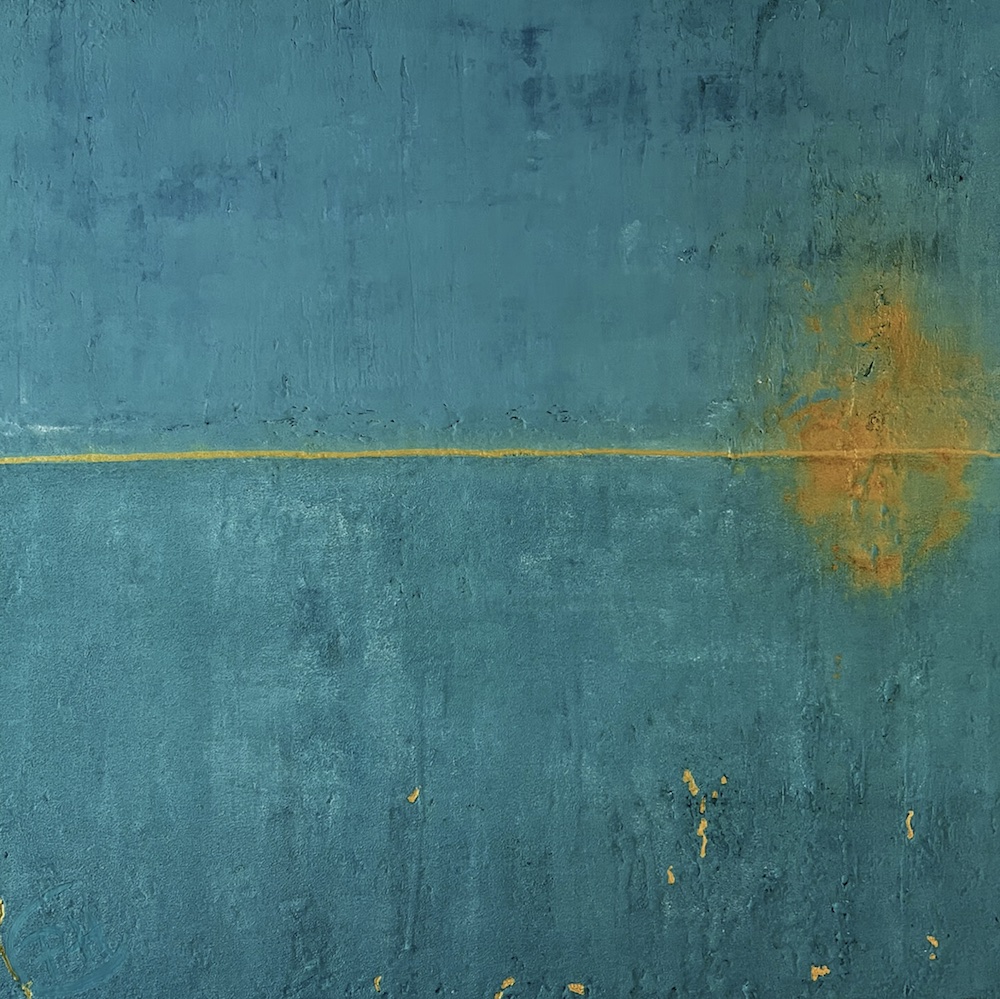
Philippe Ceulemans. Aqua e Sole. Oil on canvas, 100 x 100 cm.

In your paintings there is a clear interest in nature, but also in going beyond depiction to look for structures, movement, flows, that directly connect with your digital artworks. Can you tell us more about how your creative process transits between canvas and code?

For me, painting and coding are simply two different ways of exploring the same questions.

When I paint, I work with color, texture, layering, and material. When I write code, I work with movement, mathematics, repetition, transformation, and emergence. But the underlying curiosity remains the same.

“I am not interested in depicting nature literally. I am interested in translating the experience of being present within it.”

Ideas often travel back and forth between the two practices. A texture discovered in a painting may inspire a digital system. A mathematical behavior discovered while coding may later influence a painting.

I think both practices are really about observing relationships. How elements interact. How complexity can emerge from simplicity. How order and unpredictability coexist.

Many people see technology and painting as opposites. I don’t. For me they are simply different tools for exploring perception. 
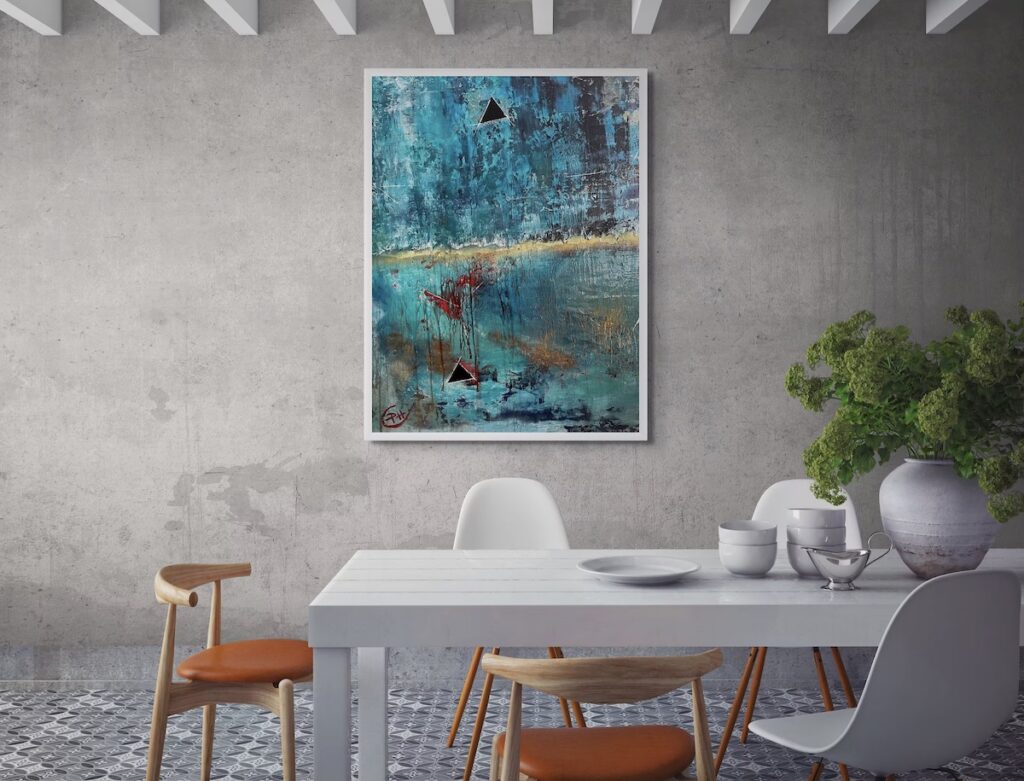
Philippe Ceulemans. Bermuda Triangle. Oil on canvas, Black 3.0 pigment. 100 x 120 cm.

The use of the Black 3.0 (or Vantablack-like) pigment is an interesting indication of your interest in going beyond traditional forms of painting on canvas and looking for new forms of perception. It is also interesting that this pigment is linked to the pioneering work of another Belgian artist, Frederik De Wilde. What drove you to use this pigment, and how do you see the concepts of silence and nothingness represented by the color black in both your canvases and your digital work?

My interest in Black 3.0 was never about finding the darkest possible black. It was about perception.

When you stand in front of a surface that absorbs so much light, something unusual happens. It almost stops behaving like a color and starts behaving like an absence. It challenges the way we normally read space, form, and depth.

That fascinated me.

I have always been interested in silence, emptiness, and stillness —not as negative concepts, but as spaces of possibility. Black can function in that way. It removes distractions. It creates room.

I often think about silence in music. Silence is not the absence of sound. It is what allows sound to have meaning. Black operates in a similar way within my work.

The same idea appears in my digital pieces. Moments where movement becomes extremely slow, where forms dissolve, or where visual information becomes minimal are often the moments that interest me most. They create space for reflection rather than consumption.

“I have always been interested in silence, emptiness, and stillness as spaces of possibility. Black can function in that way. It removes distractions. It creates room.”

Your interest in science is also patent in series such as The Unrepeatable Field, which is inspired by cellular structures and the possibilities of expressing them through mathematical formulas. Can you elaborate on how this scientific view of nature complements the more poetic aspects of your work, and how it is shaped by creative coding?

I have always been fascinated by the fact that nature combines strict rules with endless variation.

A cell follows certain principles. A tree follows certain principles. An ecosystem follows certain principles. Yet no two outcomes are ever exactly the same.

That tension fascinates me.

Science helps us understand the structures behind the visible world, while art allows us to experience them emotionally. I don’t see those approaches as contradictory. I see them as complementary. Creative coding has become a natural extension of this interest. Through mathematics and algorithms, I can create systems that behave in a similar way. I establish a framework, but I never know exactly what will emerge from it.

The Unrepeatable Field was born from that idea: that uniqueness is not the exception in nature, but its fundamental condition.

Philippe Ceulemans. A Singularity Flow — The Unrepeatable Field II, 2026

You underscore the fact that you do not use AI models in your work but rather write every line of code. This brings to mind the craft behind applying pigments to a canvas to create a work of art. Please tell us about your decision to move away from AI and how you carry out your creative process writing algorithms.

I don’t consider myself anti-AI. I find the technology fascinating and I follow its development with great interest.

At the same time, I realized early on that it wasn’t the path I wanted to take in my own artistic practice.

What attracts me is the process of building something myself. I enjoy understanding every mechanism that contributes to the final work. When I paint, I work directly with materials. When I write code, I work directly with systems.

In many ways, coding feels surprisingly close to painting.

I often spend weeks or months developing a visual idea. A small mathematical adjustment can completely change the behavior of an artwork and lead me somewhere unexpected. Those discoveries are some of the most rewarding moments in my practice.

For that reason, I write all my own code and do not use generative AI models in the creation of my artworks.

The process is slower, but it allows me to maintain a direct relationship with every aspect of the work. The algorithms themselves become part of the artwork. They are not just tools used to create images—they are artistic material.

“Science helps us understand the structures behind the visible world, while art allows us to experience them emotionally.”

You have described your work as “a still point inside the moving world.” Your attention to a more meditative and calm artistic expression can be clearly perceived throughout your work, but since your digital artworks incorporate motion, I’d like to know how you create motion to denote stillness and introspection.

This is probably the central question in my work.

I am interested in motion that does not seek attention. Most moving images today compete for our attention through speed, intensity, and constant change. My work moves in the opposite direction. The movement is often extremely slow, sometimes almost imperceptible.

I am not interested in creating images. I am interested in creating conditions for contemplation.

Paradoxically, very slow movement can make us more aware of stillness. It changes the way we experience time. The work remains active, yet it can feel calm and stable.

I often think of these pieces less as animations and more as environments for perception. Their purpose is not to tell a story. Their purpose is to create a space in which reflection becomes possible.

Philippe Ceulemans. After Ice III — Residue, 2026

“I am not interested in creating images. I am interested in creating conditions for contemplation.”

Many of your works feel particularly timeless, subtly suggesting ancient symbols and rituals, as is the case of the Aureate series. While you state that you do not intend to dictate meaning, the choice of colors, textures, and elements does insert a certain narrative, albeit subtle and open to interpretation. How do you play with the balance between creating a purely abstract composition and hinting at certain meanings?

I am very interested in the space between recognition and ambiguity.

If everything is explained, the viewer has little room to participate. If nothing is recognizable, it can become difficult to establish a connection.

I try to work somewhere in between.

Certain colors, forms, textures, and spatial relationships naturally evoke memories, symbols, or cultural references. Rather than defining their meaning, I prefer to leave them unresolved.

The Aureate works are a good example. Some viewers see ritual objects, sacred spaces, ancient architecture, or spiritual symbols. Others see purely abstract compositions.

Both responses are valid.

I want the work to remain open enough that viewers can bring their own experiences and interpretations into it.

“The algorithms themselves become part of the artwork. They are not just tools used to create images—they are artistic material.”

Tell us a bit about Lumin820 and your collaboration with your brother Olivier. Has his photographic work influenced your creative process? How do your visions of the world connect?

Lumin820 grew out of a shared fascination with observation, light, and image-making. Although Olivier and I work in different mediums, I think we share a similar sensitivity toward the world around us. We are both interested in looking beyond the obvious and paying attention to things that are often overlooked.

His photographic work has certainly influenced me. Photography teaches patience. It teaches observation. It teaches the importance of light and atmosphere.

At the same time, our approaches remain distinct. Olivier works through the camera, while I often move toward abstraction, painting, and algorithmic systems.

What connects us is a desire to create work that invites people to slow down and look more carefully.

Philippe Ceulemans. Aureate Radiant Core, 2026

Your digital artworks are displayed on screens in public spaces such as hotel lobbies and offices through platforms such as Niio. How do you imagine the experience of the viewer and the interaction between the artwork and the surrounding space in these contexts?

I find these contexts very interesting because they are different from traditional exhibition spaces.

People do not necessarily arrive with the intention of looking at art. They encounter the artwork while moving through everyday life.

Because my pieces evolve slowly, they can operate almost like a presence within a space. Someone may notice the work briefly, walk away, and then encounter it again later from a different perspective.

I like that relationship.

Rather than demanding attention, the work can coexist with its environment and gradually influence the atmosphere of a space. If it encourages someone to pause for a moment or become more aware of their surroundings, then it has already achieved something meaningful.

“Rather than demanding attention, the work can coexist with its environment and gradually influence the atmosphere of a space.”

Philippe Ceulemans. Papaver Nocturne, 2026

Given your interest in taking art beyond the canvas, have you considered creating artworks for immersive environments using Virtual Reality technology, or developing Augmented Reality pieces that could be connected to a specific location?

Absolutely.

Many of the ideas I explore already exist beyond the limits of a traditional frame. They deal with space, perception, movement, and presence. Immersive technologies therefore feel like a natural extension of that exploration. What interests me most is not spectacle but experience.

Much immersive technology focuses on stimulation and visual impact. I would be more interested in creating contemplative environments—places where viewers can slow down, reflect, and experience a different relationship with time and space.

Augmented reality also offers exciting possibilities because it allows digital artworks to enter into dialogue with specific locations, landscapes, or historical contexts.

For now my focus remains on painting and hand-coded digital works, but I definitely see immersive environments as a possible future chapter in my practice.
Valentina Ferrandes: Reshaping Icons

Niio Editorial

Valentina Ferrandes is an artist working across moving image, installation, and digital world-building, whose practice weaves together ecology, mythology, and the lived experience of place. Grounded in research and a documentary sensitivity to landscapes, archives, and historical traces, she shifted from filming toward constructing sensorial 3D environments, using scans, procedural tools, and real-time engines to let forms drift, fracture, and evolve. Classical sculpture and ancient narratives become both emotional anchors and critical material in her work: icons that carry through time, re-shaped through contemporary technologies into atmospheres of beauty and tension where political rupture can be felt indirectly through light, motion, and sound.

On the occasion of the launch of her solo artcast Metamorphoses: Myth, Body, and Code, we had a conversation about her work and creative process.

Valentina Ferrandes. Aurea, 2023

You describe your practice as connecting ecology, mythology, technology, and post-human imaginaries. When you start a new project, what drives it, the research, the story, or the technique you have chosen to produce it?

I normally start with research.

I’m interested in the way we live through environments and the stories that shape them. Myths, landscapes, architectures, archaeological traces. At first, these things appear separate; when you sit with them long enough, they begin to echo one another.

Only then do I choose the technique, the choice is never neutral.

Lately, I’ve been working with 3D motion, procedural tools, real-time engines, and 3D scans,  not to represent the world, but to build systems that can behave like it. Tools that allow things to drift, mutate, and occasionally slip out of control. Sometimes a project expands from a single shape, a scanned object from an archive, or material gathered through direct observation. That form becomes a world. Using game engines and procedural workflows, I stretch it, repeat it, let it evolve.

Ultimately, I’m trying to immerse the viewer in a mood, mostly driven by aesthetics, fragments of stories, and sensory tension, rather than by purely documentary logic.

Valentina Ferrandes. Still from Travelogue, 2018

You made experimental documentaries for years, then moved into CGI and real-time worlds. What changed for you around 2020 that made 3D the right language?

Around 2018 I made a film called Travelogue. It was a visual diary of a journey I took to Izmir in Turkey and then to the island of Kos, shot in a documentary register a couple of years back, right at the height of the Mediterranean migratory crisis. It followed my previous work Other Than Our Sea, where I used montage to collapse fragments of Mediterranean mythology, classical literature, ethnographic film, archival material, and glimpses of contemporary newsreels of shipwrecks in the Mediterranean into layered visual narratives.

But shooting Travelogue felt tougher as it touched something much closer. My family has a history of forced migration. Although Italian citizens, my father’s family had long-standing ties to Libya and Tunisia. After decades of living in Libya, they were compelled to return to Italy as refugees in the late 1970s. That sense of loss, of having to abandon an entire world to rebuild another, was something I grew up with. Filming along the semi-illegal routes in Turkey and Greece that many migrants were taking toward Europe, witnessing those crossings and the weight they carried, made me realise that documentary language had reached its limit for me.

Depicting reality no longer felt feasible. I didn’t want to record crises anymore but construct worlds that could allude to moments of rupture, holding some emotional truth but without reproducing their images directly.  I needed a medium that could be more sensorial, more abstract, and more heartfelt than documentary realism.

I had no language for it, so I stopped making films for a while.

“Depicting reality no longer felt feasible. I didn’t want to record crises anymore but construct worlds that could allude to moments of rupture.”

Then, around 2020, I turned to 3D. I began experimenting with scanned classical sculptures that had shaped my imagination growing up in southern Italy, fragments of classicity that, for me, functioned as emotional anchors. They were beautiful, but also quietly critical: stabilising forms in times of uncertainty, grounding while still provoking thought and aspiration. At the same time, I was going through a period of personal losses. Working in 3D allowed me to move away from documentation and toward construction: creating works driven by form, light, and colour rather than evidence.  Real-time worlds and CGI offered that kind of a-political space, a way to build beauty and tension, and to think about crisis indirectly, through atmosphere, motion, light and colour.

From that point on, my work shifted toward 3D hybrid forms.

Valentina Ferrandes. Victory, 2020


“Victory” treats Nike of Samothrace as something that can be algorithmically decomposed and rebuilt. What does computation allow you to “see” in sculpture that a camera cannot?

A camera can only register what is visible. It freezes what is already there. Computational tools do something else: they open the parameters to make instability visible and let you play with latent forms. Even the most solid material, like marble, is in reality energy in motion, atoms vibrating, matter constantly becoming. We just can’t see it.

In Victory, computation allows me to see sculpture as movement rather than image. When the Nike of Samothrace is translated into a 3D motion system, it stops being a fixed surface and becomes a fluid field of forces, basic geometries, vectors, and polygons that can shift, fracture, and reassemble.

“Even the most solid material, like marble, is in reality energy in motion, atoms vibrating, matter constantly becoming.”

In the Athena works, you connect a local pre-Christian cult, the olive tree, and the long chain of copies from Greece to Roman times and beyond. What does that continuity mean to you inside a digital artwork today?

We often think of digital media as something entirely new, as if it belongs only to the future. For me, however, digital tools are a means of reshaping icons that are already deeply ingrained in our collective memory.

In the Athena works, bringing together a local pre-Christian cult, the olive tree, and the long chain of copies creates a sense of continuity rather than rupture. Using a hyper-contemporary medium to work with ancient mythology opens up a different timeline, one where past and present coexist instead of replacing one another.

Classical icons are solid, almost a-temporal structures, narratives that can be applied to any moment in history, much like religious icons. They carry ethical, emotional and symbolic lessons that can stay legible across centuries.

“For me, digital tools are a means of reshaping icons that are already deeply ingrained in our collective memory.”

At the same time, I want my works to remain open. A digital artwork can be interpreted in various ways, ranging from a purely aesthetic encounter driven by form, light and rhythm to a more layered and reflective interpretation, depending on the viewer’s sensitivity and cultural background.

Digital tools don’t need to reject this legacy in favour of futuristic expectations. They enable us to revisit these foundational forms, reshape them, and discover new meanings within them. 

Valentina Ferrandes. Daaphne, 2022

You revisit Apollo and Daphne in both “Daaphne” and “Aurea.” Why return to that myth now, and what feels ethically or emotionally at stake in reanimating it with AI and procedural CGI?

This myth, at its core, stages a clear opposition: Apollo as a rational, male-driven force, mathematical, controlling, and oppressive, and Daphne as a figure bound to nature, freedom, and transformation. The moment of rupture between them could not be more explicit and in my work, I used AI to push that rupture even further.
I worked with an AI writing tool trained on game narratives and powered by a rudimentary version of GPT-3, fed it the story of Daphne as written in Ovid’s Metamorphoses and asked it to imagine what this nymph might wake up as after a set time as a laurel tree.

The AI imagined Daphne re-emerging as a post-human, hybrid being, part human, part aquatic, drifting in an underwater world, without language or memory, completely disoriented. I loved that the story had a hallucinatory, almost comic tone, like a futuristic fiction gone off-track.

“Daphne’s transformation is survival, a reminder that neither nature nor the systems we create can ever be fully governed by pure rationality.”

From there, I worked with 3D motion to animate forms suggested by the AI’s text. The work became a meditation on rupture at multiple levels: between human and nature, between rationality and excess, and between control and unpredictability. AI, in this sense, operates like an alter ego, a parallel intelligence that accelerates extraction, mutation, and instability.

In that way, the myth of Apollo and Daphne can be uncannily contemporary as it speaks to an enduring conflict: nature versus culture, rational order versus metamorphosis.  Apollo’s loss of power in the face of nature, something fundamentally uncontrollable, mirrors our relationship with AI today. We are building a system that behaves like a subconscious, one that evolves beyond our control, driven by its own form of self-preservation.

Daphne’s transformation is survival, a reminder that neither nature nor the systems we create can ever be fully governed by pure rationality.

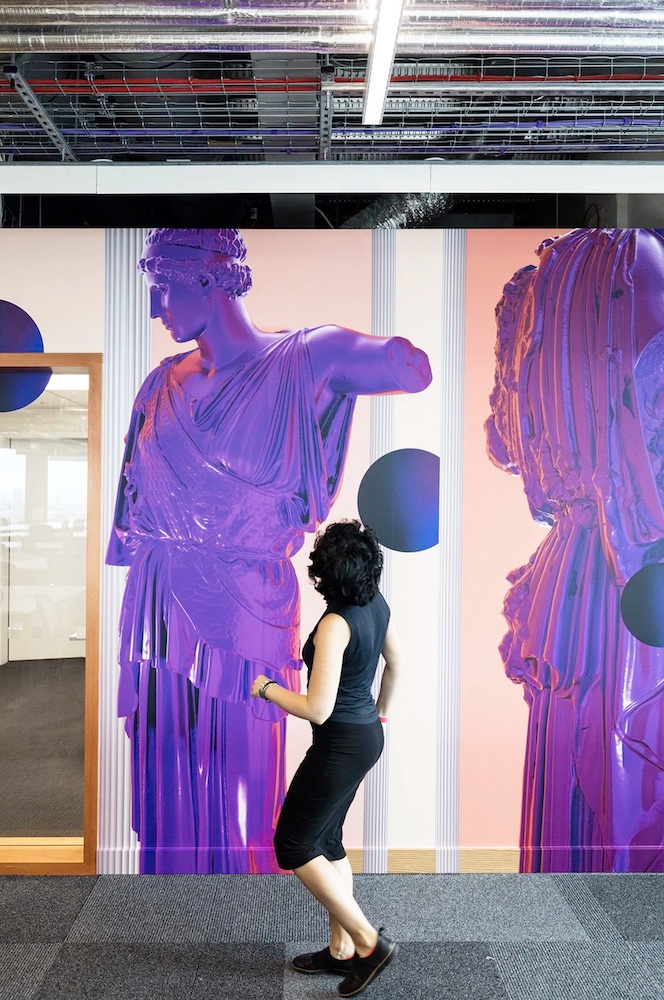
Valentina Ferrandes. Midday Muse, 2022. Site-specific installation, META London Headquarters.


A lot of your work sits between fiction and documentation. How do you decide what must remain “true” and where you allow speculation to take over?


Usually, I decide on a set of rules, fixed conditions and boundaries for a given project.
I tend to ground a new work in real elements, a place, a historical fact, a piece of storytelling, a dataset, a myth that already exists, a landscape I’ve walked through. It’s almost a forensic layer to start building upon. This documentary approach anchors the work to the world as it is, while I use fiction to open a door to how it might feel, how it might mutate, or how it could be remembered in the future.

The balance is intuitive more than anything. What remains “true” is the research spine and the ethical position. Form, narrative, and atmosphere can drift in fluid ways.

Valentina Ferrandes. The Beautiful One Has Come, 2021.

Sound shows up as a structural element in several projects. Do you think of sound as world-building, as evidence, or as emotion?

When I began working on Daaphne, it was 2022, and the war in Ukraine had just started. One of the first elements I used in my soundtrack was a Russian lullaby,  a song meant to put children to sleep, but sung as an eerie horror story. I layered it with voices of phone calls from Russian mothers trying to find out where their sons had disappeared on the battlefield.

These sounds were among the first field recordings to surface from the conflict. They weren’t yet shaped by long-form reporting or political framing. They were raw, deeply human, and I knew they would soon be buried under 24h news coverage. I wanted to hold onto them before they disappeared. I’m drawn to these small, fragile fragments of reality, pieces of evidence that are emotionally charged but not always fully legible. They speak of a specific moment in time, yet they slip away easily, like trying to remember a conversation heard in a dream just after waking.

Much of the sound material I work with also comes from evidence: archival recordings, field recordings I collect myself, binaural sound, fragments of voiceover. But it’s almost always assembled as a collage. Sound often becomes the backbone of my work but it does not demand that everything be decoded. If someone wants to sit with it and trace the details, that’s possible. If not, the surface remains open.

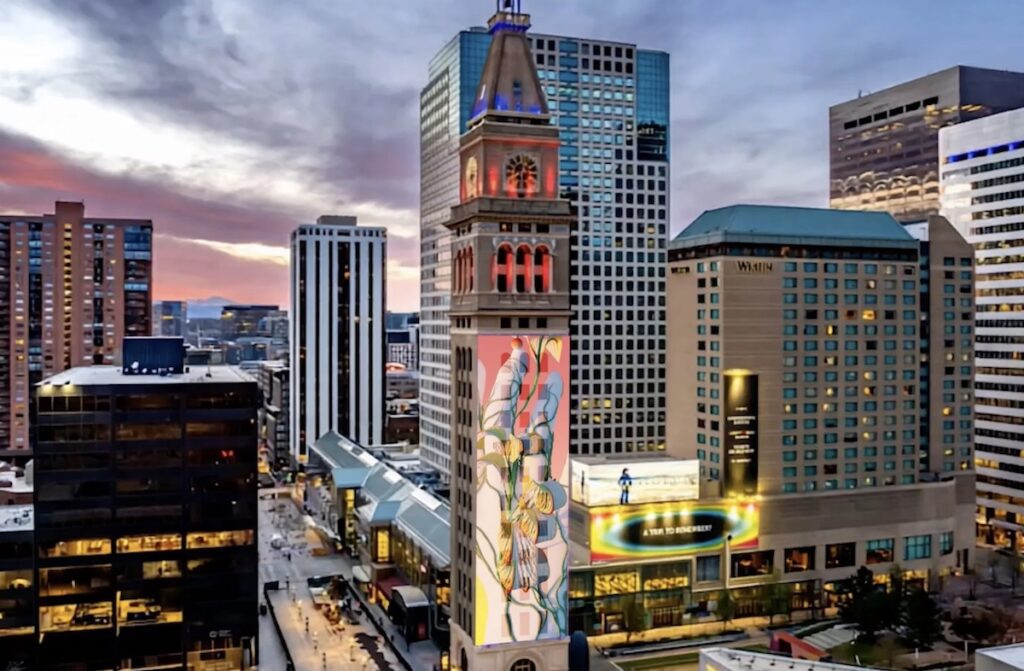
Valentina Ferrandes. Bloom, 2024. Site-specific 3D animation, Night Lights Denver

In “BLOOM,” classical iconography is projected onto a city landmark. What draws you to public architecture as a screen, and what do you want viewers to feel at that scale?

Public architecture is interesting because it operates at a scale where meaning turns physical. Facades, towers, and landmarks are symbols of power, progress, and permanence. Using them as screens immediately creates a shift in perception.

In BLOOM, projecting classical iconography onto a hypermodern skyline for Denver Night Lights meant staging a clash of meanings. On one side, you have contemporary architecture, on the other, a classical image that many viewers may never have encountered directly, unless they’ve visited the museum that houses it. That displacement is intentional.

“Classical iconography carries a quiet power because it transcends specific cultures to communicate through beauty rather than explanation.”

At that scale, the work isn’t meant to be fully legible. It’s meant to interrupt routine, to slow people down, and to create a brief moment of disconnection from the everyday flow of the city. Ultimately, to leave space for a  few minutes of awe.

Ultimately, classical iconography carries a quiet power because it transcends specific cultures and historical knowledge to communicate through beauty rather than explanation. When placed on an urban skyline like Denver’s, it opens up a small pocket of dreaming,  a moment of wonder appearing where it doesn’t quite belong.