Valentina Ferrandes: Reshaping Icons

Niio Editorial

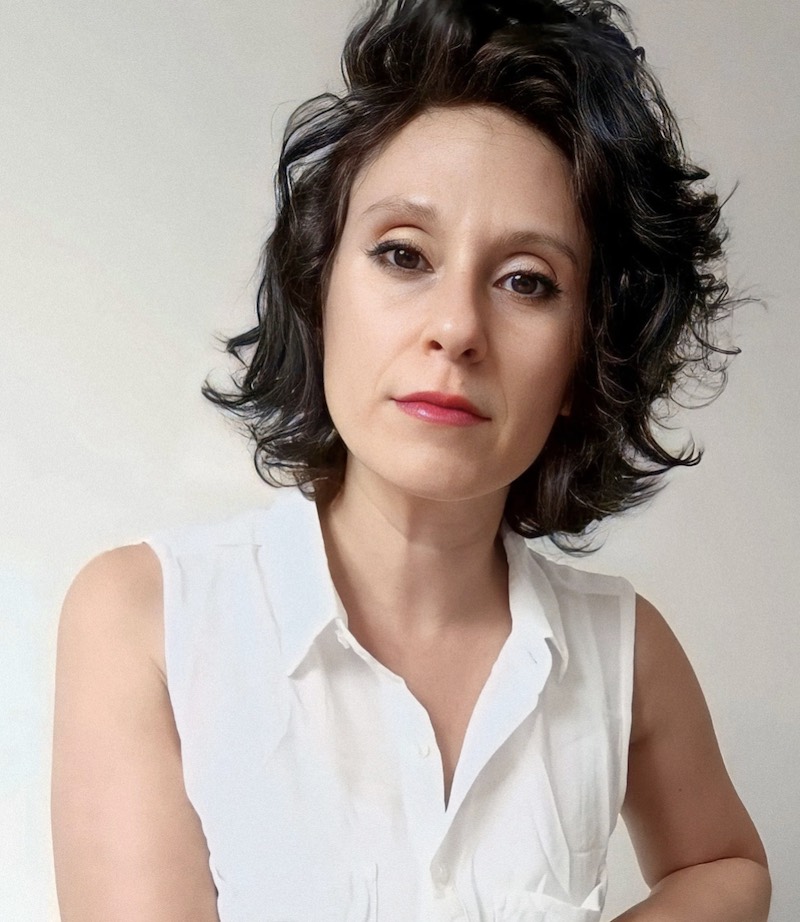
Valentina Ferrandes is an artist working across moving image, installation, and digital world-building, whose practice weaves together ecology, mythology, and the lived experience of place. Grounded in research and a documentary sensitivity to landscapes, archives, and historical traces, she shifted from filming toward constructing sensorial 3D environments, using scans, procedural tools, and real-time engines to let forms drift, fracture, and evolve. Classical sculpture and ancient narratives become both emotional anchors and critical material in her work: icons that carry through time, re-shaped through contemporary technologies into atmospheres of beauty and tension where political rupture can be felt indirectly through light, motion, and sound.

On the occasion of the launch of her solo artcast Metamorphoses: Myth, Body, and Code, we had a conversation about her work and creative process.

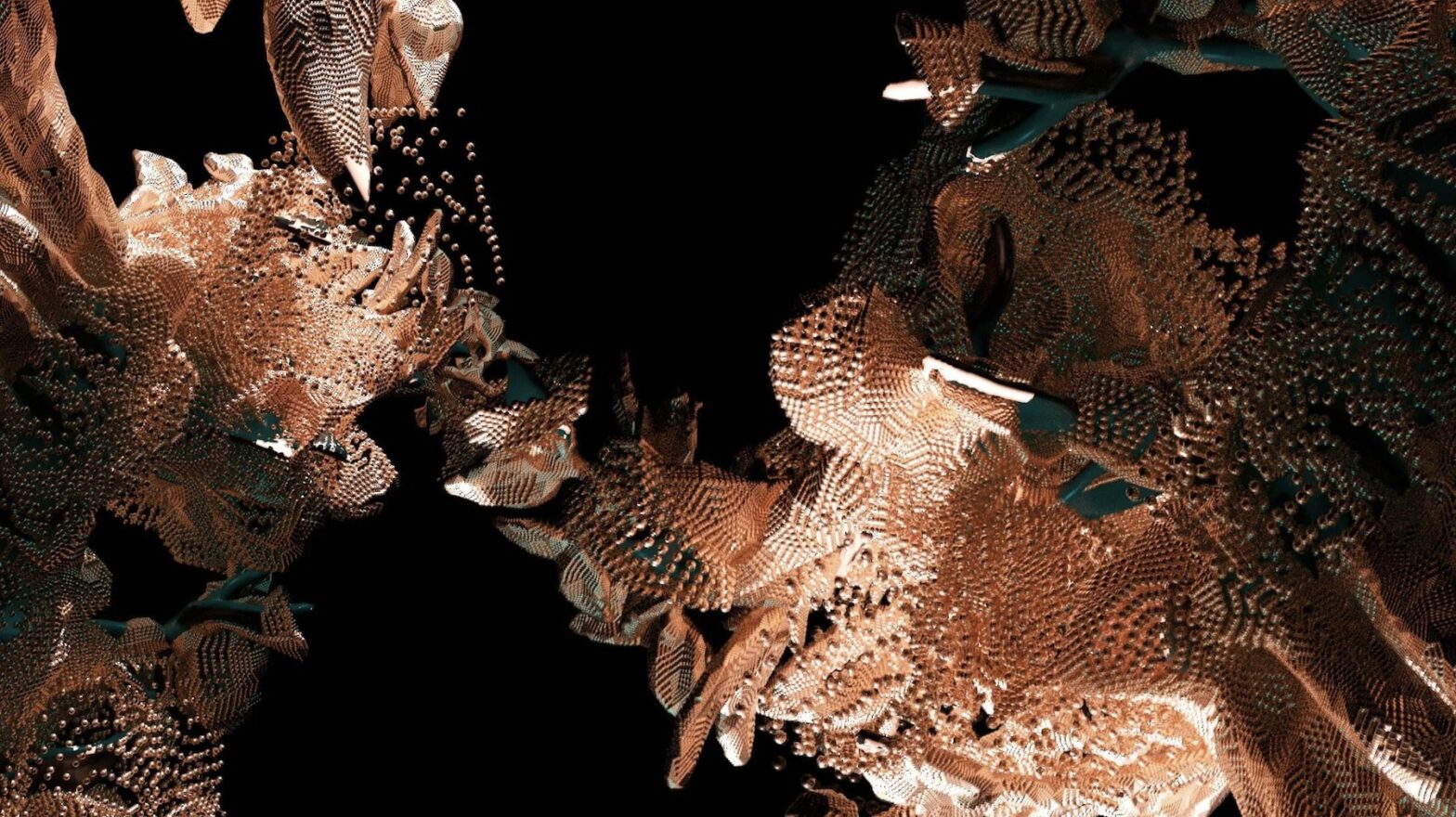
Valentina Ferrandes. Aurea, 2023

You describe your practice as connecting ecology, mythology, technology, and post-human imaginaries. When you start a new project, what drives it, the research, the story, or the technique you have chosen to produce it?

I normally start with research.

I’m interested in the way we live through environments and the stories that shape them. Myths, landscapes, architectures, archaeological traces. At first, these things appear separate; when you sit with them long enough, they begin to echo one another.

Only then do I choose the technique, the choice is never neutral.

Lately, I’ve been working with 3D motion, procedural tools, real-time engines, and 3D scans,  not to represent the world, but to build systems that can behave like it. Tools that allow things to drift, mutate, and occasionally slip out of control. Sometimes a project expands from a single shape, a scanned object from an archive, or material gathered through direct observation. That form becomes a world. Using game engines and procedural workflows, I stretch it, repeat it, let it evolve.

Ultimately, I’m trying to immerse the viewer in a mood, mostly driven by aesthetics, fragments of stories, and sensory tension, rather than by purely documentary logic.
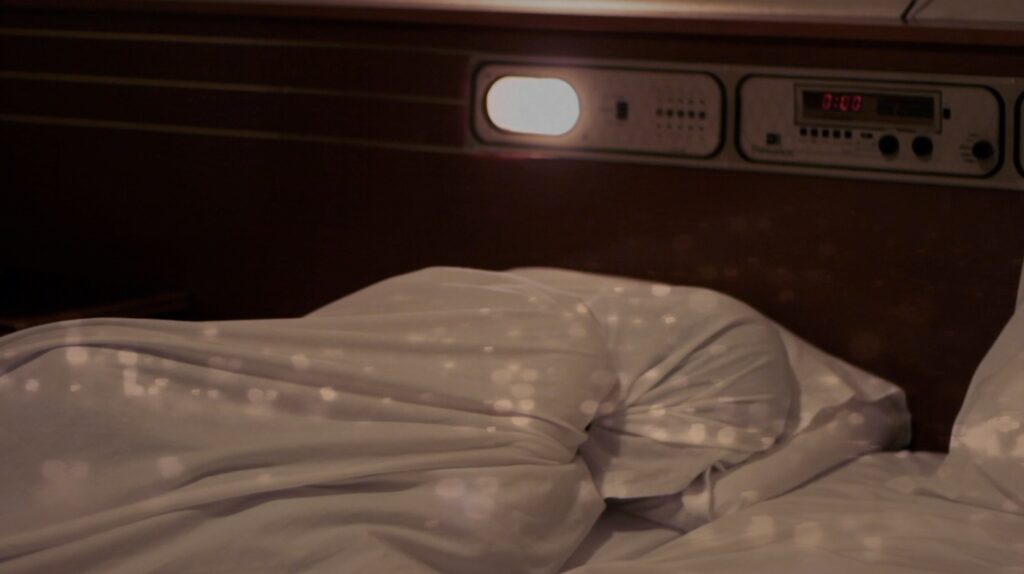
Valentina Ferrandes. Still from Travelogue, 2018

You made experimental documentaries for years, then moved into CGI and real-time worlds. What changed for you around 2020 that made 3D the right language?

Around 2018 I made a film called Travelogue. It was a visual diary of a journey I took to Izmir in Turkey and then to the island of Kos, shot in a documentary register a couple of years back, right at the height of the Mediterranean migratory crisis. It followed my previous work Other Than Our Sea, where I used montage to collapse fragments of Mediterranean mythology, classical literature, ethnographic film, archival material, and glimpses of contemporary newsreels of shipwrecks in the Mediterranean into layered visual narratives.

But shooting Travelogue felt tougher as it touched something much closer. My family has a history of forced migration. Although Italian citizens, my father’s family had long-standing ties to Libya and Tunisia. After decades of living in Libya, they were compelled to return to Italy as refugees in the late 1970s. That sense of loss, of having to abandon an entire world to rebuild another, was something I grew up with. Filming along the semi-illegal routes in Turkey and Greece that many migrants were taking toward Europe, witnessing those crossings and the weight they carried, made me realise that documentary language had reached its limit for me.

Depicting reality no longer felt feasible. I didn’t want to record crises anymore but construct worlds that could allude to moments of rupture, holding some emotional truth but without reproducing their images directly.  I needed a medium that could be more sensorial, more abstract, and more heartfelt than documentary realism.

I had no language for it, so I stopped making films for a while.

“Depicting reality no longer felt feasible. I didn’t want to record crises anymore but construct worlds that could allude to moments of rupture.”

Then, around 2020, I turned to 3D. I began experimenting with scanned classical sculptures that had shaped my imagination growing up in southern Italy, fragments of classicity that, for me, functioned as emotional anchors. They were beautiful, but also quietly critical: stabilising forms in times of uncertainty, grounding while still provoking thought and aspiration. At the same time, I was going through a period of personal losses. Working in 3D allowed me to move away from documentation and toward construction: creating works driven by form, light, and colour rather than evidence.  Real-time worlds and CGI offered that kind of a-political space, a way to build beauty and tension, and to think about crisis indirectly, through atmosphere, motion, light and colour.

From that point on, my work shifted toward 3D hybrid forms.

Valentina Ferrandes. Victory, 2020


“Victory” treats Nike of Samothrace as something that can be algorithmically decomposed and rebuilt. What does computation allow you to “see” in sculpture that a camera cannot?

A camera can only register what is visible. It freezes what is already there. Computational tools do something else: they open the parameters to make instability visible and let you play with latent forms. Even the most solid material, like marble, is in reality energy in motion, atoms vibrating, matter constantly becoming. We just can’t see it.

In Victory, computation allows me to see sculpture as movement rather than image. When the Nike of Samothrace is translated into a 3D motion system, it stops being a fixed surface and becomes a fluid field of forces, basic geometries, vectors, and polygons that can shift, fracture, and reassemble.

“Even the most solid material, like marble, is in reality energy in motion, atoms vibrating, matter constantly becoming.”

In the Athena works, you connect a local pre-Christian cult, the olive tree, and the long chain of copies from Greece to Roman times and beyond. What does that continuity mean to you inside a digital artwork today?

We often think of digital media as something entirely new, as if it belongs only to the future. For me, however, digital tools are a means of reshaping icons that are already deeply ingrained in our collective memory.

In the Athena works, bringing together a local pre-Christian cult, the olive tree, and the long chain of copies creates a sense of continuity rather than rupture. Using a hyper-contemporary medium to work with ancient mythology opens up a different timeline, one where past and present coexist instead of replacing one another.

Classical icons are solid, almost a-temporal structures, narratives that can be applied to any moment in history, much like religious icons. They carry ethical, emotional and symbolic lessons that can stay legible across centuries.

“For me, digital tools are a means of reshaping icons that are already deeply ingrained in our collective memory.”

At the same time, I want my works to remain open. A digital artwork can be interpreted in various ways, ranging from a purely aesthetic encounter driven by form, light and rhythm to a more layered and reflective interpretation, depending on the viewer’s sensitivity and cultural background.

Digital tools don’t need to reject this legacy in favour of futuristic expectations. They enable us to revisit these foundational forms, reshape them, and discover new meanings within them. 

Valentina Ferrandes. Daaphne, 2022

You revisit Apollo and Daphne in both “Daaphne” and “Aurea.” Why return to that myth now, and what feels ethically or emotionally at stake in reanimating it with AI and procedural CGI?

This myth, at its core, stages a clear opposition: Apollo as a rational, male-driven force, mathematical, controlling, and oppressive, and Daphne as a figure bound to nature, freedom, and transformation. The moment of rupture between them could not be more explicit and in my work, I used AI to push that rupture even further.
I worked with an AI writing tool trained on game narratives and powered by a rudimentary version of GPT-3, fed it the story of Daphne as written in Ovid’s Metamorphoses and asked it to imagine what this nymph might wake up as after a set time as a laurel tree.

The AI imagined Daphne re-emerging as a post-human, hybrid being, part human, part aquatic, drifting in an underwater world, without language or memory, completely disoriented. I loved that the story had a hallucinatory, almost comic tone, like a futuristic fiction gone off-track.

“Daphne’s transformation is survival, a reminder that neither nature nor the systems we create can ever be fully governed by pure rationality.”

From there, I worked with 3D motion to animate forms suggested by the AI’s text. The work became a meditation on rupture at multiple levels: between human and nature, between rationality and excess, and between control and unpredictability. AI, in this sense, operates like an alter ego, a parallel intelligence that accelerates extraction, mutation, and instability.

In that way, the myth of Apollo and Daphne can be uncannily contemporary as it speaks to an enduring conflict: nature versus culture, rational order versus metamorphosis.  Apollo’s loss of power in the face of nature, something fundamentally uncontrollable, mirrors our relationship with AI today. We are building a system that behaves like a subconscious, one that evolves beyond our control, driven by its own form of self-preservation.

Daphne’s transformation is survival, a reminder that neither nature nor the systems we create can ever be fully governed by pure rationality.
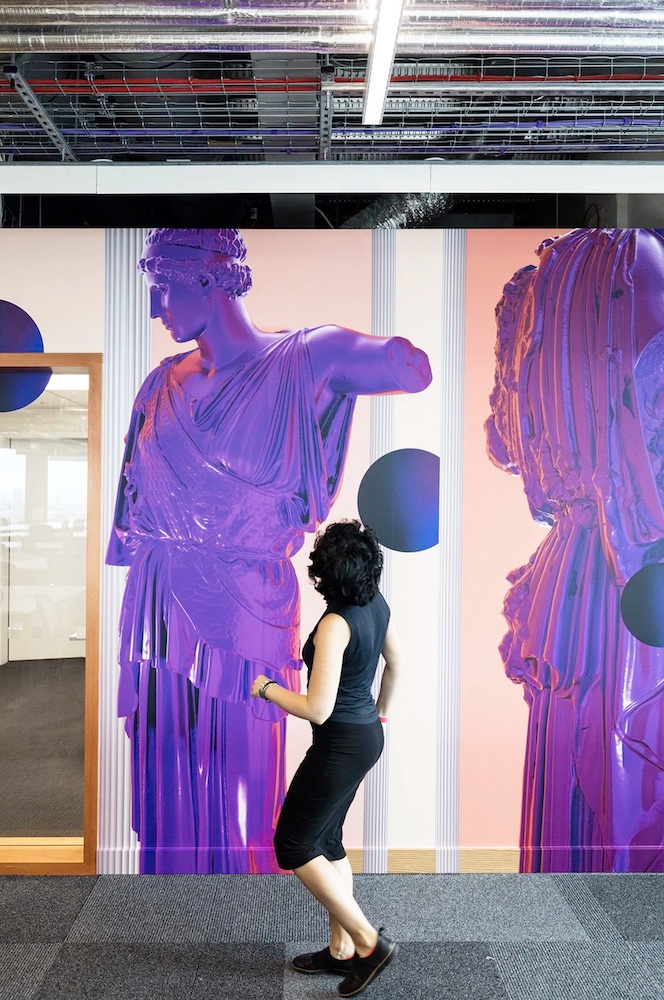
Valentina Ferrandes. Midday Muse, 2022. Site-specific installation, META London Headquarters.


A lot of your work sits between fiction and documentation. How do you decide what must remain “true” and where you allow speculation to take over?


Usually, I decide on a set of rules, fixed conditions and boundaries for a given project.
I tend to ground a new work in real elements, a place, a historical fact, a piece of storytelling, a dataset, a myth that already exists, a landscape I’ve walked through. It’s almost a forensic layer to start building upon. This documentary approach anchors the work to the world as it is, while I use fiction to open a door to how it might feel, how it might mutate, or how it could be remembered in the future.

The balance is intuitive more than anything. What remains “true” is the research spine and the ethical position. Form, narrative, and atmosphere can drift in fluid ways.

Valentina Ferrandes. The Beautiful One Has Come, 2021.

Sound shows up as a structural element in several projects. Do you think of sound as world-building, as evidence, or as emotion?

When I began working on Daaphne, it was 2022, and the war in Ukraine had just started. One of the first elements I used in my soundtrack was a Russian lullaby,  a song meant to put children to sleep, but sung as an eerie horror story. I layered it with voices of phone calls from Russian mothers trying to find out where their sons had disappeared on the battlefield.

These sounds were among the first field recordings to surface from the conflict. They weren’t yet shaped by long-form reporting or political framing. They were raw, deeply human, and I knew they would soon be buried under 24h news coverage. I wanted to hold onto them before they disappeared. I’m drawn to these small, fragile fragments of reality, pieces of evidence that are emotionally charged but not always fully legible. They speak of a specific moment in time, yet they slip away easily, like trying to remember a conversation heard in a dream just after waking.

Much of the sound material I work with also comes from evidence: archival recordings, field recordings I collect myself, binaural sound, fragments of voiceover. But it’s almost always assembled as a collage. Sound often becomes the backbone of my work but it does not demand that everything be decoded. If someone wants to sit with it and trace the details, that’s possible. If not, the surface remains open.
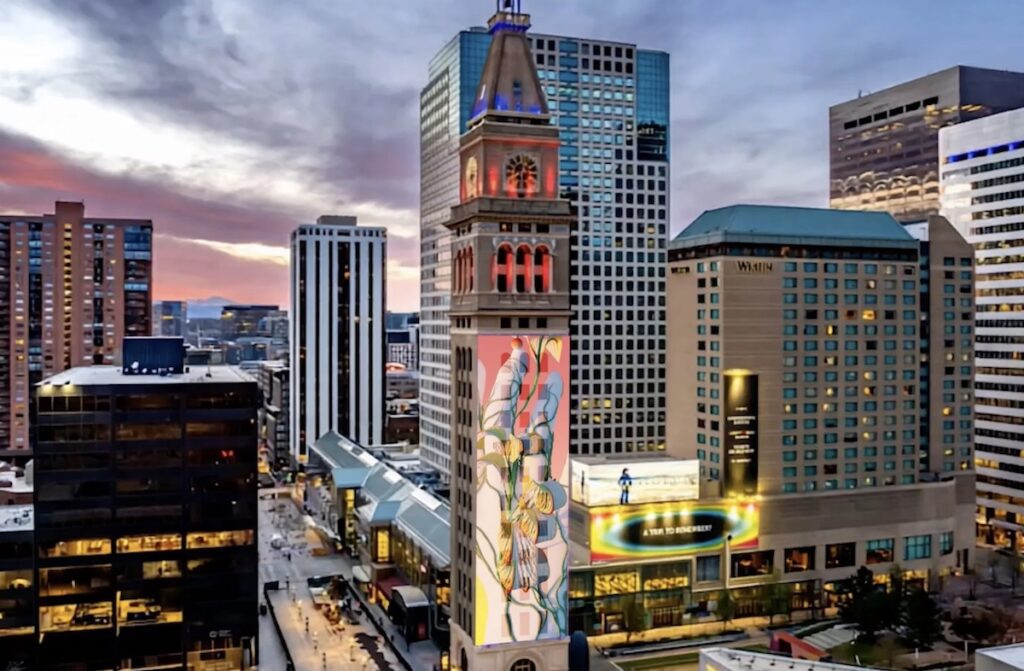
Valentina Ferrandes. Bloom, 2024. Site-specific 3D animation, Night Lights Denver

In “BLOOM,” classical iconography is projected onto a city landmark. What draws you to public architecture as a screen, and what do you want viewers to feel at that scale?

Public architecture is interesting because it operates at a scale where meaning turns physical. Facades, towers, and landmarks are symbols of power, progress, and permanence. Using them as screens immediately creates a shift in perception.

In BLOOM, projecting classical iconography onto a hypermodern skyline for Denver Night Lights meant staging a clash of meanings. On one side, you have contemporary architecture, on the other, a classical image that many viewers may never have encountered directly, unless they’ve visited the museum that houses it. That displacement is intentional.

“Classical iconography carries a quiet power because it transcends specific cultures to communicate through beauty rather than explanation.”

At that scale, the work isn’t meant to be fully legible. It’s meant to interrupt routine, to slow people down, and to create a brief moment of disconnection from the everyday flow of the city. Ultimately, to leave space for a  few minutes of awe.

Ultimately, classical iconography carries a quiet power because it transcends specific cultures and historical knowledge to communicate through beauty rather than explanation. When placed on an urban skyline like Denver’s, it opens up a small pocket of dreaming,  a moment of wonder appearing where it doesn’t quite belong.
Chun Hua Catherine Dong: “My body is a material for my art”

Pau Waelder

Chun Hua Catherine Dong, Meet Me Halfway – part 1, 2021

A performance and conceptual artist whose work spans different media, Chun Hua Catherine Dong successfully navigates the space between an artistic practice characterized by the physical, bodily presence of the artist in the same space and time as her audience, and another one based on the mediation of digital technologies and a distributed and almost immaterial existence. Dong has taken her performance artworks worldwide, combining action with documentation in the form of photographs and videos that often become artworks on their own. She is also exploring the creative possibilities of VR, AR, and Artificial Intelligence in a series of artworks that are still deeply rooted in her research on gender, memory, identity, body, and presence.

Dong has exhibited their works at The International Digital Art Biennial Montreal (BIAN),  The International Biennial of Digital Arts of the Île-de-France (Némo), MOMENTA | Biennale de l’image, Kaunas Biennial, The Musée d’Art Contemporain du Val-de-Marne in France, Quebec City Biennial, Foundation PHI for Contemporary Art, Canadian Cultural Centre Paris, Museo de la Cancillería in Mexico City, The Rooms Museum, Canadian Museum of Immigration at Pier 21, DongGong Museum of Photograph in South Korea, He Xiangning Art Museum in Shenzhen, Hubei Museum of Fine Art in Wuhan, The Aine Art Museum in Tornio, Bury Art Museum in Manchester, Art Museum at University of Toronto, Varley Art Gallery of Markham, Art Gallery of Hamilton, among others. She is represented by  Galerie Charlot in Paris.

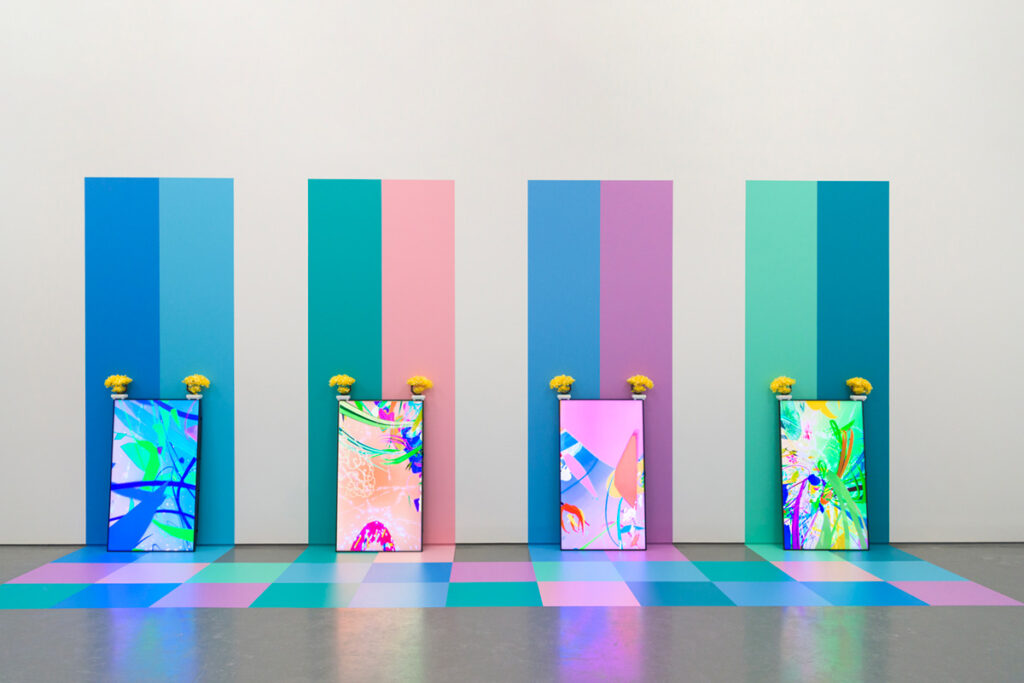
The artist recently presented the artcast Meet Me Halfway, which collects four videos from her multi-channel VR video installation that explores the perception of time and space in virtual reality and the inability to return to the present from searching the inner world.

Experience Chun Hua Catherine Dong’s immersive VR spaces in Meet Me Halfway

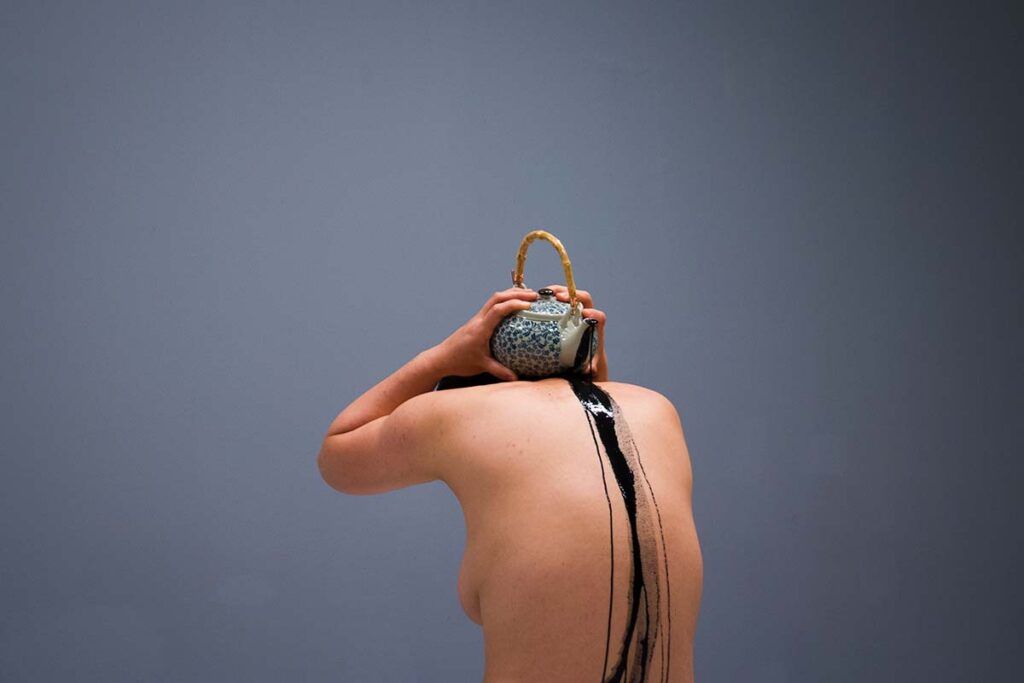
Chun Hua Catherine Dong, The Lost Twelve Years (2015)

As a Chinese-born, Montreal-based artist, the issues of identity, culture, belonging, and distance are present in your life and your work as well. In our globalized world, these issues can sometimes be overlooked, or else exoticized and clichéd, even demanding of an artist with a mixed cultural background to address them. Would you say that there is still a dominant Western perspective on multiculturalism, and if so, how do you address it in your work? 

This is a very interesting question. I can’t speak for others, but it’s natural for me to explore these topics. Living in a different cultural context often prompts questions about one’s identity.  If I lived in China, I would probably never feel the need to deal with these difficult issues. But I immigrated to Canada a long time ago. I need to reconnect with my roots because I feel that something that nurtured me has faded and been forgotten. It is important for me to renew it from time to time. I addressed this issue in my earlier performances. For example, in my performance The Lost Twelve Years (2015) I use a Chinese teapot to pour ink over my head and a squirt gun to shoot ink to my heart and head, which are actions that force me to remember who I am.  

“After living as a «living sculpture» for a long time, I came to the conclusion that it is wise to keep life and art separate.  Now, I state that «I use my body as my material in my artwork» rather than «my body is my artwork.»”

Your body is a key element in your work, both as “the body of the artist”, representing you as an individual and your personal experiences, and as “a female body,” addressing issues of the representation of women in a patriarchal society. When you conceive your performances, how do you weigh these two possibilities?

As a performance artist, my “body as an Asian woman” and my “body as an artwork” frequently change. When I first started doing performance, I considered performance as an attitude, and that “life is a performance, performance is life.” The two were inseparable; thus, my life was always in a performance/artwork mode, or “living sculpture” mode. But I realized that I was quite weary of being my own artwork. It is also harmful to one’s mental health and sanity because the concept “life is art and art is life” could mess up your life. After living as a “living sculpture” for a long time, I came to the conclusion that “Life can be a performance, but performance is not life—at least, not my entire life.”  It is wise to keep the two separate.  Later, I use the statement that “I use my body as my material in my artwork” rather than “my body is my artwork.”

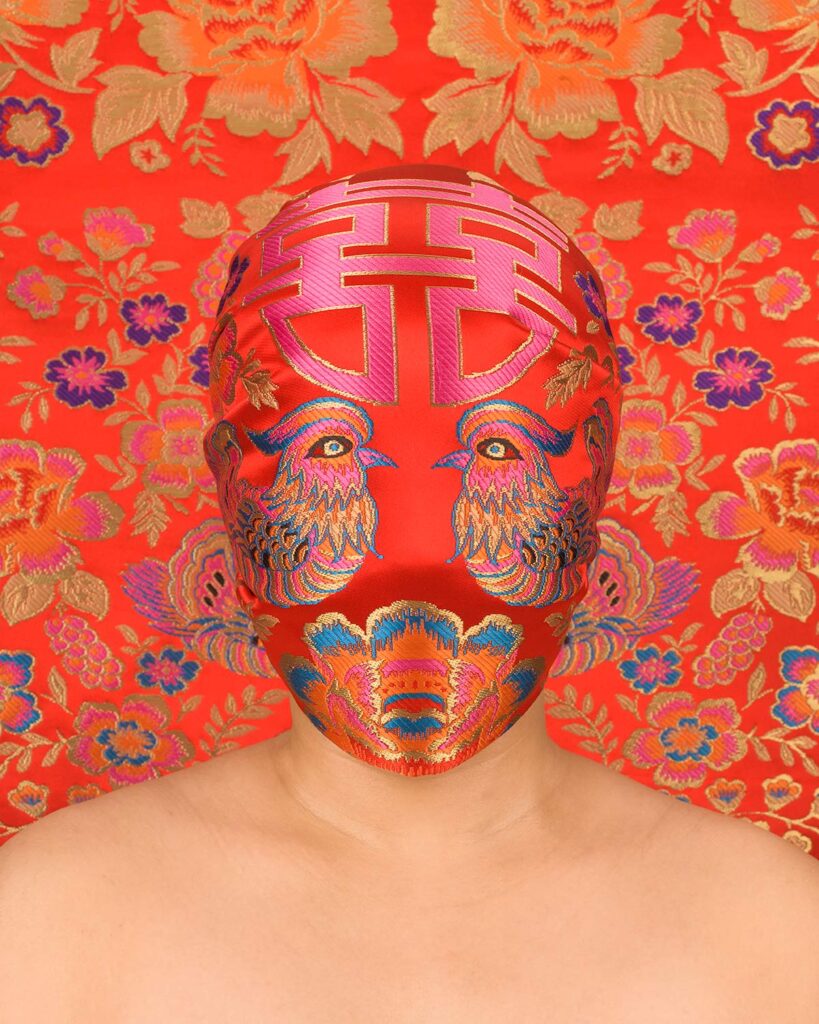
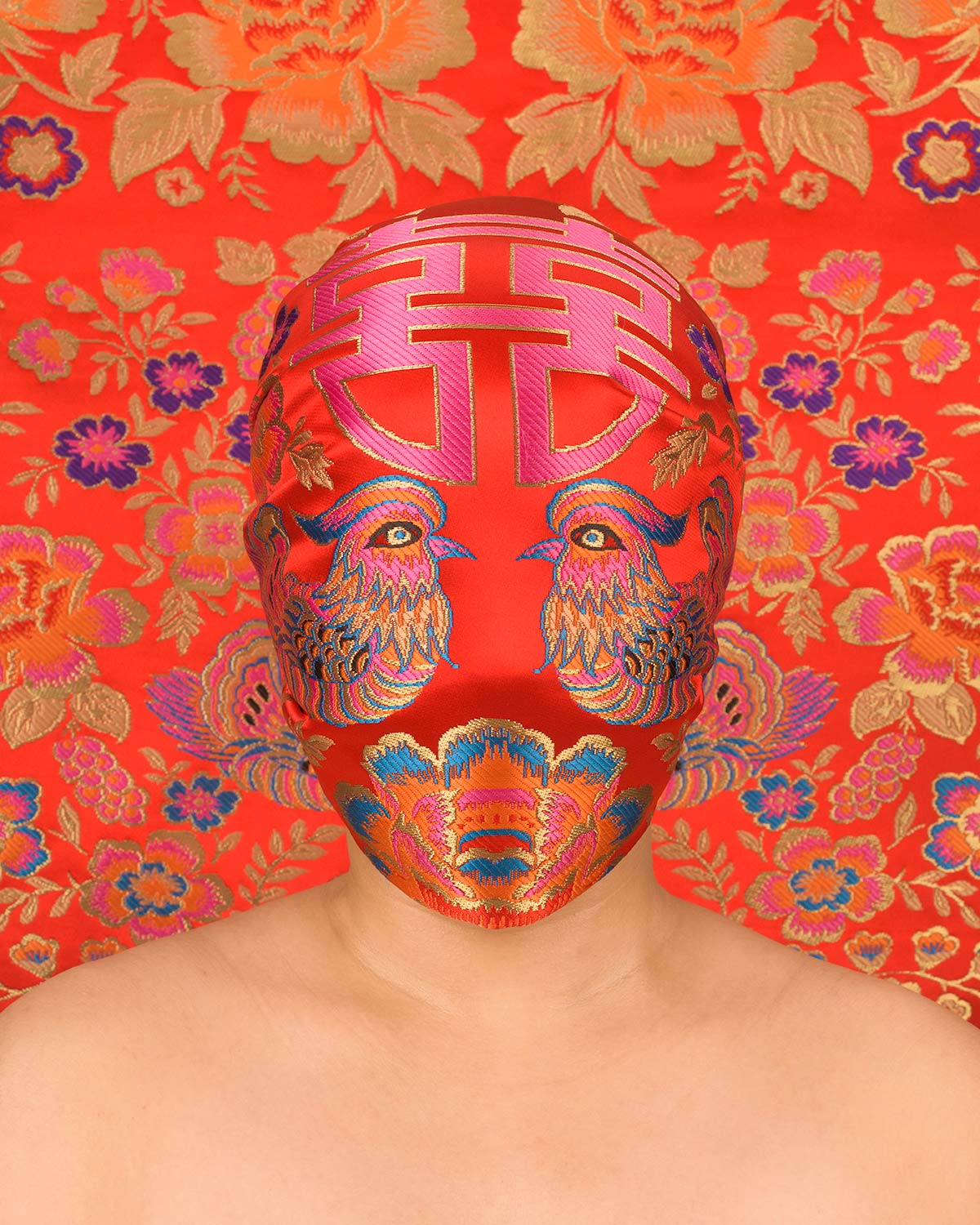
Chun Hua Catherine Dong, Skin Deep (2014-2020). Photographs with Augmented Reality

In your work, we can find on the one hand a direct approach to the body, naked, as a canvas or an object, and on the other hand the body veiled by masks and disguises. What do you find more interesting about playing with the different levels of displaying and hiding the body, maybe also seducing or unsettling the viewer’s gaze?

This is a very interesting question. Yes, there were naked bodies in my early performance work. For me, the body is a blank canvas, and any type of clothing or even makeup can give “identity” to it. Perhaps viewers perceive me as vulnerable when they see me naked, but I don’t feel that way. Being naked doesn’t challenge me but rather challenges the viewers. The power of the naked body in performance art lies in its rawness, it’s a pure form of art. Anyway, who isn’t born naked?

“For me, the body is a blank canvas: any type of clothing or even makeup can give “identity” to it. Being naked doesn’t challenge me but rather challenges the viewers.”

In the digital world, physical distance, the presence of the human body, and even identity tend to be blurred or seemingly erased. For instance, your work Meet Me Halfway is strikingly different from your performance work in both aesthetics and the presence of the body, yet you have incorporated your body in the form of camera movements. How do you navigate the differences between an immaterial digital environment and the materiality of your performances?

Meet Me Halfway (2021) was created during the pandemic. According to reports, many Asian people were attacked in public places during the pandemic. I was afraid of going out. If I had to go out, I wore a big hat and mask to cover myself because I didn’t want to be recognized. This situation subconsciously influenced my work Meet Me Halfway, which is why my body is absent in this work but just camera movements.  I became interested in VR during the pandemic as well because I discovered that VR can help me to escape from reality. VR space is less political, at least, you won’t get physically attacked. You can build your own virtual world in VR and visit it from time to time whenever you want. It is interesting that you mentioned immateriality in the digital environment. Actually, performance art is often regarded as an immaterial practice as well. Because of its immaterial nature, it is very easy for me to shift my practice from performance art to digital art.

Chun Hua Catherine Dong, Mulan (2022)

Following with the previous question, Mulan addresses gender identity through a folk heroine placed in an underwater landscape. What seems at first a scene of pure fantasy contains numerous symbolisms. How would say that a viewer immersed in this VR space can connect with the message you want to convey? 

Gender is an important component of my work. Mulan (2022) was inspired by Beijing Opera. You are right. “Mulan” depicts a pure fantasy scene because Beijing Opera is my fantasy. I used to dream of wearing the Beijing Opera costume and performing on stage when I was little. But Beijing Opera is a form of high art, not many people have a chance to access it. For me, art provides a space for asking questions and discovering; I’d be very happy to see that people have questions when they experience Mulan, such as, “Why Mulan? Why are there two Mulan? What outfit does Mulan wear? What are the names of the sea creatures surrounding Mulan?” If people ask questions, they will find answers.  Sometimes I realize that I am more interested in how viewers feel and think about my work rather than telling them what my work is about. Viewers’ different interpretations enrich and expand the artwork itself.

“I am more interested in how viewers feel and think about my work rather than telling them what my work is about. Viewers’ different interpretations enrich and expand the artwork itself.”

The mise en scène is an important element in a performance, which in your work translates to carefully set up photographs, installations, and VR environments. What is the role of space in your work across the many different media you use?

Mise en scene is a stage. Most of my works are staged. In performance, “mise en scene” can be in any place, including public, private, virtual, or imaginary spaces. Camera frame is a type of stage too because activities must occur within the frame in order for the camera to capture them. If we apply this concept to traditional art, a plinth is a stage for sculptures, and a wall serves as a stage for two-dimensional artworks.

Chun Hua Catherine Dong, Meet Me Halfway (2021). Four-channel VR video installation. Exhibition view at Foundation Phi.

You have stated that you initially wanted to become a painter, but found that performance was more expressive. Yet there is a painterly quality to much of your work, particularly in photography and digital art, besides the use of paint in some of your performances. Which would you say is your approach to painting nowadays? 

Yes, I wanted to be a painter before. But painting has its own limitations because you work in a two-dimensional space, and you must sometimes wait for it to dry before applying another layer. Performance is an expressive medium, I never wanted to go back to painting after I fell in love with performance. My work does have painterly quality, I guess it is because of my painting background. Regarding how I approach painting nowadays, I think it is VR drawing/ painting. It doesn’t limit you in a 2D space like traditional painting, but rather you work in a 3D space. When you draw a line in VR, it is a 3D line, and you can zoom in and out to see your drawing/painting in 3D perspective, which fascinates me.

“I approach painting through VR. It doesn’t limit you in a 2D space like traditional painting, but rather you work in a 3D space. When you draw a line in VR, it is a 3D line, and you can zoom in and out to see your drawing/painting in 3D perspective, which fascinates me.”

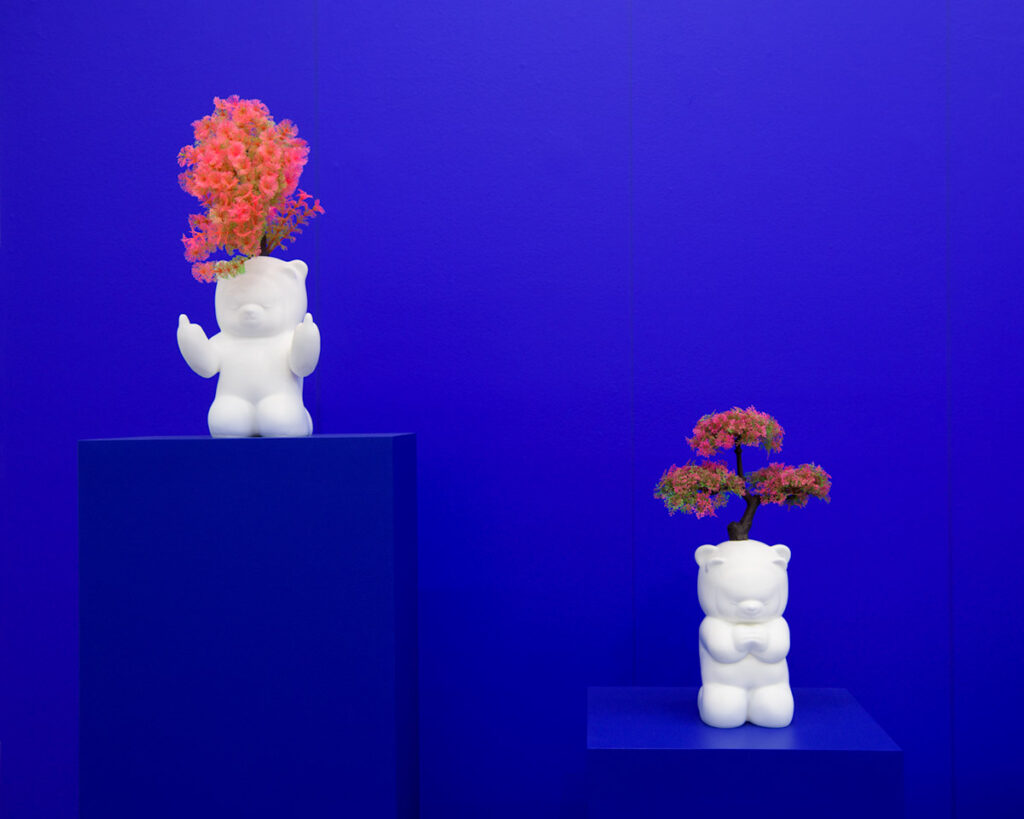
In your recent work Out of the Blue, you address your childhood and feature a teddy bear character that has been present in your work over the last three years. Can you tell us more about this character? You frequently use 3D printing techniques to create sculptures, why have you chosen this technique over more traditional forms of modeling and sculpting?

The teddy bear is a symbol of childhood.  With its eyes closed, the bear refuses to look at the world, rather prefers to dream. In my digital art practice, I began with AR and VR, and then 3D printing. It is very natural for me to use 3D printing to make sculptures because 3D printing is a type of digital fabrication. 3D printing is also a practical choice. Traditional sculpture requires a large studio space and special tools, which I don’t have. On the other hand, 3D printing doesn’t require much space; simply having a table or a desk at home is sufficient. Traditionally, 3D printing has been used to make molds or prototypes for further work. However, I embrace its rawness. I use 3D printing as the raw material for my finished artwork, with no additional touches such as sanding or painting. The unpolished raw nature of 3D printing fascinates me because it captures the essence of the technological and digital process, demystifying how artwork is made.

Chun Hua Catherine Don. Solo Exhibition: At the Edge of Two Worlds. TRUCK Contemporary Art, 2022

You have recently started experimenting with AI, first in the photographic series For You I Will Be an Island, and lately creating animations of what appear to be underwater creatures. Can you tell me about your experience with this technology? Which are your objectives when using AI programs? How does working with these programs differ from your VR and 3D animations?

I like AI. For me, AI is more than simply a tool; it’s like having an assistant. I understand that people have concerns about AI. I completely respect that. However, as an artist with limited resources and financial assistance, AI helps me save time and money when creating artwork.  For example, in For You I Will Be an Island (2023) I printed 23 pieces of 2.5 m x 2.5 m AI generated graphics; I can’t imagine how I would do this without AI. I could paint 23 pieces of 2.5 m × 2.5 m paintings, but how long would it take? Or I could use photographs, but where would I find such locations to photograph? I probably can find them if I have the financial freedom to travel around the world to look for them, but how long would it take?  Now AI is able to create animation and 3D objects, although it is not there yet, it is still very exciting. Animation and 3D modeling are often very time consuming and costly. If I have a budget, of course, I prefer to work with creative people, but if I don’t, AI is a good way to go.

Chun Hua Catherine Dong, For You I Will Be An Island (2023)

As we are starting the year (in the Gregorian calendar, and soon the Chinese New Year), it begs the question: what are you currently working on, and which projects do you have in store for the coming months?

Thanks! I am very excited that the Chinese New Year is coming soon. This is the year to celebrate the dragon. I am currently working on a public art project with 35 video displays at Place des Arts in Montreal. I am also working on an upcoming solo exhibition at Galerie Charlot in Paris in April. And I will participate in Montreal’s International Digital Art Biennial (BIAN) in May.

“If I have a budget, of course, I prefer to work with creative people, but if I don’t, AI is a good way to go.”